GPT-6 Astra Hands-On: 8 Use Cases Revealing a New Breakthrough in AI 3D Modeling

GPT-6 Astra tops coding benchmarks and breaks new ground in AI-generated 3D worlds across 8 tested use cases.
OpenAI's GPT-6 Astra scores 74.1% on SWE-bench and 95.9% on 3D object creation tests, outpacing major competitors. Based on hands-on demos and international creator cases, this article covers eight key use cases: from web design and educational video production to navigable 3D simulated cities, reconstructed landmarks, and virtual societies with 600 autonomous AI characters. The model also supports calling professional tools like Blender and building personal knowledge bases from user data. The tradeoff is steep pricing — $50 per million output tokens — and massive time and token costs for large-scale tasks.
OpenAI's latest model, GPT-6 Astra, has sparked a wave of discussion across social platforms worldwide. This model not only delivers across-the-board performance improvements on everyday tasks, but pushes AI capabilities into previously unimaginable territory — especially in 3D modeling and spatial awareness. Based on hands-on demonstrations by a Bilibili creator, this article breaks down GPT-6 Astra's core capabilities and eight representative use cases to help you decide whether it can genuinely fit into your own workflow.
Benchmarks: Coding and 3D Capabilities Steal the Show
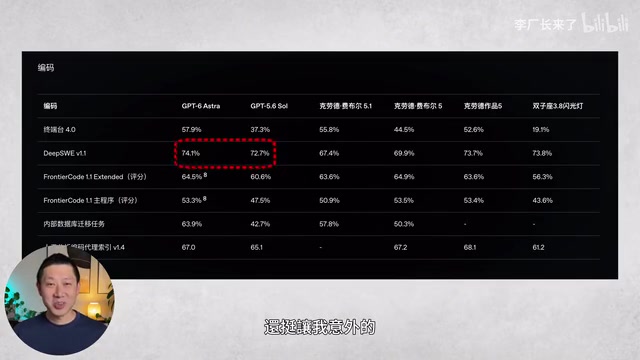
While more and more users have grown skeptical of benchmark scores, a few of GPT-6 Astra's results are still worth noting. On SWE-bench — one of the most practical measures of real-world coding ability — Astra scored 74.1%, surpassing the Claude series at 67.4% and Gemini Flash at 73.8%. The creator behind the hands-on demo said outright that Astra is the strongest coding model he's used to date, calling its code-writing ability "exceptional."
Even more striking is the massive leap in automation benchmarks, jumping from 18.1% to 41.4%, along with a near-perfect score of 99.9% on ARC-AGI-style tests — which measure an agent's ability to learn when confronted with unfamiliar problems. For context, the average human test-taker scores around 48%.
In benchmarks specifically designed to measure a model's ability to create 3D objects, GPT-6 Astra reached a saturation score of 95.9%, outpacing competitors by more than 10 percentage points. The creator specifically highlighted the model's standout performance in 3D object creation and overall spatial awareness, particularly when building complete 3D worlds.
Pricing: Higher Performance Comes at a Higher Cost
As the latest flagship model, GPT-6 Astra doesn't come cheap: $10 per million input tokens and $50 per million output tokens. There's also a turbo mode that doubles the speed — and the price. According to data from artificialanalysis.ai, completing a single task with GPT-6 costs roughly $2.57. While that's lower than the most expensive competitors, it's more than double the cost of the GPT-5 series. Users on paid plans with generous usage quotas will notice a meaningfully faster experience.
SWE-bench (Software Engineering Benchmark) is one of the most widely used code evaluation benchmarks in the industry today, developed by a research team at Princeton University. It draws thousands of real, already-fixed bugs from open-source GitHub projects (such as Django and scikit-learn), asking models to automatically locate and patch the code based on a problem description, with results verified via unit tests. Unlike simple evaluations that ask a model to "write a snippet of code," SWE-bench tests a model's ability to understand a real codebase, trace issues, and generate patches — making it a more accurate reflection of how useful a model actually is in real-world software development. ARC-AGI (Abstraction and Reasoning Corpus for Artificial General Intelligence), designed by AI safety researcher François Chollet, specifically tests a model's inductive reasoning when faced with entirely novel, unseen patterns. It's considered a key indicator of "genuine intelligence" rather than "memorized recall." The average human scores around 48%, while most mainstream large models have historically scored below 10%.
Web Design and Video Production: Significant Leaps in Frontend and Creative Ability
GPT-6 Astra shows notable improvement in web design, frontend development, and visual creativity. The creator asked it to design an interactive website on the theme "How AI Takes Over a Day's Work in 2030." Within a short time, it generated a well-laid-out, tightly structured page: a top section differentiating user roles, a left-side daily schedule, and buttons allowing users to hand tasks off to AI, review the output, proceed to the next item if satisfied, or edit directly if not.
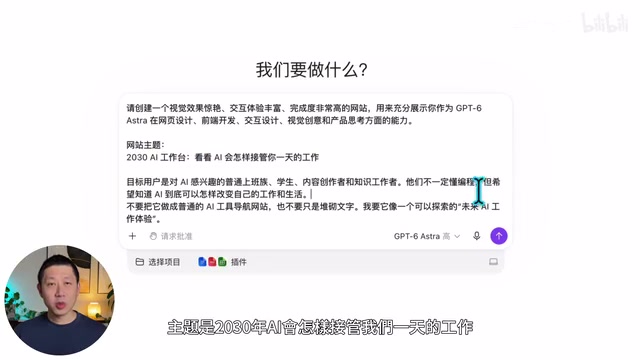
This capability means that whether you need a marketing landing page for a matcha product or a stylized site on any theme, a single prompt can quickly generate a working draft.
On the video production side, the creator asked GPT-6 to produce a one-minute Chinese-language educational video on the topic "How Ordinary People Can Save Two Hours a Day Using AI Agents." It was completed in roughly 10 minutes. He sees strong potential for this kind of feature in presentation-making and education. Compared to the noticeable rough edges that used to appear when making educational videos with tools like Notebook LM, AI-generated content is becoming increasingly natural — gradually crossing the threshold of user acceptance.
Building 3D Worlds: From Little Planets to Simulated Cities
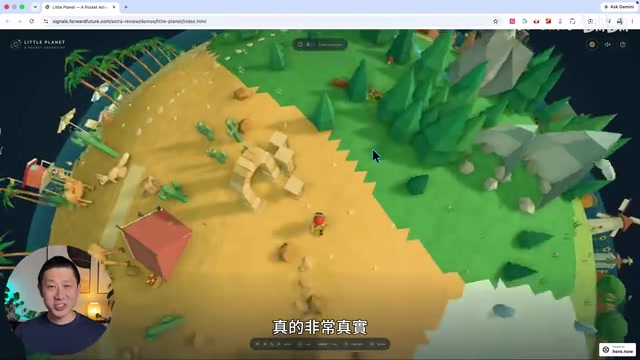
GPT-6 Astra's most groundbreaking capabilities are most visible in 3D scene generation. The creator referenced a case from international creator Matthew Berman: he built a "little planet" where a controllable character can walk, run, and jump, with impressively realistic 3D visuals — when the character steps into a pond, it automatically switches to a wading animation.
Matthew also created a 3D simulated city called New Haven, complete with pedestrians walking the streets, traffic flowing through intersections, people crossing roads, and distinct residential, commercial, industrial, and office zones — with the ability to manually add new buildings.
Wharton School associate professor Ethan Mollick built a 3D scene of the Library of Alexandria where users can walk through while listening to real-time narration. He also used GPT-6 Astra to read through thousands of his own emails, writing, and calendar entries to build a knowledge repository based on the "personal wiki" framework proposed by Andrej Karpathy — having AI push him twice daily with highlights he should pay attention to or might find interesting. Mollick did flag two risks: first, the process requires granting AI full access to his computer; second, the task took 4 days and 21 hours to complete, with a token consumption that can only be imagined.
Virtual Societies and Real-World Scene Reconstruction
Creator Matt Schumer used GPT-6 to build a world containing 600 virtual AI characters, giving them autonomy to move freely with the goal of keeping all of them alive — they can even communicate with each other through dialogue. The complexity of projects like this lies not just in character and text generation, but in the fact that all the 3D models for the characters, the map, and the underlying logic of the entire system were all built by GPT-6.
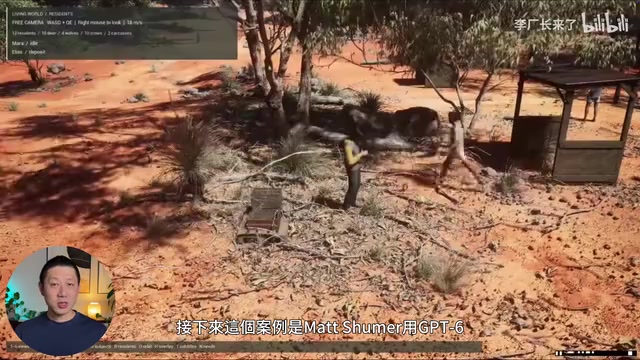
Where AI-generated games used to be limited to simple 2D mini-games or space shooters, they can now produce genuine 3D games. In another case, someone had GPT-6 call the 3D modeling software Blender to reconstruct San Francisco's Palace of Fine Arts, with impressive detail. The creator noted that achieving this kind of result used to require a large number of 3D assets, complex pipelines, and training data — now it takes a single prompt. This opens up new possibilities for "virtual tourism" or experiencing historical landmarks before visiting in person.
Blender is an open-source, professional-grade 3D modeling and rendering application widely used in game development, visual effects, and architectural visualization. It offers a full Python API that allows external programs to automate modeling, materials, lighting, and rendering through scripts. The way GPT-6 Astra calls Blender typically involves having the model generate script code that conforms to Blender's Python API spec, which is then executed by a local or cloud-based Blender instance — translating natural language descriptions into exportable 3D assets. The significance of this workflow is that users don't need to master complex modeling skills or software operations; they simply describe the target scene and receive a 3D file that can be further edited, rendered, or imported into a game engine. The "personal wiki" framework proposed by Andrej Karpathy is a concept for structuring a person's digital life (emails, calendars, writing, browsing history, etc.) into a knowledge base that AI can search — designed to let an AI assistant truly "know" a user's context, rather than starting from scratch with every conversation.
Final Thoughts
As of when the creator recorded his video, GPT-6 Astra was being gradually rolled out to ChatGPT Plus, Pro, and enterprise users. Both the web and desktop versions allow you to select the model under work mode and adjust thinking intensity. While there are rumors that the rollout pace has been slow and many users haven't gotten access yet, these use cases clearly show that AI has expanded from "helping you complete tasks" to "building virtual 3D worlds for virtually any scenario" — something that was nearly unimaginable just two years ago.
One caveat worth noting: the majority of the demonstrations and data cited above come from a single creator's hands-on testing and reporting. Some benchmark figures and product naming may contain inaccuracies — the OpenAI official blog remains the authoritative source. For users who already have access to GPT-6, it's worth exploring which of these use cases might fit your own work and daily life.
Related articles

When Did Paid Childcare Become the Norm? Working Mothers and the Evolution of Childcare
When did paid childcare become the norm? This article traces the evolution from the rise of childcare centers in the 1970s–80s and the 1990s linking of federal subsidies to work requirements, to declining stigma and rising costs, and explores advocates' 25-year effort to catch up with other countries on childcare and paid parental leave.

Red Flags for Product-Market Fit: A Practical Guide from Top VCs and the Superhuman Founder
Investors from Iconiq and Sapphire Ventures and Superhuman founder Rahul Vohra share PMF red flags and practical methods, including the 40% disappointment rule, retention curves, and acquisition costs.

What Task Should AI Agents Take Over Most? Heated Reddit Discussion
Reddit discussion: Which task do you most want AI agents to take over completely? Cross-app data migration, CRM updates, and report generation top the list, but insufficient reliability and the trust gap are the biggest obstacles to automation adoption.