GPT-6 Astra Hands-On: End-to-End AI Collaboration from Idea to Finished Project

GPT-6 Astra turns vague spoken ideas into complete projects without step-by-step instructions.
OpenAI's GPT-6 Astra demo introduces a new collaboration model where users only need to roughly dictate an idea and Astra autonomously understands intent, plans the workflow, and drives the project end-to-end. Four scenarios are covered: building a YouTube thumbnail generator by dictation (proactively using hidden layers unprompted), developing and deploying an Ableton music plugin, independently sourcing hardware components and manufacturing specs online, and organizing the world-building and narrative structure of a 15-chapter tactical RPG. Together, these cases point to a core capability — Astra doesn't just execute instructions, it fills in unstated intent and maintains coherence across complex, long-horizon projects. The demo extends this vision to everyday family use, suggesting the barrier to creation is falling sharply. Note: all scenarios are from official demos; real-world stability remains to be verified.
Astra: An AI That Doesn't Need Hand-Holding at Every Step
OpenAI's latest GPT-6 Astra demo showcases a fundamentally new model of human-AI collaboration. One feeling that users repeatedly emphasize is that Astra can handle genuinely complex problems without needing careful guidance at every single step.
"Astra gives me the sense that I can hand it a really complex problem without having to lead it by the hand at every turn." That quote captures the essential difference between this tool and traditional AI assistants — it's no longer a passive tool waiting for precise instructions, but a collaborator that understands intent and moves things forward on its own.
Based on the demo, Astra isn't positioned as a single-task executor. It's a system that can transform vague ideas into complete, working projects. Users typically only need to voice a rough direction; the planning, execution, and iteration can all be handed off from there.
Building Projects by Dictation: Starting with a Thumbnail Generator
The first case study in the demo involves building a YouTube thumbnail generator. The user described the entire process as having "rambled off in dictation" — barely any formal planning, just thinking out loud and letting Astra reference everything discussed previously with a colleague.
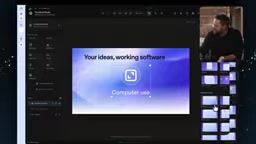
The requirements were extremely broad: a minimal page layout centered on intuitive visuals. Astra read through the course plan content and generated a graphic it judged to be sensible and user-friendly. Even more impressively, it proactively used features like hidden layers — "I didn't tell it to do that. It just naturally understood."
This intuitive grasp of what the user "wants to see" is a capability the demo returns to repeatedly. Astra doesn't just translate instructions into actions — it fills in the intent the user never explicitly stated. The entire interaction flow is presented in a clear, sequential format, streamlining steps like sending messages to code, queuing songs on Spotify, and collecting thumbs-up or thumbs-down feedback.
Deep Integration with Software: Autonomous Operation in Ableton
The second case study better illustrates Astra's ability to engage deeply with external software systems. The user mentioned being new to Ableton — a powerful music production application — and starting to build an Ableton plugin.
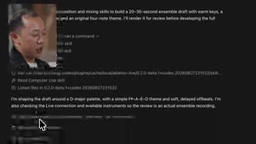
A notable detail: Astra noticed the user had an older project already open, so it planned to save that file first before opening a new Live project. This kind of awareness of the current environment state — and acting on it proactively — goes well beyond simply executing instructions.
The user felt the most powerful aspect was that Astra understood the "taste" of what he wanted to build, then actually invoked the plugin to interface with the software system and assist with mixing. This closed loop — from code generation to operating professional software in practice — demonstrates how deeply AI can embed itself into creative workflows.
Ableton Live is a digital audio workstation (DAW) widely used by professional musicians, known for its complex plugin ecosystem and non-linear arrangement interface with a steep learning curve. Developing plugins for it typically requires mastery of the Max for Live environment or C++ programming using VST/AU standard interfaces, involving audio signal processing, the MIDI protocol, and API integration with the host software. What Astra demonstrated here goes beyond generating code snippets — it understood the host software's state (detecting the open project), determined the appropriate sequence of operations (save first, then create new), and ultimately loaded the generated plugin into the live software environment. This chain spans code generation, file system operations, and application control — far beyond the scope of traditional code completion tools.
From Digital to Physical: Hardware Design and Component Sourcing
Astra's capabilities aren't limited to pure software. One user mentioned designing a physical device they wanted to manufacture, and the level of detail Astra provided was remarkable.

It autonomously searched the web for all required components and produced a complete specification list, identifying parts to be procured or handed directly to a manufacturer. This means Astra can span the full range from design concept to supply chain research to engineering specifications, advancing an abstract hardware idea all the way to an actionable manufacturing stage.
For product prototype developers, this capability compresses the enormous amount of information gathering and documentation work that typically sits between concept and execution.
A Long-Form Creative Project: A 15-Chapter Tactical RPG
The case study that best illustrates Astra's ability to handle complexity is the development of a 2D tactical RPG. The user's requirements were ambitious: a complete game experience spanning 15 distinct chapters, with a main protagonist and a narrative arc that builds over time while introducing new characters along the way.
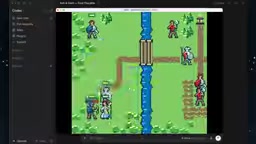
Faced with a project this sprawling — covering world-building, character systems, and multi-chapter storylines — the user was "very impressed" by Astra's ability to untangle the requirements and organize them into something coherent.
The challenge in projects like this isn't implementing any single feature; it's maintaining a grasp of the overall structure and keeping everything consistent across a long timeline. That's precisely where past AI tools have been weakest.
Tactical RPGs (Tactical Role-Playing Games) are a genre that blends turn-based strategy with deep role-playing narratives — think Final Fantasy Tactics or the Fire Emblem series. Their development complexity far exceeds that of casual games: map layouts, unit attributes, and combat formulas all need to be designed, while a consistent world-building canon, character growth arcs, and branching story logic must be maintained across chapters. Fifteen chapters means preserving narrative consistency, balanced difficulty curves, and a coherent web of character relationships throughout the entire project lifecycle. Previous AI coding assistants could typically only handle individual functional modules and struggled to provide guidance at the macro project-structure level. What Astra demonstrated here is an understanding of "overall architectural intent" and the ability to organize around it — arguably the most technically demanding and hardest-to-replicate aspect of this entire demo.
Making Ideas Accessible: Lowering the Creative Bar for Everyone
The closing message of the demo is about accessibility. Once users realize they "can have an idea and then prototype it end-to-end," their mindset around creative work shifts.
One user plans to run some lightweight experiments — like making something for his kids, an interactive storybook. The approach has become completely natural: "I know I can just hand it the idea, even use voice with my kid and say together, hey, let's make this."
The possibility of bringing creative tools into everyday family life may be the direction where Astra's imagination runs widest. When the technical barrier between an idea and a working project drops dramatically, creation stops being the exclusive domain of professionals and becomes something anyone with an idea can reach.
Summary
From thumbnail generators and music software plugins to hardware component sourcing and a full RPG game, the GPT-6 Astra demo revolves around a single theme: transforming vague ideas into executable projects without requiring users to issue precise commands at every step. Its intuitive grasp of user intent, its ability to autonomously invoke software and external resources, and its capacity to organize complex long-term projects form the core value proposition of this tool. It's worth noting that everything above reflects official demo scenarios — real-world stability and edge cases still await broader validation.
Related articles

Non-Reversible Anchored Langevin Dynamics: Accelerating Sampling for Non-Smooth and Heavy-Tailed Distributions
NALD and NRALD introduce gradient-free non-reversible circulation drift into anchored Langevin dynamics to accelerate sampling of non-smooth, heavy-tailed, and constrained distributions.

Universal Regret Lower Bounds for Kernel Bandits: A Near-Optimality Theoretical Breakthrough
An arXiv paper establishes a universal minimax regret lower bound Ω(√(Tγ_T/logT)) for kernel bandits, proving existing upper bounds are near-optimal up to log factors, with exact Θ(√(Tγ_T)) rates for Matérn and γ-exponential kernels.

Transformed Samplers and Variance Reduction: Solving the Control Variate Problem with Normalizing Flows
A new arXiv paper proposes learning variable transformations via normalizing flows to extend Poisson equation solutions to arbitrary target distributions, constructing explicit control variates that reduce MCMC and importance sampling estimator variance.