GPT-6 Astra Meets H3 Director Edition: Real-Time AI Livestreaming Where Viewer Comments Control the Movie
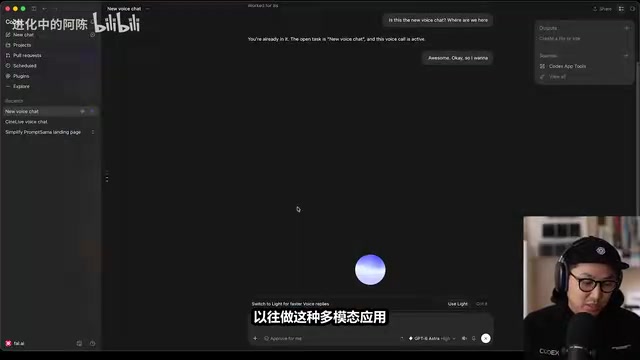
Astra writes the code, H3 renders the scenes in real time — viewer comments become the director.
A developer combined OpenAI's Astra with MiniMax H3 Director Edition to build a viewer-comment-driven AI livestream app using only voice commands in under 30 minutes. Astra's end-to-end coding agent capability drastically lowers the barrier to API integration, while H3's single-stream continuous streaming breaks the offline "batch render" model — enabling real-time character dialogue and lip sync. Together, they hint at a future where pre-rendering in games and interactive media may become obsolete.
When a Model That Writes Code Meets a Model That Directs in Real Time
OpenAI has launched a new model codenamed Astra, and on the same day an overseas platform introduced MiniMax's H3 Director Edition. One developer abroad did something remarkably imaginative: pairing the two models together, letting Astra act as the programmer and H3 as the real-time rendering engine, ultimately assembling an AI livestreaming app where viewer comments can direct movie scenes in real time.
According to a breakdown by Bilibili creator "进化中的阿成," the most striking takeaway from this live test wasn't how powerful any single model was — it was the combination of two capabilities: automated code generation + real-time action scheduling. Together, they're rewriting the production logic for interactive content. Building this kind of multimodal application used to take days just to dig through API documentation and scaffold a frontend interface.
Astra: From Voice Command to Deployed App in Half an Hour
Throughout this demo, the developer wore headphones and communicated with Astra entirely by voice. He pasted the H3 Director Edition's API documentation into the chat window, and Astra instantly parsed the data structure.
The division of labor was clear: a lightweight version of Astra handled voice commands while the advanced version took on the heavy lifting. From automatically designing the front-end and back-end architecture, to building a webpage with a monitor view and script input panel, to catching two hidden configuration conflicts on the fly — in under half an hour, a complete, broadcast-ready application was deployed.
What's worth unpacking here is the end-to-end capability Astra demonstrated: "read documentation → understand structure → generate complete application." It wasn't just completing code snippets. Given an unfamiliar API spec, it independently inferred data structures, planned the architecture, and proactively identified conflicts. For developers, this means the barrier to integrating a new API is being dramatically lowered.
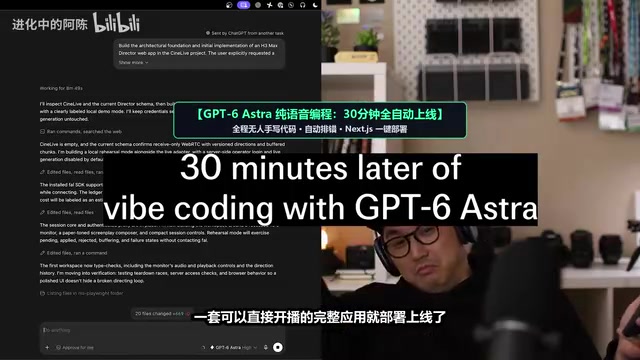
OpenAI's Project Astra is positioned as a multimodal real-time interaction agent, with its core capability being the integration of voice, images, documents, and other multimodal inputs into a continuously running context — enabling a "talk and build" workflow. Unlike ordinary code completion tools, Astra is designed to function as an end-to-end coding agent: it can proactively break down tasks, invoke tools, read external documentation, generate multi-file project structures, and autonomously backtrack to fix errors when they're found. The complete chain demonstrated in this test — "read API docs → infer data structure → generate full application → resolve configuration conflicts" — is precisely what distinguishes agentic programming from traditional Copilot-style completion. The former handles project-level decision-making; the latter offers line-level suggestions.
H3 Director Edition: Single-Stream Continuous Streaming Breaks the "Lottery Pull" Logic
What truly powered the demo's impact was MiniMax H3 running in the background.
Most video generation models we encounter work in offline "lottery pull" mode: you write a prompt, wait a minute or two for a short clip to render, and can't modify it once it's done. H3 Director Edition takes a different approach — single-stream continuous streaming — where it can simultaneously play back video while receiving new action instructions within a long context window.
Live Direction: Changing the Scene While It Plays
The developer typed into the newly built webpage: "A man in a black suit explores a dimly lit corridor." The scene opened instantly like a livestream, with the camera already moving.
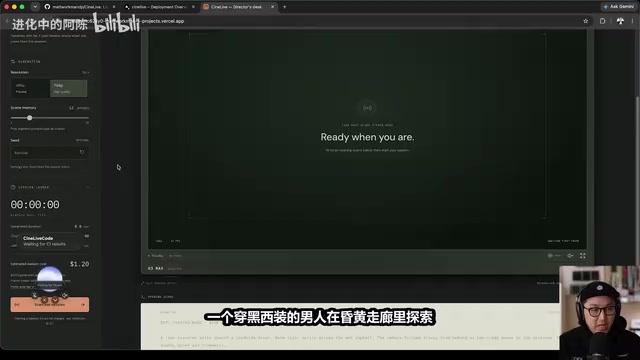
He then added a new directive: "Have him walk toward the glowing door ahead, push it open — there's a female executive sitting inside." The footage didn't cut or stutter. The camera smoothly guided the character into the room, and the executive looked up to meet his gaze. Going further, the developer prompted the two virtual characters to have a live conversation in English about newly released large language models — and the on-screen figures immediately started talking, with lip sync and facial expressions updating in real time.
As the creator noted, the developer reportedly said during the demo that "his typing speed could barely keep up with H3's real-time generation." That line gets at the most critical feature of single-stream output: generation latency is low enough to be driven by human interaction in real time, rather than waiting for offline rendering.

Single-stream continuous streaming is an architectural approach distinct from traditional offline batch generation. Conventional video generation models (such as early Sora, Runway, etc.) use a "request → wait → return" pattern: after submitting a prompt, the model generates a complete video clip in the background and returns it as a file — essentially offline rendering, with no mid-process intervention possible. Continuous streaming is closer to a live broadcast protocol: the model outputs frames in a streaming fashion, the client plays them back as they arrive, and a long context window remains open to accept new instructions that steer subsequent frame generation. This requires the model to perform conditional generation at extremely low inter-frame latency, placing far greater demands on inference speed and contextual consistency than offline mode. H3 Director Edition's demo showed the initial viability of this mechanism at the level of character motion, dialogue, and lip sync — but maintaining visual style and character consistency over extended streaming sessions remains a well-recognized technical challenge in the video generation field.
The Combined Value: Pre-Rendering as a Concept May Be Rewritten
Viewed separately, one model is a more powerful coding assistant and the other is a faster video generation engine. But when Astra — which can automatically write code — connects to H3 — which supports real-time action scheduling — the result is multiplicative.
For games and interactive dramas, traditional workflows are heavily dependent on pre-rendering and pre-scripted branching: plot trajectories, camera moves, and dialogue all have to be produced in advance. In this demo, storylines and cinematography can be directed entirely by viewers in real time through live comments — and the concept of pre-rendering itself may be fundamentally rewritten.
It's worth noting that this is still a single developer's proof-of-concept demonstration. Questions around stability, cost, and visual consistency over extended streaming sessions all require validation at greater scale. The data in this article comes from a Bilibili creator's breakdown video, and no independent third-party replication has been confirmed. But it at least points toward a direction: interactive real-time content generation is moving from concept to working prototype.
Pre-rendering is the production method that has long dominated the game and film industries. To ensure visual quality and narrative consistency, all cutscenes, branching storylines, and camera work are produced by professional teams before release and locked in as static asset files. The downside is that the content is fixed — regardless of what choices a player or viewer makes, they're seeing pre-recorded footage, and truly "real-time responsive" storytelling is extremely limited. Interactive narrative games like Detroit: Become Human introduced branching stories, but every branch is still an independently pre-rendered segment. The potential breakthrough of real-time generation is that content no longer needs to exist in advance — it's generated the instant the viewer makes a decision. In theory, this could expand narrative branching from a finite tree structure to a nearly infinite dynamic space, though the trade-off is a proportional increase in the difficulty of controlling generation quality, consistency, and content safety.
Final Thoughts
The significance of this demo isn't in showing how high any single model scores on a benchmark — it's in demonstrating a new application paradigm: "speak to build" an application, then use "comment-driven direction" to control the visuals. If every future livestream's storyline and camera work can be determined by viewers in real time, the boundaries of interactive content will be redefined.
If you had this kind of toolset in hand, what story would you want to direct live?
Related articles
Automattic Executives Signed Reciprocal Severance Agreements During Mullenweg's Brief Ouster
Automattic's CFO and General Counsel signed reciprocal severance agreements during Matt Mullenweg's brief ouster, covering one year's salary and accelerated equity vesting, raising corporate governance concerns.
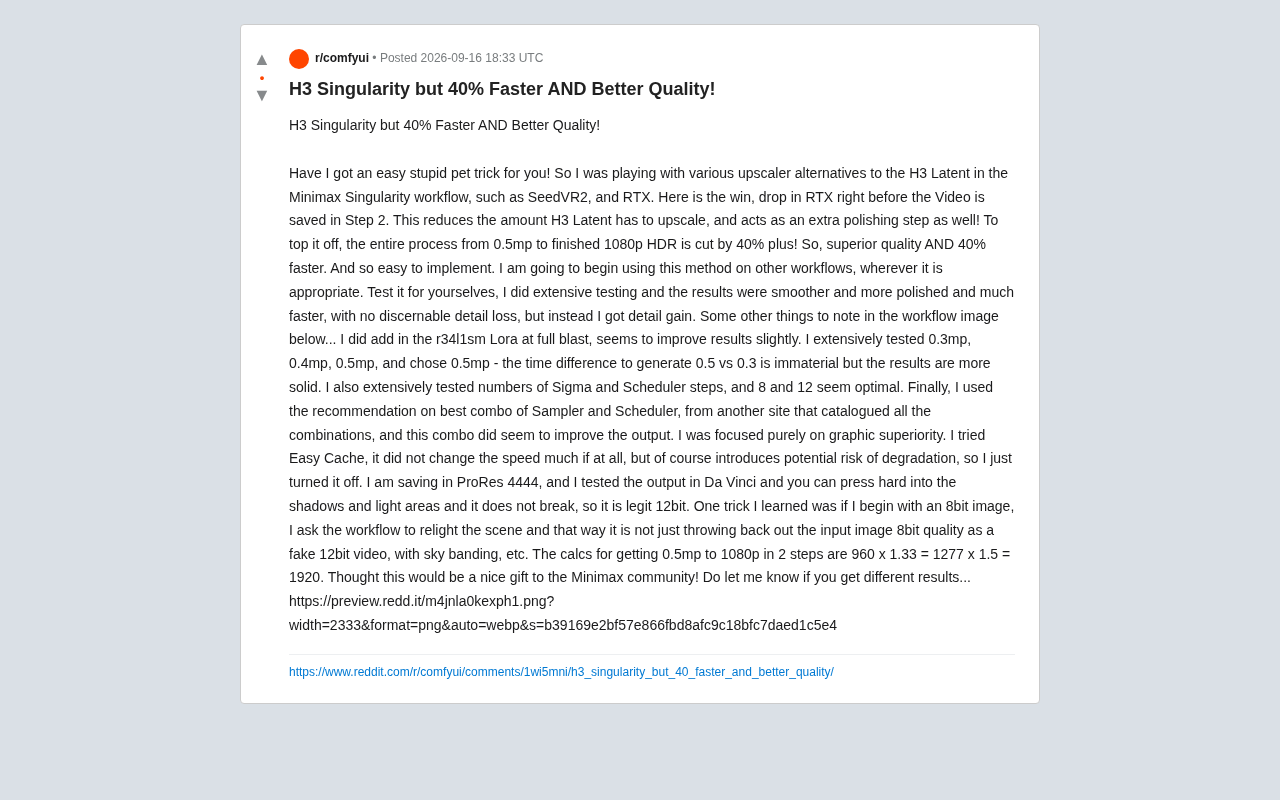
H3 Singularity Optimization: 40% Speed Boost With Better Image Quality
A Reddit user's Minimax Singularity workflow tip: insert an RTX upsampler before H3 Latent for 40%+ speed gains and better quality. Covers parameters, 12-bit output, and more.
Glyph: A Multi-Strategy Agent System for Automated Enterprise Data Catalog Annotation
Glyph is a multi-strategy LLM agent system for enterprise data catalogs that automates column description generation and sensitivity ontology tagging, grounding outputs in pipeline source code to improve accuracy.