GPT-6 Astra Real-World Test: Can It Handle SketchUp Modeling and CorelDRAW Layout for Actual Projects?
GPT-6 is the only model to pass a real-project design benchmark, and it even handles CorelDRAW layout via scripting.
Bilibili creator 曹涛叔叔 benchmarked GPT-6 (Astra), DeepSeek V4.1 Flash, GLM 3.8 Flash, and GLM 5.3 against actual in-progress design projects. GPT-6 completed partial SketchUp modeling — including a screen partition and a bamboo blind Dynamic Component — in about 30 minutes with iterative refinement, earning the only "production-ready" rating. DeepSeek V4.1's output was chaotic, GLM 3.8 struggled to work independently, and GLM 5.3 was the best of the rest but still fell short. GPT-6 also surprised by scripting CorelDRAW to produce a complete graphic layout, extending AI's design toolchain coverage beyond 3D software. The key takeaway: AI modeling is shifting from demo-capable to production-capable — but massive gaps between models remain.
AI Modeling Benchmarked Against Real Projects
There's no shortage of AI model benchmarks out there, but most only ask whether the model can produce something. Bilibili creator 曹涛叔叔 (Uncle Caotao) took a different approach — he fed several leading AI models his actual, in-progress design projects and judged them by production standards.
His criteria were clear: AI-assisted modeling isn't just about generating geometry. It has to integrate into real business workflows and deliver results that are actually ready to use. That's what sets this benchmark apart from typical "demo-style" comparisons. The models tested include GPT-6 (Astra), DeepSeek V4.1 Flash, GLM 3.8 Flash, and GLM 5.3.
GPT-6 Astra: Local Model Built in Half an Hour
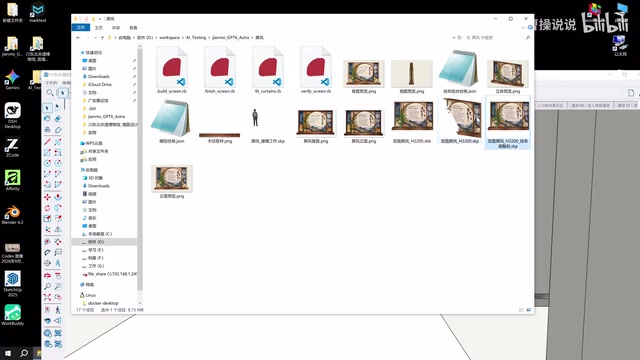
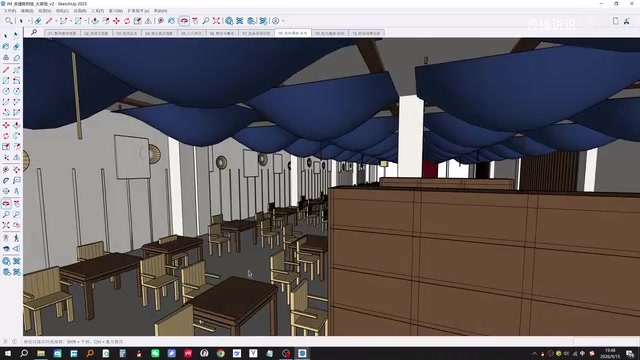
The creator gave GPT-6 a floor plan and a few reference renders, then asked it to build a partial model in SketchUp. The whole process took about half an hour. There were errors along the way, some results didn't match expectations, and there were a few modeling-level issues — but through multiple rounds of back-and-forth, everything was gradually corrected.
Two standout cases from the test: a screen partition model based on a reference render, and a bamboo blind. The screen partition had solid detail fidelity. The bamboo blind was structurally simpler, but the creator went further and turned it into a SketchUp Dynamic Component — anyone familiar with SketchUp will know that parametric control isn't a trivial requirement.
Overall, the creator rated GPT-6 as the only model in this test that truly reached "production-ready" status, excelling in both generation speed and final completeness.
SketchUp Dynamic Components are a parametric modeling feature in SketchUp that let users assign interactive attributes and behavioral logic to models. By defining variables and formulas, dynamic components can respond to user input — enabling size scaling, opening/closing actions, material switching, and more. For example, a door can be configured to open automatically when clicked, or a set of cabinets can automatically adjust spacing based on entered dimensions. Creating dynamic components requires not only understanding SketchUp's component structure, but also writing attribute formulas and conditional logic — a relatively high technical bar. The fact that an AI can generate functional dynamic components means it's not just stacking geometry; it understands the parametric relationships and interaction logic behind the model. That's exactly why the creator singled out this example.
Other Models: Completion Quality Becomes the Dividing Line
By comparison, the gaps between other models and GPT-6 were magnified under real-project standards.
DeepSeek V4.1 Flash
The creator bluntly called its modeling results "a mess," with significant deviations from the reference. He noted that in a pure benchmark context — detached from real-world application — models like this might still look impressive. But the moment you apply production-level expectations, they fall well short.
GLM 3.8 Flash
This model was described as "passable," but the creator flagged a concerning issue: it appeared to have referenced GLM 5.3's earlier modeling process before completing its own work. Asked to build entirely from scratch, it tended to stall. This revealed a lack of stability when independently tackling complex modeling tasks.
GLM 5.3
Among the non-GPT models, GLM 5.3 was rated the best of the group — good enough to serve as a backup option. Still, its overall completion quality was unsatisfactory, with some results showing inexplicable deviations.
The Surprise: CorelDRAW Graphic Layout
The biggest surprise in this benchmark wasn't the 3D modeling — it was GPT-6's ability to handle graphic layout as well.
For design professionals, 2D layout work is just as common as 3D modeling. The creator used a "Eastern Sichuan Intangible Cultural Heritage Museum" themed project as the test case, providing an AI-generated concept render and several source images, then asked GPT-6 to produce a layout that matched the aesthetic and theme.
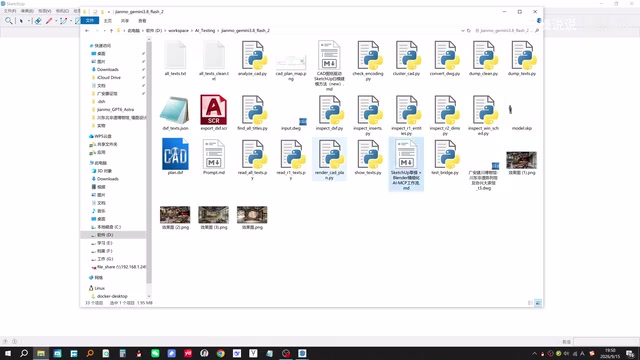
The results were once again unexpected: GPT-6 quickly delivered a CorelDRAW layout file, complete with a background image and finished compositions. The creator's analysis was that GPT-6 achieved this by writing scripts in the background to control CorelDRAW.

Up until now, the industry has mostly seen AI use scripts to control 3D and engineering tools like Blender, SketchUp, and CAD. GPT-6 extending that automation capability to CorelDRAW — a vector graphic design application — signals that AI's coverage of the design toolchain is becoming significantly more complete.
AI's ability to control desktop software via scripting generally relies on each application's exposed scripting interface or automation API. SketchUp supports Ruby scripting; AutoCAD supports AutoLISP and .NET APIs; Blender has a built-in Python environment. CorelDRAW likewise provides automation interfaces based on VBA (Visual Basic for Applications) and CorelDRAW Script, allowing external programs to control document creation, layout element positioning, and property settings via a COM object model. The core capability required for AI to generate such scripts is understanding the target software's object model — the hierarchical relationships between documents, layers, text frames, and graphic objects — so it can produce code the software will execute correctly. This approach of "controlling design software through code" essentially transforms design operations into a programmable sequence of instructions, rather than direct GUI interaction.
What This Means for the Design Industry
At the end of his test, the creator remarked that "design is about to be turned upside down." Based on this real-world benchmark, that sentiment isn't unfounded.
The key inflection point: AI modeling is starting to move from "good enough to demo" to "good enough to ship." When a model can complete a partial build of a real project in half an hour, iterate through multiple rounds of feedback, and also handle graphic layout automatically, its impact on design workflows goes well beyond being a productivity tool.
That said, the benchmark also reveals the current reality: capability gaps between models remain enormous. Most still fail to deliver acceptable results under real-project standards, and there are clear weaknesses in stability and the ability to build independently from scratch. In other words, whether AI can genuinely replace design production capacity depends on whether it can consistently pass the "real project" test — not just put on a polished demo.
Note: This article is based on a single creator's personal test and review. Conclusions reflect the specific project context and subjective judgment of that creator. Actual model performance may vary depending on task type and usage approach.
Related articles
Automattic Executives Signed Reciprocal Severance Agreements During Mullenweg's Brief Ouster
Automattic's CFO and General Counsel signed reciprocal severance agreements during Matt Mullenweg's brief ouster, covering one year's salary and accelerated equity vesting, raising corporate governance concerns.
H3 Singularity Optimization: 40% Speed Boost With Better Image Quality
A Reddit user's Minimax Singularity workflow tip: insert an RTX upsampler before H3 Latent for 40%+ speed gains and better quality. Covers parameters, 12-bit output, and more.
Glyph: A Multi-Strategy Agent System for Automated Enterprise Data Catalog Annotation
Glyph is a multi-strategy LLM agent system for enterprise data catalogs that automates column description generation and sensitivity ontology tagging, grounding outputs in pipeline source code to improve accuracy.