GPT-6 Astra Takes on Goldbach's Conjecture: How Capable Is AI at Mathematics?

GPT-6 Astra unconditionally proved a Liouville-function weakening of Goldbach's Conjecture in two elegant pages.
AI is breaking mathematical ground faster than expected. GPT-6 Astra recently produced an unconditional two-page proof of a weakened form of Goldbach's Conjecture — showing every even number greater than 2 can be written as the sum of two numbers with Liouville value -1 — then extended the result to all even numbers within 48 hours. A 2024 proof by mathematician Alexander required the unproven Generalized Riemann Hypothesis; AI's version removes that condition entirely. Even more striking is the proof's style: elementary algebra, proof by contradiction, and a "closest decomposition" extremal construction — concise, elegant, and indistinguishable from the work of a top human mathematician.
The speed at which AI is conquering mathematical problems is outpacing many people's expectations. Following its brute-force assault on the Navier–Stokes equations — one of the Millennium Prize Problems — AI has now set its sights on another legendary challenge: Goldbach's Conjecture. According to educator Li Yongle, GPT-6 Astra has unconditionally proved a weakened version of Goldbach's Conjecture in a mathematical paper just two pages long. What makes this stunning is not merely that AI solved another problem, but how it solved it: with elegance, concision, and flashes of genuine mathematical insight — qualities indistinguishable from the great classical breakthroughs in mathematical history.
What Is Goldbach's Conjecture?
Goldbach was an 18th-century German mathematician who, in correspondence with the Swiss mathematician Euler, posed the question: can every integer be expressed as the sum of three prime numbers? Euler replied that this idea is actually equivalent to two separate conjectures.
Strong Goldbach's Conjecture (what we commonly refer to as Goldbach's Conjecture today): Every even integer n greater than 2 can be written as n = a + b, where both a and b are prime numbers. For example: 4 = 2+2, 6 = 3+3, 8 = 3+5, 10 = 3+7, 12 = 5+7.
Weak Goldbach's Conjecture: Every odd integer n greater than 5 can be written as n = a + b + c, where all three numbers are prime. For example: 7 = 2+2+3, 9 = 2+2+5, 11 = 3+3+5.
The two are logically connected: if the strong conjecture holds, the weak one follows automatically. Since any odd number greater than 5 minus 3 gives an even number greater than 2, if that even number can be split into two primes, the odd number can be written as 3 plus two primes. In 1900, Hilbert included Goldbach's Conjecture in his famous list of 23 unsolved mathematical problems — specifically as part of Problem 8.
Hilbert's eighth problem was one of 23 open problems presented at the 1900 International Congress of Mathematicians, widely regarded as a blueprint for 20th-century mathematics. Problem 8 is actually a bundle of problems: in addition to Goldbach's Conjecture, it includes the Riemann Hypothesis and the Twin Prime Conjecture. To this day, all three remain unsolved, which speaks to their extraordinary difficulty. Goldbach's Conjecture is deceptively simple — understandable with elementary arithmetic — yet its simplicity conceals deep mysteries about the distribution of prime numbers. Since no exact analytic formula for the distribution of primes exists, the conjecture has remained open for nearly three centuries.
From Chen Jingrun's "1+2" to AI
The weak Goldbach's Conjecture was resolved in 2013 by mathematician Harald Helfgott, while the strong conjecture remains open. Looking back at history, mathematicians have taken a long and winding road.
In 1930, Schnirelmann proved that any sufficiently large even number can be written as the sum of a finite number k of primes — and the goal became pushing k down to 2. In 1920, Brun approached the problem from a different angle, proving "9+9": any large even number can be expressed as the sum of two numbers, each the product of at most 9 primes. A long relay race followed — 8+8, 7+7 — until Chen Jingrun proved the celebrated "1+2."
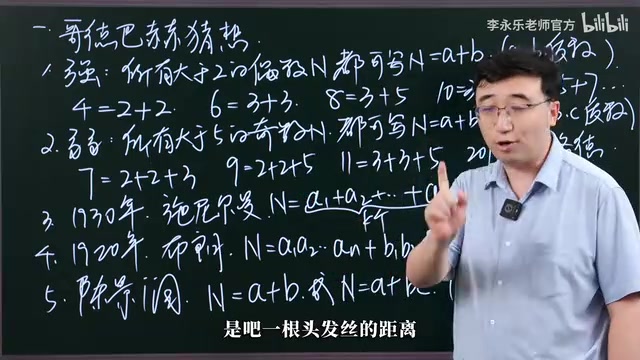
What Chen Jingrun proved was: any sufficiently large even integer N can either be written as a+b (the sum of two primes), or as a+bc (one prime plus the product of two primes). This is just a hair's breadth away from "1+1," yet that gap has never been bridged. It is widely believed that traditional sieve methods have likely reached their limits, and no substantial progress has been made in many years.
What Exactly Did AI Prove?
Since a direct proof of Goldbach's Conjecture remains out of reach, mathematicians have turned to studying weakened versions. Around 2018, someone on the mathematics forum MathOverflow proposed a weakened conjecture framed in terms of the Liouville function.
The Liouville function is defined as λ(a) = (-1)^ω(a), where ω(a) denotes the number of prime factors of a counted with multiplicity. For example: λ(2) = -1 (2 has one prime factor), λ(4) = +1 (4 = 2×2, two prime factors), λ(12) = -1 (12 = 2×2×3, three prime factors). All prime numbers have a Liouville value of -1, but a Liouville value of -1 does not guarantee primality.
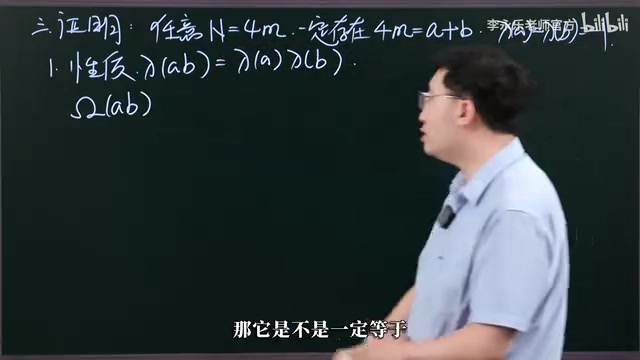
The weakened conjecture asks: can every even number greater than 2 be written as the sum of two numbers, each with a Liouville value of -1? This represents an exploration of a necessary condition for Goldbach's Conjecture.
In 2024, mathematician Alexander proved that this conjecture holds — but with two caveats: it applies only to sufficiently large even numbers, and it requires assuming the Generalized Riemann Hypothesis (GRH) — which itself remains unproven. This means Alexander's result is conditional.
According to Li Yongle, GPT-6 Astra's breakthrough lies in providing an unconditional proof. It first used two pages to prove the result for all multiples of 4, then within 48 hours extended the result to all even numbers greater than 2 in an 8-page follow-up. Unlike previous AI efforts involving tens of thousands of agents in brute-force attacks, this proof is remarkably concise — comprehensible to anyone with a high school mathematics background.
The Generalized Riemann Hypothesis (GRH) is one of the most important unsolved conjectures in number theory, and a generalization of the original Riemann Hypothesis. The Riemann Hypothesis asserts that all non-trivial zeros of the Riemann zeta function lie on the critical line Re(s) = 1/2 in the complex plane; GRH extends this assertion to all Dirichlet L-functions. Because L-functions are intimately connected to the distribution of primes in arithmetic progressions, a proof of GRH would yield precise error estimates for a vast body of results in number theory. In practice, "assuming GRH" is a common strategy for conditional proofs — it bypasses deep uncertainties about prime distribution, but the reliability of the conclusion depends entirely on GRH actually being true. GPT-6 Astra's breakthrough lies precisely in removing this assumption, delivering an unconditional proof.
The Elegance of a Two-Page Proof
The proof goal is: for any n = 4m, show that n can be written as a+b with λ(a) = λ(b) = -1.
Two key tools are at work. The first is the multiplicativity of the Liouville function: λ(ab) = λ(a)·λ(b), because ω(ab) = ω(a) + ω(b) (prime factors with multiplicity are additive), and addition in exponents corresponds to multiplication of signs. This gives us: λ(4m) = λ(m), and λ(4m) = -λ(2m) — multiplying by 2 flips the sign, a detail that proves crucial later.
The second tool is a lemma (proved previously): for any m ≥ 11, there exists a decomposition m = a+b such that λ(a) and λ(b) have the same sign.
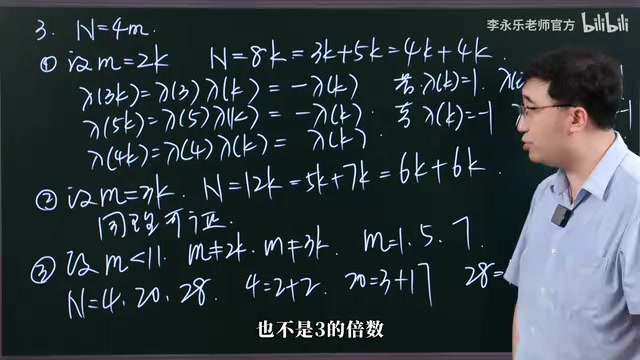
The proof first handles the easy cases: when m is divisible by 2, divisible by 3, or m < 11, all cases can be verified by direct construction (e.g., splitting into 3k+5k or 4k+4k). The real challenge is when m ≥ 11 and m is divisible by neither 2 nor 3 — here AI employs proof by contradiction.
Assume 4m cannot be written as the sum of two numbers with λ = -1. Using the sign-flipping relations, this implies 2m cannot be split into two numbers with λ = +1, and m cannot be split into two numbers with λ = -1. Combined with the lemma, we can write m = a+b with λ(a) = λ(b) = +1, choosing the pair that is as close together as possible — this "closest pair" construction is the masterstroke of the entire proof.
AI then constructs a series of auxiliary numbers (such as a' = (m+a)/3) and, through clever sign manipulations, produces a pair with an even smaller difference — directly contradicting the assumption that the original pair was closest. The contradiction invalidates the initial assumption, proving by contradiction that 4m must be expressible as the sum of two numbers with Liouville value -1.
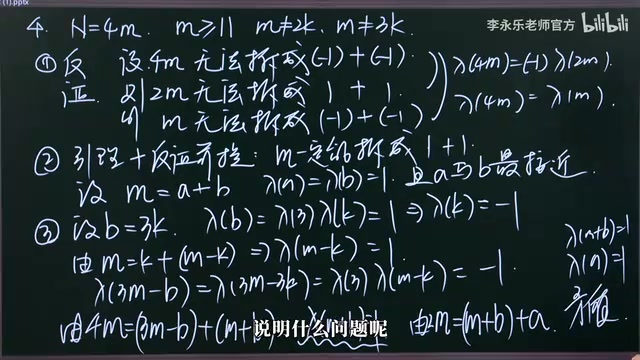
The entire argument uses only elementary algebra, yet every step interlocks with the next in a beautifully precise construction — and that is precisely what makes it so astonishing.
Proof by Contradiction is one of the most classical strategies in mathematics: assume the target proposition is false, derive a logical contradiction, and conclude the proposition must be true. Its power lies in transforming "prove that something exists or holds" into "prove that its negation is impossible" — often circumventing the difficulty of direct construction. In this proof, AI introduces the "closest decomposition" as an extremal assumption — a technique known as the Minimal Counterexample method. The idea is to assume a counterexample exists and take the most extreme one, then use that extremality to derive an even more extreme counterexample, generating a logical paradox. This pattern appears throughout proofs involving infinite descent and the well-ordering principle, yet it requires genuine mathematical intuition to identify the right extremal quantity to build the contradiction around. AI's choice here is strikingly consistent with the style of the greatest mathematicians in history.
Is the Era of Human Mathematics Coming to an End?
To be clear: AI has not actually cracked Goldbach's Conjecture. What it proved is a weakened version — an exploration of a necessary condition framed via the Liouville function. But as Li Yongle notes, the mathematical ability demonstrated here already far surpasses that of most people, reaching the level of elite mathematicians.
Earlier, Terence Tao and 24 other Fields Medal recipients jointly issued a statement expressing concern that AI's "brute-force, targeted attacks" on mathematical problems could disrupt human mathematicians' research and harm the healthy development of the scientific ecosystem. But this episode reveals another dimension: AI is not just good at brute-force computation — it appears to be acquiring the flashes of insight that mathematicians have always considered their defining strength. Pure intellectual reasoning may no longer be an exclusively human domain.
Li Yongle has compared the present moment to Newton's miracle year of 1666 or Einstein's of 1905, suggesting we are witnessing a scientific revolution unlike any in a thousand years. That judgment may be optimistic — but the "inspiration" AI has demonstrated in mathematical reasoning is something the entire research community should take seriously.
Related articles

When Did Paid Childcare Become the Norm? Working Mothers and the Evolution of Childcare
When did paid childcare become the norm? This article traces the evolution from the rise of childcare centers in the 1970s–80s and the 1990s linking of federal subsidies to work requirements, to declining stigma and rising costs, and explores advocates' 25-year effort to catch up with other countries on childcare and paid parental leave.

Red Flags for Product-Market Fit: A Practical Guide from Top VCs and the Superhuman Founder
Investors from Iconiq and Sapphire Ventures and Superhuman founder Rahul Vohra share PMF red flags and practical methods, including the 40% disappointment rule, retention curves, and acquisition costs.

What Task Should AI Agents Take Over Most? Heated Reddit Discussion
Reddit discussion: Which task do you most want AI agents to take over completely? Cross-app data migration, CRM updates, and report generation top the list, but insufficient reliability and the trust gap are the biggest obstacles to automation adoption.