GPT-6 Astra Tested: Recreating Academic Figures 1:1 and Converting Them to Editable PPT

GPT-6 Astra reconstructs complex academic figures into fully editable PPT slides with near 1:1 fidelity.
A Bilibili creator tested GPT-6 Astra's ability to convert complex academic figures directly into editable PowerPoint files. Using a "complex visual fidelity + primary text editable" hybrid reconstruction strategy, GPT-6 Astra successfully decomposed arrows, icons, distribution charts, and dense flowchart boxes into individually editable PPT objects — a dramatic improvement over GPT-5.5's chaotic output. Processing an ultra-dense flowchart took about 6 minutes and identified 20 boxes and connectors. The creator sees clear productivity value for academic use but cautions that results aren't 100% reliable, token costs are high, and copyright concerns apply.
From Chaotic Results to Near-Perfect Reconstruction
Taking a paper figure and asking AI to output an editable PPT from it was little more than a half-baked idea just a few months ago. According to a hands-on demo by a Bilibili creator, early attempts at the same task using GPT-5.5 typically produced chaotic results — text and graphics overlapping, complex diagrams barely recognizable.
When the same complex figure was run through GPT-6 Astra, the results changed dramatically. The creator noted that the complaint from viewers — "the image is too complex to recognize" — has now been completely resolved: arrows, symbols, "brick"-style structures resembling chemical models, small computer logos, and even embedded normal distribution charts have all been reconstructed at near 1:1 fidelity, with fonts and line directions preserved.
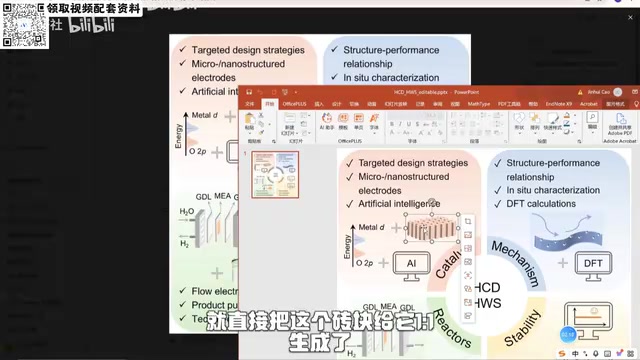
Based on the demo, this is not simply screenshot-and-paste — it's a full decomposition and reconstruction of visual elements into individually editable objects within PowerPoint. For anyone who regularly works with academic figures, this leap in capability is genuinely worth paying attention to.
The Core Method: Hybrid Reconstruction Strategy
The key to achieving this result lies in prompt design. The creator's core instruction was essentially: reconstruct this image into an editable PPT format, using a "complex visual fidelity + primary text editable" hybrid reconstruction strategy, with an explicit instruction to "not flatten the entire page into a background image."
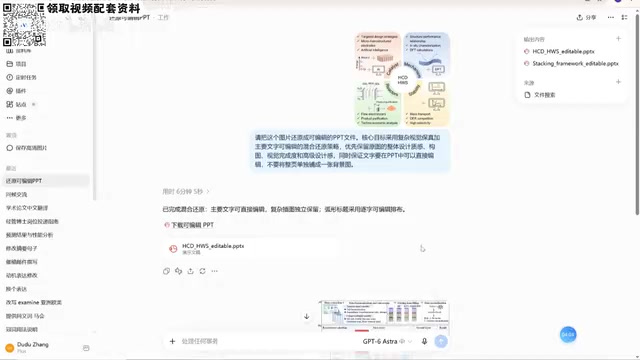
The cleverness of this prompt lies in how it distinguishes between two types of elements: for complex graphics that are difficult to vectorize, visual fidelity is preserved; for structured content such as text, tables, and flowchart boxes, these are converted into genuinely editable objects. This avoids the whole page becoming a static image while ensuring flexibility for later edits.
The workflow is also straightforward: select the GPT-6 Astra model in the chat interface (distinct from versions like 5.5 or 5.6), set the token consumption level to medium or high, then upload the image along with your prompt. The creator used the "medium" setting in their test; switching to "high" is an option if better results are needed.
The essence of the hybrid reconstruction strategy is semantic layering of image content. The PPT file format (PPTX) is based on an XML structure where every text box, shape, and image is an independent XML node that can be modified individually. When a model "reconstructs" a complex figure into a PPT, it is actually generating the code for these XML nodes — not embedding a screenshot. This means the model must simultaneously accomplish two things: identify the visual structure of the image (position, size, color, hierarchy), and determine whether each element should be represented as a text box, SmartArt, shape, or kept as an embedded image. For complex graphics that cannot be precisely vectorized (such as hand-drawn illustrations or microscopy images), falling back to an embedded image is a reasonable compromise; for regular geometric shapes and text, generating true vector/text objects should be prioritized to preserve editability. The explicit instruction to "not flatten into a background image" is guiding the model to prefer the latter path over the former fallback.
Pushing the Limits: Ultra-Dense Flowcharts
After successfully reconstructing the first figure, the creator went further and tested an "ultra-dense flowchart" — a diagram packed with small stacked boxes, dense text, and icons in an extremely tight layout. This type of image is a far more demanding test of recognition and layout capabilities.
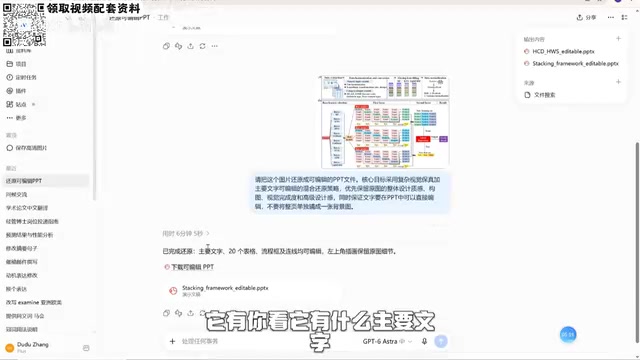
Generation took approximately 6 minutes and 5 seconds, during which the model identified 20 flowchart boxes and their connecting lines. In the final output, text, arrows, dots, tables, shaded areas, and small icons were all reconstructed as editable elements — with no obvious misalignment or stacking despite the extremely compact layout. The creator described the wait as "the time it takes to drink a cup of milk tea" — a reasonable processing time given the sheer complexity of the task.
Real-World Impact on Academic Productivity
The creator argued that figure-making has long been an invisible barrier for many researchers on the path to publication. The visual quality of a paper's figures directly influences reviewers' impressions — papers with poor layout and color choices may not even make it past the initial screening stage.
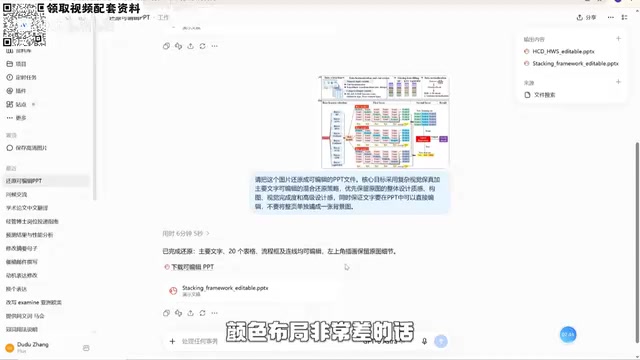
Being able to one-click adapt the color schemes and compositions of top-journal figures and rework them into your own version could meaningfully elevate the quality of a paper's visuals. Beyond research papers, this capability applies equally to lab group presentations, academic talks, and workplace report slides — no need to lay out everything from scratch; just have the model generate the image and convert it into an editable PPT.
It's worth noting that this kind of "adapt and reuse" approach raises questions around copyright and academic integrity. Directly repurposing someone else's figures carries real risks, and users should exercise caution in practice.
An Honest Assessment: Significant Progress, but Not a Silver Bullet
The creator also acknowledged that this feature is not 100% reliable — it's a major improvement over GPT-5.5, but not a guarantee. Success depends on both image complexity and prompt configuration, and failed cases still require iteration.
Additionally, the cost of this improved capability is faster token consumption and noticeably longer processing times for complex images. The fact that results on the same type of task have improved so dramatically in just a few months — from June to September — is itself a reflection of how quickly multimodal models are currently evolving. The creator also mentioned a perceived gap between domestic and international large models in multimodal capabilities, though this is a personal assessment offered for reference.
For everyday users, the most practical advice is: test it with your own real materials rather than relying solely on demo videos. After all, promotional content tends to showcase the most ideal outcomes.
Token consumption deserves special attention in multimodal tasks. Unlike pure text conversations, uploading a high-resolution image causes the model to split it into tiles for separate encoding, with each tile consuming hundreds to thousands of tokens. The more complex and high-resolution the image, the greater the consumption. GPT-series models bill image tokens the same way as text tokens, so a single call to process a dense flowchart can cost as much as dozens of ordinary text conversations. Setting the "token consumption level" to "high" allows the model to use more computational steps during inference (similar to extended thinking in the o-series models), which significantly improves accuracy on complex tasks — but also multiplies both processing time and cost. For high-frequency use cases, it's advisable to first validate feasibility at the "medium" setting before deciding whether to upgrade.
Related articles

Amphibious Transforming Drone: Beyond 100x Power Savings, What Are the Real Needs?
Is the amphibious transforming drone just a gimmick? Starting from the 100x power difference of the M4 Morphobot, explore real application scenarios and thesis topic ideas, analyzing boundary conditions where pure drones and pure ground robots both fail.

Warhound Raises $200 Million: Genetically Engineered "War Dogs" Paired with Anduril Gear
Warhound raises $200M, backed by Ben Lamm and Palmer Luckey, to genetically engineer dogs for military and law enforcement use and equip them with Anduril gear. This article analyzes its technology direction, funding logic, and ethical controversy.

Claude API Comes to Google Cloud: IAM Integration and SDK Access Guide
Anthropic hosts the full Claude API on Google Cloud with IAM-controlled permissions and unified billing. This guide covers the Vertex AI and Anthropic-hosted entry points, IAM role configuration, and SDK access.