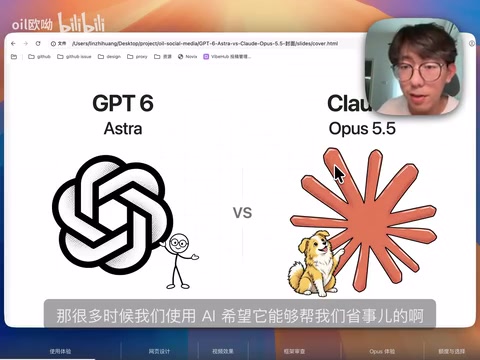
GPT-6 Astra vs Claude Opus 5.5: A Comprehensive Real-World Showdown

Claude Opus 5.5 outperforms the entire GPT-6 lineup in real-world creative and coding workflows.
A heavy-use AI creator benchmarks Claude Opus 5.5 against GPT-6 Astra, Soul, and Luna in actual workflows. GPT-6 struggles on three fronts: Astra costs more with little improvement; Soul and Luna regress in performance with poor instruction-following and broken Skill recall; copy quality is cryptic and UI designs are cluttered with filler text; and Codex-generated framework reviews are nearly incomprehensible. Opus 5.5 excels in design restraint, readable code reviews, animation implementation, and natural conversational flow — all at 40% lower cost than its predecessor, with true 1M-token context and faster response times.
As a creator who relies heavily on AI models every day — for generating presentations, producing videos, and building code frameworks — I ran both the newly released GPT-6 lineup and Claude Opus 5.5 through my actual workflows. The verdict is clear: Claude Opus 5.5 is a dramatically better experience than GPT-6 Astra, and this marks the largest gap I've seen between Claude and GPT models all year.
This article isn't about benchmark leaderboards. It's about the differences you actually feel when getting work done — conversational quality, aesthetics, coding capability, long-task stability, and all those maddening little details.
GPT-6's Awkward Position: Higher Version Numbers, Worse Experience
Compared to GPT-5.6, GPT-6 Astra shows meaningful improvement only in computer automation tasks and modeling capabilities — areas that aren't essential needs for most people. What most people actually need is: a model with natural conversational flow, copy that reads like a human wrote it, solid creative instincts and aesthetic sensibility, reliable coding ability, and stable instruction-following across long tasks. On all of these dimensions, GPT-6 Astra is barely an improvement over GPT-5.6 — yet it costs significantly more.
What's even more puzzling is the subsequent release of GPT-6 Soul and GPT-6 Luna. They're priced 50–60% lower than their predecessors with the same model names, which sounds great — but the actual experience falls well short of the previous generation. Same name, higher version number, worse performance.
GPT-6 Luna has been particularly bad these past couple of days: poor instruction-following, weak Skill recall. It produces obvious errors on even simple Skill implementations — like spontaneously translating project names into Chinese, or dumping the daily report template itself into the body of the report. These are basic mistakes that shouldn't exist at GPT's level.
My daily workflow — making slides, generating cover images, adding subtitles, auto-distributing videos — ran without issues on GPT-5.6 Luna. After switching to GPT-6 Soul, it started applying subtitle styles incorrectly; even after reading the Skill, it didn't grasp the intent and rewrote its own subtitle style from scratch. When you constantly have to step in and correct the model, that's a clear sign its execution capability is lacking — and the experience suffers accordingly.
GPT's Cryptic Copy: Every Word Makes Sense, the Sentence Doesn't
GPT models have always had poor conversational quality — it's practically their signature flaw. The copy it produces isn't the generic "AI-flavored" text you might expect; it's grammatically fractured and uses oddly obscure phrasing that's genuinely painful to read. Every word is familiar, but strung together it just doesn't land.
Whether you're asking it to make slides, build web pages, write scripts, or draft daily reports, the output never meets expectations. No matter what Skill or prompt constraints you use, the result is just bad.
My take on Codex is similar. Unless you have strong AI-wrangling skills, it's hard to produce something good with it. You either need sharp creative instincts, deep technical knowledge, and real product insight to give it a clear direction — or, if you hand it a vague goal and let it iterate for hours, you'll end up with a pile of code nobody can make sense of. The code it generates tends to be heavily gated, layered with technical debt, full of hardcoded if-else logic with tests written for each branch, and every new requirement gets patched on top — then the patch gets its own test to verify it's actually a patch.
Codex is OpenAI's dedicated coding agent, distinct from the GPT-6 conversational model. It runs asynchronously in a sandboxed environment, autonomously breaking down tasks, writing code, and running tests after receiving a goal — sometimes taking hours to return results. This "point it at a target and let it run" model is highly efficient when the goal is clear, but when direction is vague, it iterates endlessly while drifting from the original intent — accumulating test scaffolding, hardcoded logic, and patch-on-patch if-else chains, which is the root of what the author calls the "legacy code mountain" problem. Understanding this helps contextualize the criticism of Codex-generated frameworks later in the article: the issue isn't just code style, but a systemic tendency for agents to spiral out of control without clear constraints.
UI Design Compared: Opus's Restraint vs. GPT's Text-Stuffing Compulsion
Using the same Skill to have both models design a web page reveals a stark contrast.
Claude Opus 5.5 correctly interprets the image generation guidelines in the Skill, produces assets with transparent backgrounds and lays them out on the page, and delivers three distinct styles as requested — cassette-tape, film-grain, and flat design — with pleasing color palettes. The CTA section even features neumorphic buttons. The overall result has genuine design sensibility.
GPT-6 Astra's design ability is actually decent — the color choices and layout are bold, and it looks good at first glance. But it has one fatal flaw: if there's any space on the page, it will fill it with text. Meaningless filler copy appears everywhere, even when the Skill explicitly states "do not insert these meaningless text elements." It ignores the instruction entirely.
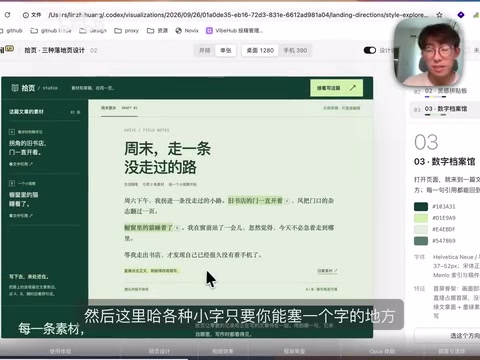
Even more absurd is how nonsensical its copy often is. Ask it to design a UI mockup and it'll write things like "Conceptual Product Design Demonstration" — text that would never appear on any real website. All these stacked elements make the design feel cluttered, unrefined, lacking in sophistication. It looks fine at a glance, but the moment you try to refine it, you can't get it to write copy that actually communicates anything meaningful.
Complex Framework Review: Whose Feedback Actually Makes Sense
The clearest illustration of the gap between these two models came from asking them to review the video generation framework I'd spent a long time building with Codex.
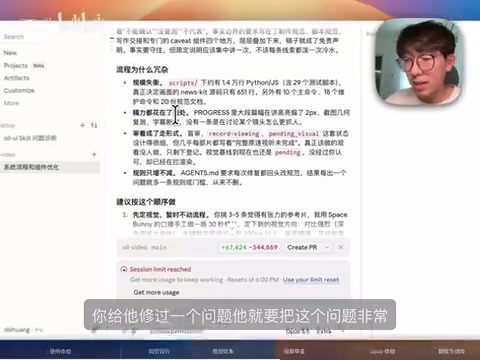
I'd tried repeatedly to improve this framework with GPT-6 Astra — cleaning up the specs, automating what could be automated — but never managed to get it right. One review session with Opus 5.5 surfaced the issue immediately: the entire pipeline was 14,000 lines of Python and JS, but only 651 lines actually determined what appeared on screen. The rest was essentially useless test code.
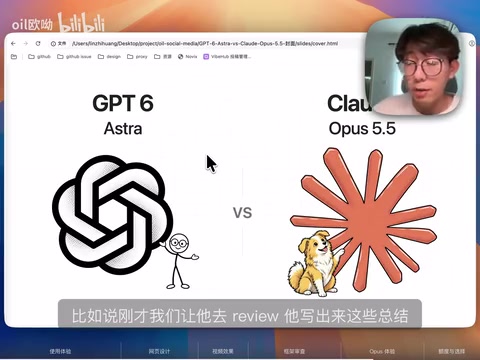
Opus also called out a pile of bad habits GPT had accumulated: the Progress documents were filled with discussion of highlight colors, 2px adjustments, screenshot geometry rechecks, and subtitle line breaks — not a single note about "how to make a particular shot compelling." GPT has a tendency to zero in on minutiae — fix a one-pixel issue once, and it writes that specific detail up as a formal rule. These rules pile up endlessly. Its review specs become incredibly granular, but nearly every film entry is flagged as "complete visual-audio elements not finished" — meaning after all that spec-writing, none of it was actually followed. It's just a log, with zero value for iteration.
By comparison, when given the same prompt, Codex's review produced five points I couldn't parse a single one of — "New projects cannot directly traverse the claimed main path," "Arbitrary models have not yet implemented writing model, model name can be changed"… I built this framework myself and still couldn't figure out what it was trying to say. Opus's feedback, by contrast, was immediately legible to anyone — the summary was sharp and actionable. That difference alone determines whether a project can be iterated on effectively.
"Skill" here refers to structured prompt documents or specification templates that the author pre-writes — essentially an "operations manual" for the model — defining output format, design style, workflow steps, and other constraints to maintain consistency across repetitive tasks (like generating slides, adding subtitles, or distributing videos). "Skill recall capability" refers to the model's ability to accurately read and follow the Skill's specifications during execution, rather than rewriting or ignoring its constraints. The criticism of GPT-6 Luna's "poor Skill recall" is fundamentally about instruction-following stability: the model understands the spec but doesn't execute it, or executes a misinterpretation of it — forcing constant user correction and eliminating the automation efficiency that Skills are meant to provide.
Opus 5.5: World-Class Coding Ability and Natural Conversational Flow, Together
Claude Opus 5.5 represents the biggest single leap since Opus went from 4.5 to 4.6.
Looking back: after 4.6 came 4.7, which lost the natural, easy conversational feel that made the earlier version great — it became more AI-flavored, a bit self-important, and task performance declined too. Versions 4.7, 4.8, and 5.0 were all underwhelming. It wasn't until Fable 5 that Claude got a genuinely top-tier model back — excellent execution and aesthetics — but the conversational quality and copy readability still didn't quite match Opus 4.6.
Opus 5.5, in my view, brings back that effortless, point-and-shoot conversational quality while also pushing coding capability to a genuinely high level. Ask it to write a Skill and it accurately understands the requirements, does the research, and precisely translates the intended workflow into a document.
What surprised me even more was its animation and video implementation capability. I'd seen posts about Opus 5.5 generating impressive animations in code and was skeptical — it seemed hard to believe those smooth transitions and highlight-zoom effects could be written in pure code. My own tests confirmed it. On a $20/month subscription, Opus 5.5 completely refactored my entire framework within a 5-hour usage window and rendered the video — producing better results than the framework I'd painfully built with GPT-6 Ultra over a much longer period.
Pricing and Quotas: Cheaper, Faster, and More Capable
Opus 5.5 is priced 40% lower than Opus 5. This means the same prompt can achieve comparable results with fewer tokens, making your overall quota go further.
On context, Claude has genuine 1M-token context that doesn't silently compress after a few exchanges the way GPT does. On speed, even without Fast mode enabled (likely because of my subscription tier), it's noticeably faster than GPT without Fast mode, and the quota holds up much longer. With GPT-6 Ultra, by contrast, credits drain at a frightening rate — a full day's budget often isn't enough.
Closing Thoughts and One Wish
All things considered, Claude Opus 5.5 is the best model available right now. The only downside is a relatively high barrier to entry. As for the GPT-6 lineup — Astra is overpriced, and Soul and Luna underperform — it's hard to recommend any of them at the moment.
One thing I'm still hoping for: a domestic Chinese model that takes cues from Claude's sensibility — strong conversational flow, good aesthetics — even if it only reaches 80% of Opus 5.5's capability. I'd pay the same subscription price for it. For creators, a model that genuinely gets out of your way and doesn't need constant correction is worth far more than a few percentage points on a benchmark leaderboard.
Related articles

Amphibious Transforming Drone: Beyond 100x Power Savings, What Are the Real Needs?
Is the amphibious transforming drone just a gimmick? Starting from the 100x power difference of the M4 Morphobot, explore real application scenarios and thesis topic ideas, analyzing boundary conditions where pure drones and pure ground robots both fail.

Warhound Raises $200 Million: Genetically Engineered "War Dogs" Paired with Anduril Gear
Warhound raises $200M, backed by Ben Lamm and Palmer Luckey, to genetically engineer dogs for military and law enforcement use and equip them with Anduril gear. This article analyzes its technology direction, funding logic, and ethical controversy.

Claude API Comes to Google Cloud: IAM Integration and SDK Access Guide
Anthropic hosts the full Claude API on Google Cloud with IAM-controlled permissions and unified billing. This guide covers the Vertex AI and Anthropic-hosted entry points, IAM role configuration, and SDK access.