GPT-6 In-Depth Review: 6 Real-World Test Cases — How Close Are We to AGI?
GPT-6 impresses with tool use and 3D reasoning, stumbles on Computer Use, and remains short of AGI.
Bilibili creator "AI小王子" spent roughly 20 billion tokens testing GPT-6 across six real-world tasks. The model's most notable shift is moving from generating content to actively using tools — calling Blender autonomously, sourcing assets from GitHub, and anticipating user needs. 3D spatial reconstruction from a single image was standout impressive. Computer Use was the biggest disappointment, with ~21 seconds per keypress making continuous tasks impossible. Priced at 2.5x GPT-5.6 and powered by a new "Recurrent Depth" architecture, GPT-6 is genuinely capable — but the reviewer's final verdict is clear: impressive, not AGI.
OpenAI officially launched GPT-6, which the company describes as "the world's most intelligent and most aligned" model. Bilibili creator "AI小王子" spent three nights and roughly 20 billion tokens out of pocket to run a comprehensive evaluation across six dimensions: video production, game development, 3D modeling, frontend design, automated video editing, and computer operation. Beyond the benchmark numbers, what genuinely caught attention was the model's emerging ability to "generalize from examples" and "take initiative." This article summarizes the key findings from that review — along with an honest assessment of how far GPT-6 really is from the Jarvis we've been imagining.
The Numbers: Near-Perfect Scores, With Caveats
Let's start with the official benchmarks. On the ARC-AGI-3 test, the previous-generation GPT-5.6 scored 7.8%, while GPT-6 jumped to 99.9%. On the challenging Frontier Math benchmark, GPT-5.6 scored 83%, Claude Code 5.1 scored 87.8%, and GPT-6 reached 97.6% — nearly perfect.
These improvements are genuinely striking, but they deserve a measured response — all figures were reported by OpenAI itself, without independent third-party verification, so treat them as a reference point. The reviewer also noted a practical heads-up: users coming from Codex should audit their existing Skills or Agents for rule conflicts before switching, since instructions written for weaker models can actually constrain what GPT-6 can do. This detail hints at a broader trend: as models grow more capable, the elaborate guardrails written for their predecessors can become shackles.
What is ARC-AGI? ARC-AGI (Abstraction and Reasoning Corpus for Artificial General Intelligence) is a benchmark designed by AI researcher François Chollet to measure a model's ability to generalize — not memorize. Each problem presents a novel visual pattern the model has never seen, requiring it to infer a transformation rule from just a handful of examples and apply it to new cases. Because you can't "cram" for ARC-AGI, it has long been considered a meaningful proxy for how close AI is to general intelligence. ARC-AGI-3 is the latest and hardest version, released in 2025, featuring more complex multi-step reasoning scenarios. GPT-6's leap from 7.8% to 99.9% is so dramatic because the research community widely believed ARC-AGI posed a fundamental challenge to current deep learning paradigms. If independently replicated, this result would be a landmark. If it can't be replicated, it raises serious questions about the evaluation methodology itself.
Video & Games: AI Starts "Using Tools" Instead of Just Generating
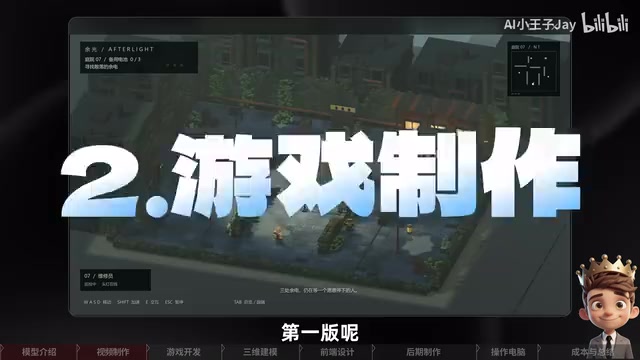
The most visible shift in GPT-6 is the move from "generating content" to "operating software." On the traditionally painful problem of AI video production — inconsistent scenes, characters drifting off their marks — GPT-6's approach was to call Blender directly, generate scene layouts and white-model (blockout) videos, then use those blockouts to precisely control camera movement and character positioning.
One practical tip from the testing is worth noting: when generating blockout videos, instruct the model to keep only the head and torso — no limbs — because limbs in the blockout severely constrain the range of motion in the final output. The failed attempt with limbs was described as looking decidedly "bizarre."
Two versions of game development were tested. One combined Blender modeling with the Godot engine; the lighting was praised as being "like a professional gaffer" — dark alleyways, warm glowing windows, and layered reflections on wet pavement all landed convincingly. The second used Three.js to produce a 3D street scene that runs directly in the browser. The reviewer was candid, though: current modeling works best for geometry-based objects or low-poly aesthetics; fine details like character facial features, hairstyles, and clothing still fall short. The cost is also real — game and modeling tasks are Token-heavy, with each case consuming roughly 30% of a 5X Pro weekly quota.
3D Modeling: Spatial Reconstruction from a Single Reference Image
The most impressive result of the entire review came from 3D spatial understanding and rendering. The test was deliberately designed to be tricky: only a single-angle reference photo was provided — no three-view drawings, no floor plans — and the model was left to infer the back, sides, and occluded portions on its own.
Given just one image of a circular building and the instruction "reconstruct this as a viewable 3D scene, accessible in a browser," the model produced a ring-shaped structure with glass curtain walls, a surrounding lake, and snow-capped mountains — all within about 14 minutes. The result supported rotation, zoom, and even the ability to remove the roof and inspect the interior. None of those interactive features were requested in the prompt. The model added them proactively — and this capacity to "anticipate what the user will want next" was one of the most frequently highlighted strengths throughout the review.
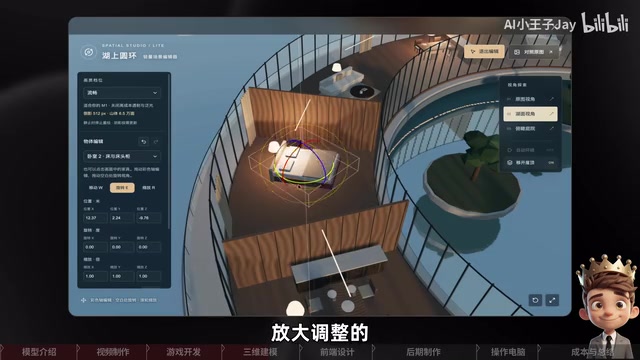
That said, the reviewer remained clear-eyed: the initial model had gaps in detail, material quality, and texture compared to a professional reconstruction. Hidden structures were the model's educated guesses. Getting accurate dimensions and spatial layouts still requires multi-angle references and precise measurements. "Doing this well under deliberately adversarial conditions is impressive — but it shouldn't be treated as a final deliverable in a professional workflow."
Frontend & Editing: Better Taste, and It Goes Online for Assets
Frontend UI design has long been a weak point for GPT-5.6. The supercar showcase website tested this time showed clear improvement: dark backgrounds, metallic body textures, and the sheen on hover cards all carried a noticeably more polished, futuristic feel.
More interesting was a medical project — an interactive 3D human anatomy viewer. The reviewer originally just wanted to see how the model handled anatomical knowledge. Instead, it went to GitHub on its own, found relevant 3D models, and integrated them into the project — delivering a fully interactive result where users could drag, rotate, and peel back layers to reveal labeled anatomical components. This "self-sourcing" behavior was described as the model becoming "a lot more resourceful."

The automated editing test illustrated the same trait: given a 38-second voiceover audio clip and a single instruction — "find your own assets and produce a YouTube-style talking-head video" — the model used Remotion to deliver a finished cut in about 16 minutes, consuming roughly 1% of a 5X Pro weekly quota. The pacing was smooth and the assets were broadly relevant, though precision was lacking: when the narration mentioned "AI comics," the model cut to footage of someone drawing on a tablet — close, but semantically off. Working with After Effects, on the other hand, allowed direct delivery of project files that AE-familiar users could pick up and refine — though some powerful third-party effect plugins failed to load correctly.
Computer Use: Biggest Claims, Biggest Stumble
OpenAI made Computer Use the centerpiece of its GPT-6 marketing, calling it "the world's most capable computer operation model." The 3D modeling and After Effects workflows described earlier both depend on this underlying capability. But the reviewer designed a pointed stress test for all the bold claims: open an online piano and play a song.
The result: complete failure. Each keypress took approximately 21 seconds to execute. There was no way to play a melody — the notes simply couldn't connect.
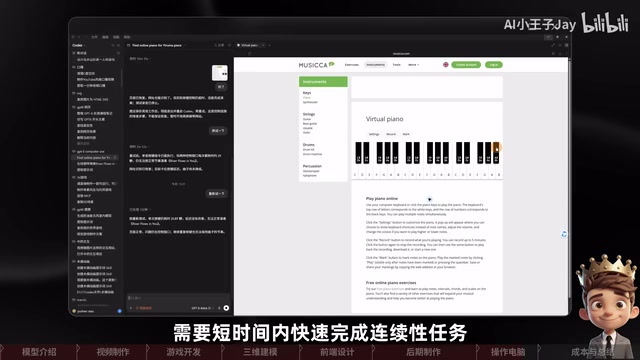
The verdict was pragmatic: Computer Use works, but it's slow. For long-horizon tasks where speed doesn't matter — transcribing sheet music, playing a game of chess move-by-move — it's genuinely useful. For anything requiring rapid, continuous input, it still can't deliver. "Impressive as it is, the room for improvement here is enormous."
What is Computer Use? Computer Use refers to an AI model's ability to operate a real computer interface by perceiving the screen via screenshots and issuing mouse clicks and keyboard input commands — essentially closing the loop between visual understanding and action execution into a single agent. Anthropic's Claude pioneered a feature by the same name in 2024, drawing widespread attention, and OpenAI subsequently integrated similar capabilities into the GPT lineup. The fundamental bottleneck is latency stacking across the perception-decision-execution pipeline: each step requires uploading a screenshot, running model inference, and dispatching a command, with each individual action taking anywhere from several seconds to tens of seconds. This is why a task like playing piano — which requires millisecond-level continuous keypresses — fails completely. Computer Use as currently designed assumes slow-paced, multi-step office tasks, not real-time interactive scenarios.
Pricing and "Recurrent Depth": More Expensive, But Not Just Bigger
Prices have gone up. At standard API rates, GPT-5.6 was $4 per million input tokens and $20 per million output tokens; GPT-6 Extra runs $10 and $50 respectively — roughly 2.5x the cost. A Plus subscription is barely sufficient; users with heavy needs typically need a 5X membership tier.
But the price increase isn't purely about stuffing in more parameters. The reviewer highlighted a new architectural mechanism in GPT-6 called "Recurrent Depth": rather than raw parameter count determining "brain capacity," data is fed into a recurrent core that iterates repeatedly, deepening its reasoning through multiple passes in latent space. For complex tasks, this reportedly delivers double the effective output while actually increasing generation speed — and means fewer unnecessary tokens get consumed.
What is Recurrent Depth? Recurrent Depth represents an architectural approach distinct from the traditional Transformer scaling path. The conventional approach stacks more layers and larger parameter matrices to boost model capacity, at the cost of linearly increasing inference computation. Recurrent Depth's core idea is to let the same set of parameters perform multiple iterative passes over intermediate representations (latent states) during inference — analogous to a human "turning something over in their mind" rather than arriving at an answer in one forward pass. This mechanism allows the model to dynamically allocate more computation to complex problems while converging quickly on simple ones, achieving a better balance between efficiency and capability. This is conceptually aligned with research like DeepMind's Adaptive Computation Time, and represents one concrete implementation of the recent "test-time compute" research direction.
How Far From AGI?
The reviewer's final verdict was notably restrained: GPT-6 Extra is genuinely powerful, but AGI remains a distance away — and there's still a lot of headroom to grow. The real lesson isn't in the benchmarks; it's a shift in how to interact with the model.
In the past, getting good results meant writing extremely long, extremely detailed prompts that prescribed every step. But with a smarter model, those old instructions can become constraints. The more effective approach is: state the goal clearly, define the acceptance criteria, specify what must not change — then leave room for the model to choose its own methods. Especially in areas where the user lacks expertise, over-specifying can backfire. It's often better to let the model draw on its vast training data and figure things out itself.
From the days when generating a Christmas tree in code could draw gasps of wonder, to today's claims of taking over an entire computer, the pace of AI progress has become rapid enough that we're almost growing numb to it. GPT-6 may not be Jarvis yet — but one foot does seem to have crossed the threshold.
Related articles

"Black October": Did AI Uncover 3% of All Critical Vulnerabilities Ever?
A Reddit post claims 3% of all critical software vulnerabilities ever were found in the past month, dubbed 'Black October.' We break down the statistical issues, how AI-assisted code auditing accelerates discovery, and how developers should respond.

Microsoft Project Gecko: Using AI to Bridge Language Gaps for African Farmers
Microsoft's Project Gecko launches PharmaChat, letting African farmers ask questions in their native language and get precise video clips and farming book chapters via AI. The project also releases three interactive manuals to advance inclusive AI.

Musk's Space Dominance: How Starlink Throttling Undermines Ukraine's Defense
SpaceX's Starshield throttling disabled Ukraine's high-speed interceptor drones, exposing how Musk's private control over low Earth orbit communications affects battlefield dynamics and national security, and highlighting the risks of commercial space militarization and space governance dilemmas.