GPT-6 Luna Real-World Test: The Best Bang-for-Buck Workhorse Model

GPT-6 Luna delivers most tasks at a fraction of the cost — just use it as an executor, not an orchestrator.
OpenAI's new GPT-6 Soul and GPT-6 Luna offer limited performance gains but a striking pricing shift: the three-tier lineup (Astra/Soul/Luna) now sits at a 1:20:100 price ratio, with Luna 50% cheaper on input and 58% on output versus its predecessor. Real-world testing across 500M tokens consumed only 3% quota, confirming Luna handles presentations, video editing, automation, and development tasks capably. Its key weakness is precise Skill recall in long-context sessions, though browser automation and Computer Use work surprisingly well. The critical insight: use Luna as an executor receiving clear instructions, delegate multi-Agent orchestration to Claude, and configure context windows at the project level to maximize value without burning high-tier model quotas.
GPT-6 Dual Model Launch — The Real Surprise Is in the Pricing
OpenAI has added two new models to the GPT family — GPT-6 Soul and GPT-6 Luna. Based on real-world performance, the top-tier GPT-6 Astra doesn't represent a huge leap over GPT-5.6 Soul, especially in scenarios that don't involve computer automation or modeling. What's truly striking is the pricing strategy behind these two new models.
GPT-6 Luna is 50% cheaper on input and 58% cheaper on output compared to the previous generation GPT-5.6 Luna. GPT-6 Soul is also half the price of GPT-5.6 Soul. After this round of adjustments, the price ratio across the three GPT-6 tiers (Astra / Soul / Luna) has stretched to 1 : 20 : 100.
What does that ratio mean in practice? A simple conversion: if heavy usage of GPT-6 Astra lasts you one day, switching to GPT-6 Luna means the same quota stretches to roughly 100 days. For users on usage-based billing, that's essentially an order-of-magnitude difference.
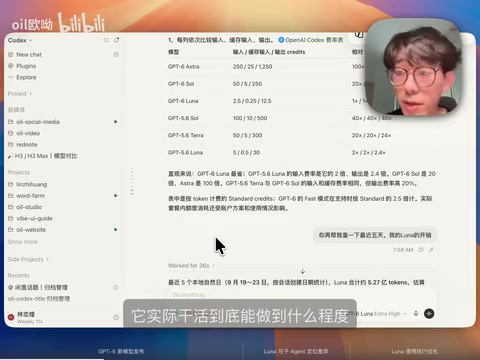
500M Token Test: Luna Can Handle Almost Everything
The author himself was pushed to his limits by runaway quota consumption. After heavy use of GPT-6 Astra over the past few days — burning through two or three reset cards — he was down to just 4% quota remaining three or four days ago. To keep using Codex (referred to in the video as CloudX/Corel X), he shifted all tasks to the more cost-efficient Luna-tier model, using it as an opportunity to stress-test just how capable Luna really is.
The results were genuinely surprising. Across combined usage of GPT-5.6 Luna and GPT-6 Luna, roughly 500 million tokens were consumed over three to four days — and the quota dropped by only 3%. More importantly, the quality of output was there: Luna handled nearly everything he had previously done with GPT-5.6 Soul:
- Creating presentations
- Video editing with subtitles
- Designing thumbnails
- Automating publishing workflows
- Modifying a series of complex Skills
- Simple project development
- Researching new technologies
He admits that in many cases, he genuinely couldn't tell he was using a "lower-tier" model. For example, when preparing a model overview a few days ago, he had Luna handle the research — the whole workflow ran smoothly without any noticeable breakdowns.
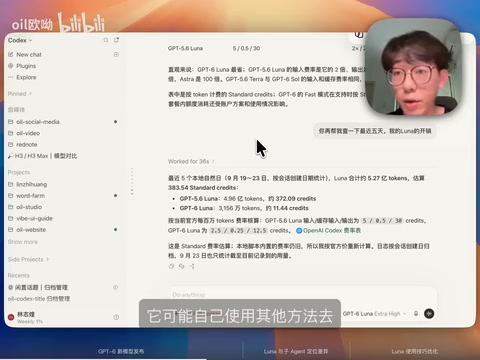
Where Luna Falls Short: Skill Calls in Long-Context Sessions
The one scenario that reveals Luna's limitations is when the task context grows very long and needs to trigger a specific Skill. In these cases, Luna's instruction-following and context-recall abilities are noticeably weaker than Soul or Astra.
For instance, a loosely phrased command will usually lead GPT-6 Astra or GPT-5.6 Soul to call the right Skill precisely. Luna, when the context gets too long, may fail to retrieve Skill parameters set earlier and instead improvise a workaround to complete the task (like coming up with an alternative approach to making a thumbnail). This is an inherent capability ceiling for a lighter-weight model.
That said, Luna actually performs impressively in browser automation and Computer Use tasks — at an extremely low cost. This challenges the assumption that budget models can't handle complex interactive tasks.
What is a Skill? In this context, Skills refer to pre-defined functional modules or tool-calling interfaces within AI workflow platforms like Codex — similar to functions or plugins. When a user issues a command, the model must identify and invoke the most appropriate Skill from a registered list, which requires accurate semantic understanding and context retrieval. As conversation turns accumulate and context length grows, lighter-weight models often struggle to pinpoint the correct Skill parameters buried in a long history, and fall back on a "figure it out myself" degradation strategy. The task gets done — but not necessarily via the intended path, which can make the workflow unpredictable or produce outputs in unexpected formats. This is the classic capability boundary for lightweight models in complex automated workflows, not a general failure of task ability.
A Key Insight: Luna Works Best as an Executor, Not an Orchestrator
The author previously had a poor impression of GPT-5.6 Luna. After reflection, he arrived at a valuable conclusion: the problem wasn't the model — it was how it was being used.
Previously, he had deployed Luna as a sub-Agent inside Codex. Meanwhile, models like GPT-6 Astra and GPT-5.6 Soul, while strong at coding and long-horizon execution, share a common weakness — poor task delegation, weak conversational clarity, and a tendency to get tunnel vision. When these models are used to dispatch subtasks, they struggle to decompose business logic at a high level and, without human intervention, end up assigning a mess of incoherent subtasks. In that setup, it doesn't matter whether the sub-Agent is Luna or Astra — the results are mediocre either way.
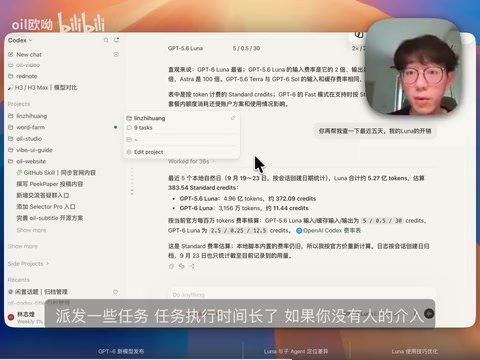
Flip the approach: when a human steps in and directly gives clear, specific instructions to the model as the primary conversational interface, even Luna performs reliably as an executor.
The conclusion is clear:
- GPT models are better suited as "hands-on executors"
- For multi-Agent orchestration, task decomposition, and pipeline coordination, the author's experience is that Claude handles this better than GPT
This is a highly practical division-of-labor framework for anyone building multi-Agent workflows.
Orchestrator vs. Executor in Multi-Agent Architecture — This distinction is one of the central challenges in modern AI engineering. An Orchestrator understands user intent, decomposes tasks, delegates subtasks, and integrates results — requiring strong instruction comprehension, macro-level planning, and context coherence. An Executor (Sub-Agent) only needs to complete a well-scoped, singular task within clear boundaries, demanding less planning ability but stable instruction-following. Claude models, trained with a stronger emphasis on conversational quality and task decomposition clarity, tend to be more stable as orchestrators. GPT models excel at coding and execution but tend to tunnel-vision or lose task boundaries when planning autonomously. This maps closely to the industry-standard "Router + Worker" multi-Agent design pattern — a highly practical architectural reference for developers building automated workflows.
Practical Configuration Tip: Increase the Context Window
Because GPT-6 Luna costs so little, the author was running Extra High thinking intensity for days — occasionally even Fast mode. With GPT-6 Luna's cost being even lower than GPT-5.6 Luna, running Fast mode continuously is entirely feasible, and the actual working experience sometimes rivals using far more expensive models.
One final tip worth bookmarking: raise your context window. Codex's default context window is on the small side. You can add a local config file at the project level that sets the default model to GPT-6 Luna and bumps the Model Context Window up to 800K.
The reason to configure this at the project level rather than globally is to avoid unintended side effects: if you set a very high context window globally, switching to GPT-6 Soul or Astra even once could drain your entire quota in a single day.
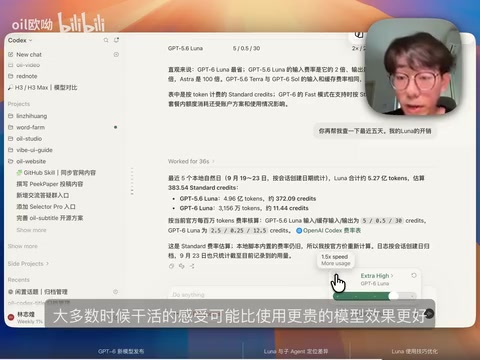
What is a Context Window? The context window refers to the total number of tokens a model can process simultaneously in a single conversation or task session. It directly affects performance on long documents, multi-turn conversation memory, and complex coding projects. When the window is too small, the model "forgets" earlier inputs, leading to failed Skill calls or logic gaps. With a large enough window, the model can maintain full awareness of the task context, reducing repeated clarifications and compounding errors. Setting GPT-6 Luna's context window to 800K tokens means even large codebases or multi-step tasks can be handled within a single run with full context intact. Note that a larger context window consumes more tokens — for high-cost models like Astra, this impact on quota is especially significant, which is exactly why the recommendation is to apply this setting at the project level only, not globally.
Who Should Use GPT-6 Luna
For users on the $200/month subscription tier, GPT-6 Luna is essentially unlimited at current pricing. The author believes the biggest beneficiaries are GPT Plus users — the model's extremely low per-unit cost means it stretches very far.
After days of heavy real-world use, the author's final verdict is this: GPT-6 Luna is more than capable of handling the vast majority of everyday tasks. If your workflow revolves around "execution under clear instructions" rather than autonomous multi-Agent orchestration, replacing high-cost models with Luna is arguably the most cost-efficient choice available right now.
Related articles

Receipt Forgery Detection Near Random? Real-World Struggles and Solutions in Document Image Forensics
A receipt forgery detection project with ROC-AUC near random reveals the pitfalls of small-sample document forensics. Explores anomaly detection, self-supervised pre-training, and numerical consistency as viable alternatives.

From Workflows to Eval-Driven Development: A Paradigm Shift in How We Solve Problems with AI
AI problem-solving is shifting from deterministic workflows to "define evals + hillclimb." This piece explores how eval-driven development reshapes tasks, data vendors, human roles, and Agent UX.

Tesla Powerwall + Electric Vehicle: A Dual Backup Power Solution for Outages
Tesla Powerwall combined with EV bidirectional charging can provide multi-layer home backup power during outages. We break down runtime, V2H realities, and Supercharger loop feasibility.