GPT-6 Sol and Luna: What We Know About the Rumored New Models

A tweet claims GPT-6 includes two models called Sol and Luna — but it remains unverified social media speculation.
A recent tweet suggests OpenAI's next-generation GPT-6 may feature two models or characters named Sol (sun) and Luna (moon), describing them as "cute" with a personified design. The naming implies a complementary product pairing — perhaps one optimized for speed and everyday tasks, the other for deep reasoning — alongside a brand identity angle. However, the tweet is an unofficial social media post with no technical specs or official confirmation. AI model rumors are common and often mix real leaks with speculation; readers should treat this as an unverified signal and wait for official announcements.
A Tweet That Sparked Attention
Recently, a discussion about OpenAI's next-generation model GPT-6 has been circulating on social media. One particular Twitter post mentioned two models (or characters) named Sol and Luna. The original text was brief: "GPT-6 Sol and Luna are great models but also these characters are so cute."
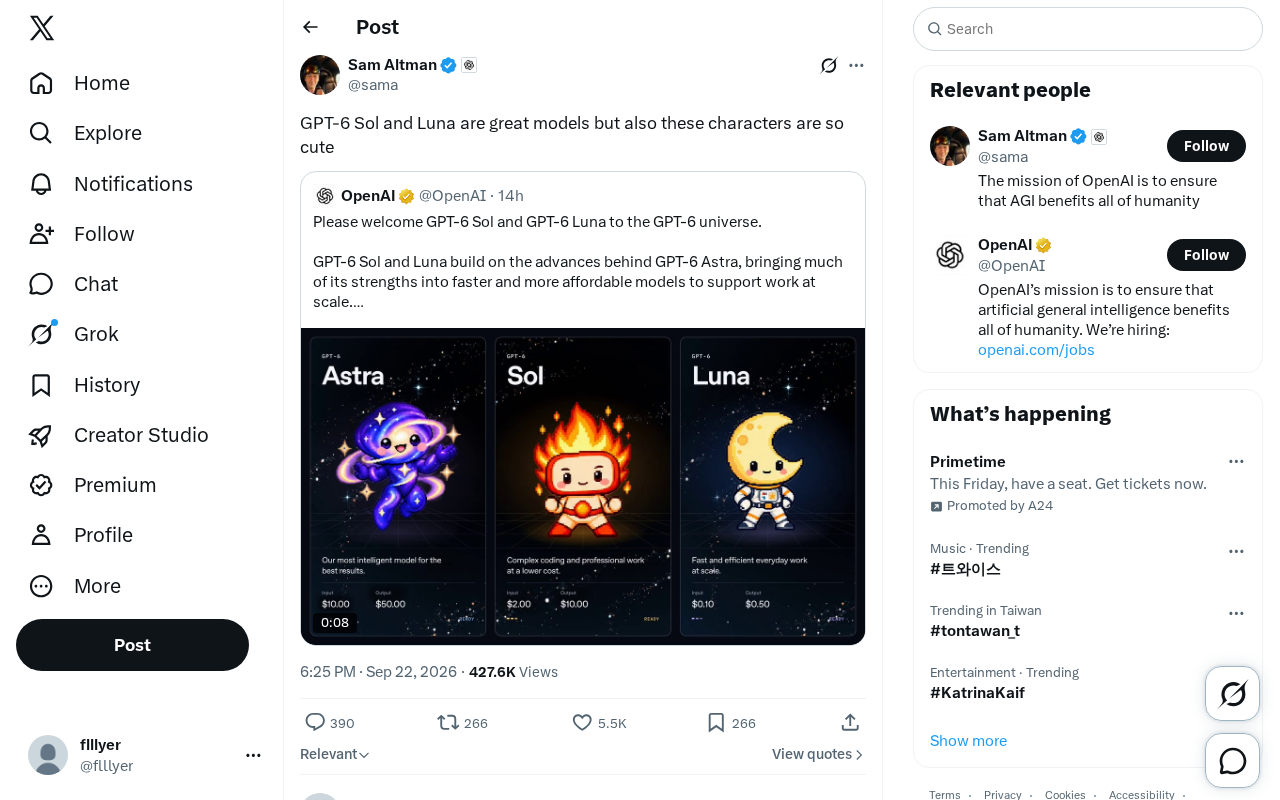
This tweet carries two noteworthy signals: first, Sol and Luna are referred to as "models," suggesting they may be distinct variants with different capability tiers or use cases; second, the author describes them as "characters" and "cute," implying these names may also carry a personified brand identity.
What Sol and Luna Might Mean
From a naming perspective, Sol (sun) and Luna (moon) form a symmetrical, complementary pair. In product design, paired naming like this typically implies the two complement each other — for example, one optimized for speed and everyday tasks, the other for deep reasoning or specialized scenarios. That said, it must be emphasized that these interpretations remain purely speculative. The original source provides no technical specifications, performance data, or official confirmation.
Personified naming is nothing new. Giving models names and personalities helps lower the barrier for everyday users and makes it easier to build emotional connections in marketing. If Sol and Luna do come with distinct visual character designs, it may reflect a broader trend in AI products toward more humanized interaction experiences and brand personalities.
There are plenty of precedents for this approach. Anthropic's Claude series drew inspiration from writer Claude Shannon; Google's Gemini references the Gemini constellation, hinting at multimodal and dual-capability positioning. OpenAI itself previously used scientist names like "davinci," "curie," and "babbage" to differentiate model tiers. A paired naming strategy is more reminiscent of Apple's early "mini/Pro" or "standard/Max" iPhone lines — using the name itself to convey product hierarchy, so users can form an intuitive sense of differentiation without needing to understand the technical details. If Sol and Luna are indeed positioned as one heavier and one lighter model, this kind of naming would make the product line distinction far more perceptible to consumers.
Stay Rational: No Official Information Yet
It must be clearly stated that this tweet represents an unofficial social media discussion with no primary-source evidence to back it up. Rumors about unreleased models are extremely common in the AI community — some are based on genuine leaks, while others are speculation or hype. Until there is an official release announcement, technical documentation, or reporting from credible media, all descriptions of GPT-6, Sol, and Luna should be treated as unverified.
For readers following the cutting edge, the recommended approach is to treat posts like this as "signals to be verified" rather than established facts. What's truly worth waiting for are official announcements and reproducible performance benchmarks.
Model rumors in the AI space operate within a unique information ecosystem. Because training large models takes months or even years, researchers, beta testers, and partners often encounter early versions well before public release, creating a common pattern of "unofficial information leaking ahead of launch." Historically, GPT-4's multimodal capabilities and Claude 3's performance numbers both surfaced on social media before official announcements. However, an equal number of "leaks" have turned out to be misreadings or fabrications — for instance, "GPT-5 is launching soon" was repeated many times, yet the actual timeline diverged significantly from those rumors. Key indicators for assessing credibility include: whether the source has a technical background, whether the content includes verifiable details (such as model parameter sizes or benchmark screenshots), and whether multiple independent sources corroborate the information.
Summary
This brief tweet offers limited information, but it points to a few trends worth watching: upcoming models may adopt paired, personified naming strategies and lean into character-driven brand identities. Until there's official confirmation, we can't determine anything about specific capabilities or release timelines. What is certain is that the AI community's anticipation for the next generation of models continues to grow.
Related articles

After GPT-6 Ignites Generative UI, the Next Gap Is Generative Workflow
After GPT-6's Intelligent UI brings Generative UI mainstream, the execution layer beneath the interface matters just as much. This article unpacks Generative Workflow and how FlowX makes agent skills runnable, editable, and evolvable.

I Gave Four AI Coding Agents a $100 Budget Each: Who Could Build a PDF Editor?
A developer gave four AI coding agents a $100 budget each to build a PDF editor. This analysis examines what the experiment reveals about real-world AI coding tool capabilities.

Anthropic's New Policy: Abusing Claude Could Get You Banned
Anthropic reportedly plans a November 2026 policy banning users who "abuse" Claude. We analyze the motivations behind it — from abuse prevention to AI welfare — and what it means for users.