GPT-6 Sol Lands on Perplexity and Computer Platforms

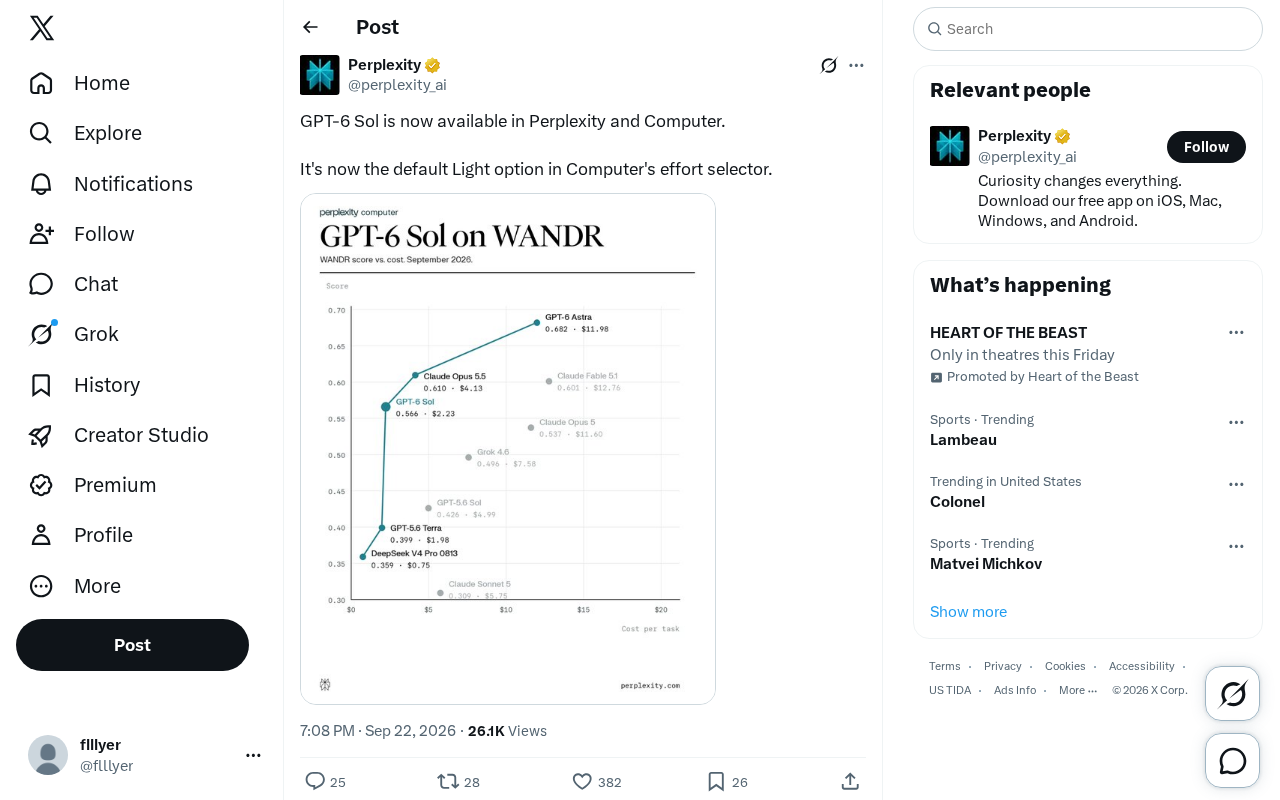
GPT-6 Sol is now live on Perplexity and Computer, set as the default Light tier on the latter.
OpenAI's latest GPT-6 Sol model has been integrated into two major AI platforms: Perplexity and Computer. Notably, Computer has set GPT-6 Sol as the default "Light" option in its effort selector, meaning users get access without any extra configuration. This positioning reflects confidence in the model's speed-cost balance and fits the tiered inference architecture now common across AI products. However, details remain limited to a single social media post, and official technical specs and benchmarks have yet to be released — developers should wait for first-party announcements before making definitive assessments.
GPT-6 Sol Now Available on Two Major Platforms
According to a post on Twitter, OpenAI's latest GPT-6 Sol model is now available on both Perplexity and Computer. This signals the model's rapid integration into mainstream AI application ecosystems.
One notable detail: on the Computer platform, GPT-6 Sol has been set as the default option for the "Light" tier in its effort selector. This means everyday users can leverage the model for routine tasks right out of the box, with no additional configuration required.
What Does the "Light" Default Mean?
In AI product design, an effort selector typically lets users trade off between response speed and reasoning depth. Setting GPT-6 Sol as the default Light option suggests it's positioned for lightweight, fast-response scenarios — prioritizing speed and efficiency over deep, complex reasoning.
This tiered design has become a common pattern in modern AI products: the light tier handles high-frequency, low-latency everyday queries, while the heavy tier is reserved for complex tasks requiring long reasoning chains. Placing GPT-6 Sol in the default Light slot signals strong confidence from the platform in its balance of response efficiency and cost.
Similar tiering mechanisms are already widespread across leading AI products. Anthropic's Claude offers Haiku, Sonnet, and Opus tiers; Google Gemini has Flash and Pro variants; and OpenAI itself has long used GPT-4o mini for lightweight use cases. The underlying logic is straightforward: more capable models require more compute, resulting in higher per-call costs and longer latency. Yet the vast majority of everyday queries — simple Q&A, summarization, translation — don't require the heaviest reasoning chains, making lightweight models faster and more cost-effective for those tasks. Being designated the default Light option means a model has struck an acceptable balance among reasoning quality, speed, and cost — not that it was "downgraded" due to insufficient capability.
What This Means for Users and the Ecosystem
For Perplexity users, the addition of GPT-6 Sol could translate to faster, more natural outputs in search and Q&A experiences. Perplexity has always positioned itself as an "answer engine," making model upgrades directly impactful to its core user experience.
For the Computer platform, setting a brand-new model as the default tier is a bold product decision — default options shape the experience for the vast majority of users. It also reflects a broader industry trend of platforms racing to integrate the latest frontier models, closing the gap between users and cutting-edge AI capabilities.
Perplexity's business model differs from traditional search engines: it relies on large language models to generate structured answers in real time, rather than simply returning a list of links. As a result, the underlying model's inference speed and accuracy directly affect its competitive edge. Perplexity has previously integrated GPT-4o, the Claude 3 series, and its own pplx models, making multi-model coexistence the norm. Bringing in GPT-6 Sol continues its strategy of offering users access to frontier model choices, and reflects the increasingly close commercial relationships between AI application platforms and model providers.
Limited Information — Still Worth Watching
It's worth noting that the publicly available information currently comes from a single brief social media post. Official details on GPT-6 Sol's technical specifications, performance benchmarks, pricing, and how it compares to other model tiers have yet to be formally disclosed.
Developers and users looking to assess the model's real-world capabilities are advised to wait for official documentation or first-party announcements before drawing conclusions based on empirical data. For now, this news is best read as an availability signal: frontier models are being integrated into mainstream applications at an ever-accelerating pace.
Related articles

Random Pruning of the DPO Computation Graph: 1.4x Training Speedup and Lower Peak Memory
DPO training too slow and memory-hungry? This paper proposes a random pruning framework for the DPO computation graph, sampling independently across position, sequence, and branch dimensions; branch pruning achieves a 1.426x step-time speedup and cuts training time by about 30%, with in-depth attribution of memory and time gains.

Why Does JEPA Underperform MLM in Longitudinal EHR Representation Learning?
New study compares JEPA and MLM for longitudinal EHR representation learning on MIMIC-IV: three JEPA variants train stably without collapse but underperform MLM; target size, not heterogeneity, drives prediction error.

Transfer Learning + Visible Light Communication: A New Approach to Energy-Efficient Indoor Positioning
A study proposes a transfer learning-based visible light communication indoor positioning method, achieving 47% accuracy improvement on the BOSCH factory dataset, 67.5% model efficiency under high noise, and introducing the ME composite metric for energy-efficient positioning in energy-constrained industrial IoT scenarios.