GPT-Live Full-Stack Rebuild: How AI Achieves Full-Duplex Conversation by Listening While Speaking

GPT-Live's full-stack rebuild enables AI to listen and speak simultaneously, achieving full-duplex conversation.
OpenAI's GPT-Live architectural upgrade rebuilds the entire voice stack from client to model, enabling AI to listen while speaking—achieving full-duplex dialogue. By decoupling thinking from speaking and keeping audio flowing continuously, deep reasoning and tool calls no longer interrupt conversations. This sets a new industry benchmark for natural voice interaction at scale.
GPT-Live Teaches AI to "Listen While Speaking"
OpenAI recently announced a major architectural upgrade to GPT-Live, with the core breakthrough being: AI can now listen while it speaks. This capability may seem simple, but it has a decisive impact on the naturalness of voice interaction.
In traditional voice assistant interactions, users and AI engage in turn-based dialogue—the user finishes speaking, then the AI begins processing and responding; when the AI is talking, user interruptions typically can't be captured in time. The technical root of this turn-based interaction model lies in Voice Activity Detection (VAD): the system detects whether the user has stopped speaking to determine "turn completion," then triggers the subsequent Automatic Speech Recognition (ASR), Natural Language Understanding (NLU), and Text-to-Speech (TTS) pipeline. This serial processing pipeline naturally segments conversations into discrete turns, with unavoidable processing latency between each turn. Early voice assistants like Siri and Alexa were all built on this paradigm, and users described the conversation experience as "walkie-talkie communication."
This model has a clear gap from how humans actually converse. Real human communication is continuous, interruptible, and overlapping: we nod in response while others are speaking, interject to add information mid-sentence, and adjust our expression at any time.
This GPT-Live upgrade aims precisely to bridge this experience gap. According to OpenAI's official description, to achieve natural real-time conversation at ChatGPT's massive user scale, the team "rebuilt the voice stack from client to model."
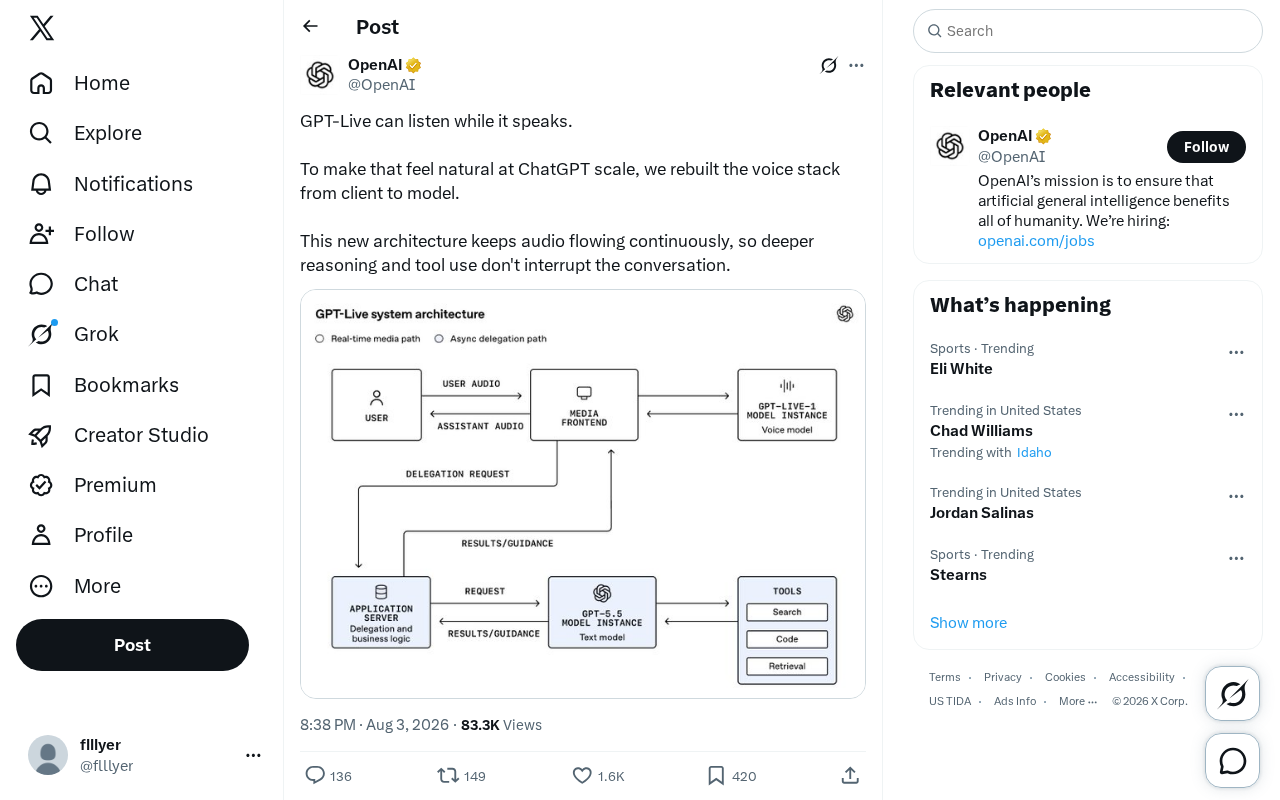
Full-Stack Rebuild from Client to Model
A notable detail: OpenAI emphasized that this change is not a local optimization but an end-to-end rebuild "from client to model." This means the transformation covers the complete pipeline from audio capture on user devices, through transmission, to cloud-based model inference.
Specifically, this end-to-end rebuild involves coordinated transformation across multiple technical layers. At the client layer, audio capture and buffering strategies need to be redesigned to support simultaneous audio input and output without echo interference—this requires advanced Acoustic Echo Cancellation (AEC) technology. At the transport layer, traditional HTTP request-response patterns need to be replaced with persistent bidirectional streaming connections (such as WebSocket or WebRTC protocols) to support real-time bidirectional audio data flow. At the model layer, the inference engine needs to support concurrent processing of streaming input and streaming output, which is fundamentally different from traditional batch inference architectures.
Why a Full-Stack Rebuild?
The biggest technical challenge in achieving "listening while speaking" lies in the contradiction between latency and continuity. When AI needs to perform deeper reasoning or tool use, these operations often require additional computation time. In traditional architectures, such processing causes conversation interruptions—the AI falls silent until processing completes before continuing to respond, breaking the flow of conversation.
The severity of this problem lies in the fact that when large language models perform deep reasoning (such as Chain-of-Thought/CoT reasoning), computation time can leap from milliseconds to seconds or even tens of seconds. Tool calling (function calling) involves external API requests, introducing uncertainty from network latency and third-party service response times. For example, when a user asks about real-time weather or performs a database query, the model needs to wait for the external system to return results. In traditional architectures, these wait times manifest directly as "dead silence" in the conversation, severely damaging the interaction experience.
GPT-Live's new architecture solves this problem by keeping audio flowing continuously. Even when the model is performing complex reasoning or tool calls in the background, the audio channel doesn't disconnect—users can continue speaking, and the AI maintains conversational coherence. This design decouples "thinking" and "speaking" along the time dimension, so computational latency no longer directly translates into conversation stuttering. From an architectural perspective, this is similar to introducing an asynchronous event-driven mechanism, converting blocking waits into non-blocking background tasks.
Core Design Philosophy: Decoupling Thinking from Speaking
In traditional architectures, the model's reasoning process and voice output are serial—think first, then speak. GPT-Live parallelizes these two processes, allowing AI to maintain smooth audio flow while performing deep computation. This fundamental architectural change is precisely why a full-stack rebuild was necessary: local fine-tuning alone cannot achieve such deep parallelism.
Technical Significance: Moving Toward True Real-Time Interaction
From a technical evolution perspective, this upgrade represents the transformation of voice AI from an "asynchronous Q&A" paradigm to a "synchronous conversation" paradigm.
The Value of Full-Duplex Communication
"Listening while speaking" corresponds to full-duplex capability in communications—where bidirectional channels can transmit data simultaneously, rather than the alternating half-duplex mode. The full-duplex concept originates from telecommunications, referring to both parties being able to send and receive signals simultaneously, with the most typical example being a phone call. In contrast, half-duplex (like a walkie-talkie) only allows one-way transmission at any given time. Achieving full-duplex in voice interaction means AI needs to simultaneously possess the following capabilities:
- Continuous listening: Continuously monitoring and understanding user input while outputting speech
- Interruption handling: Gracefully stopping or adjusting current output when users interject
- State maintenance: Maintaining conversational state continuity without interrupting audio flow even during background computation
Achieving full-duplex in AI voice interaction faces unique challenges: the model needs not only to process input audio streams in real-time but also to determine whether a user's vocalization is a meaningful interruption or meaningless background noise (such as "uh-huh" or "mm" responses). This requires the system to have extremely refined speech understanding and interruption intent recognition capabilities, rather than simply stopping output whenever sound is detected. Additionally, when the AI is interrupted, it needs to dynamically adjust subsequent generated content based on the user's new input, which involves real-time controllability of the generation process.
These capabilities together constitute an interaction experience closer to natural human conversation. Users no longer need to wait for the AI to "finish speaking," nor worry about their interjections being ignored.
Engineering Challenges of Deployment at Scale
OpenAI specifically mentioned achieving this experience "at ChatGPT scale." Behind this statement lie enormous engineering challenges: stably serving real-time full-duplex voice capabilities to hundreds of millions of users places extremely high demands on infrastructure concurrency, latency control, and cost optimization.
ChatGPT has over several hundred million weekly active users. Deploying real-time full-duplex voice services at this scale means simultaneously maintaining millions of persistent audio connections. Each connection requires continuous GPU inference resources and network bandwidth, which is fundamentally different from traditional stateless HTTP requests. On the cost front, continuous audio stream processing means GPU utilization patterns shift from intermittent bursts to sustained occupation, potentially increasing computational costs by orders of magnitude. Furthermore, global user distribution requires deploying low-latency audio relay services at edge nodes, with end-to-end latency needing to be controlled within 200 milliseconds for users not to perceive noticeable delay—a requirement far more stringent than text interaction.
Maintaining low-latency continuous audio streams at such scale is itself a significant systems engineering achievement.
Practical Impact on the Industry and Users
For everyday users, the most direct benefit of this upgrade will be that voice conversations with ChatGPT feel "more like talking to a real person." You can interrupt it at any time, add information, and it won't let the conversation go "cold" while thinking through complex problems.
For the entire AI voice interaction industry, GPT-Live's architectural upgrade sets a new experience benchmark. This upgrade comes amid fierce competition in the voice AI space—Google's Gemini Live, Meta's voice AI, and numerous startups (such as Hume AI focusing on emotional voice, ElevenLabs focusing on voice synthesis) are all competing for the high ground in real-time voice interaction. Particularly noteworthy is the rise of "voice-native" AI applications since 2024, where voice is no longer just an add-on channel for text interaction but has become an independent, and even preferred, interaction modality.
As large models increasingly penetrate real-time interaction scenarios such as voice assistants, intelligent customer service, and emotional companionship, the natural conversation capability of "listening while speaking" may gradually evolve from a differentiating advantage to an industry standard.
At the same time, this reveals an important trend: competition in voice AI is extending from "model capabilities" to "interaction experience." Simply having powerful reasoning abilities is no longer enough—how to present these capabilities to users in a smooth, natural way is becoming the key factor determining product experience. Under this trend, whoever can first achieve truly natural conversational experiences may gain the upper hand in the next-generation AI assistant market.
Conclusion
By rebuilding the complete voice stack from client to model, GPT-Live achieves continuous conversation capability of "listening while speaking," ensuring that deep reasoning and tool calls no longer interrupt the natural rhythm of communication. This is not merely a technical optimization but an important milestone in voice AI interaction paradigm shifting from half-duplex to full-duplex.
One additional note: this article is based on information from OpenAI's official announcement. Specific technical implementation details and actual experience quality still await further disclosure and user verification. But what is certain is that real-time, natural, interruptible voice interaction is becoming the core direction for next-generation AI products.
Related articles

Gaussian Process Bandit Optimization: Exploration Strategies and Inference Regret Guarantees
Cumulative regret guarantees in Bayesian optimization fail to reflect final recommendation quality. This article examines a new study that provides inference regret guarantees for Gaussian process bandit optimization through exploration query strategies and fill distance analysis, validated on hyperparameter optimization and control tasks.

The Most Detailed Codex Guide on Bilibili: From Installation to Real-World Practice
The most detailed Codex guide on Bilibili: from app store installation to daily work mode configuration, with a real coffee shop project demonstrating file organization, data extraction, dashboard creation, and other practical tasks. Learn to use Plan Mode and desktop pets to leverage Codex efficiently.

Appearance Compensation in Volume Rendering: Why RGB Accuracy Cannot Guarantee Density Correctness
Volume rendering research reveals that volumetric data perfectly reproducing external RGB views may still contain density errors: appearance compensation can double central density and keep external rays unchanged even when L2 error exceeds 14.52%. Density recovery depends on appearance capacity, spatial resolution, and measurement design.