GPT-Next Leak, Gemini 4 Argon Imminent: AI News Roundup

OpenAI's GPT-Next leaks with a 28-day shipping pledge, Google's Argon heats up, and Anthropic's subscription value report sparks debate.
This AI news roundup centers on accelerating competition among top labs. OpenAI's unreleased GPT-Next leaks with early estimates suggesting extremely high efficiency, possibly launching within its 28-day shipping pledge—which requires daily meaningful improvements or a full usage reset, and already boosted GPT-6 series speed by ~50% on day one. Google's Gemini 4 Argon codenames appear densely in backend logs, moving up the release window, while Nano Banana 2.1 has launched with mediocre results. RSI suspicions, Artificial Analysis's subscription value report, OpenAI's TextString watermark, and Reflection AI's open-source Beam model round out the picture of labs competing on efficiency, ecosystem, and compliance.
OpenAI's unreleased model GPT-Next has surfaced in the community, Google's Gemini 4 Argon is seeing intense backend activity, and a third-party report has thrust Anthropic's subscription value into the spotlight. This round of AI news doesn't have a single bombshell, but piecing the clues together reveals where the top labs are focusing their efforts.
GPT-Next: A Mysterious New Model Leaks, and Price May Be the Killer Feature
According to a breakdown by Bilibili creator "World of AI," OpenAI has an internal model the outside world knows little about, codenamed GPT-Next. It's neither GPT-Mini nor the scrapped GPT-6.1 Aster, but a checkpoint very close to the GPT-6.1 series—possibly slightly stronger, but no qualitative leap. The biggest question mark is price: early circulating estimates claim that roughly 40,000 credits produced usage worth about 5 billion tokens. If true, that implies extremely high efficiency.

In community demos, GPT-Next performed impressively in 3D scene construction—a 3D kitchen scene with lighting, shaders, and asset packs, detailed enough to include animated models of various Pokémon. It should be noted that this kind of single speed test is not enough to define a model's capabilities, but it at least hints that OpenAI has made subtle adjustments to "care and creativity." The creator speculates that this efficient model may be released within the current 28-day commitment period.
OpenAI's 28-Day Pledge: No Ship, Reset Usage
The 28-day shipping pledge initiated by OpenAI product lead Tibor is the most dramatic item in this round of news. The rules are straightforward: over the next 28 days, the team must either deliver meaningful improvements to Codex and workflow users, or reset all usage for everyone. Day one has already been honored—the default speed for GPT-6 Aster and GPT-6.1 increased from about 30 tokens per second to around 50, a roughly 50% gain, and it also applies to partners logging in through ChatGPT (OpenCode, PIMP, Deven, etc.).

The four focus areas the team listed are: simplify the product, improve efficiency, give users more usage, and ship breakthrough features and release new models. The creator's interpretation is rather blunt—Anthropic's new models are applying full pressure on efficiency and usage quotas, and OpenAI is being forced into a sprint. For users, these 28 days are a win-win either way.
Gemini 4 Argon and Nano Banana 2.1: Google's Two-Track Push
On Google's side, Argon-related model codenames are appearing densely in backend logs, including multiple experimental variants and Barium checkpoints, suggesting the release window is closer than expected. These checkpoints vary in configuration, covering fixes, summarization features, and experimental branches, reflecting active polishing rather than shelved prototypes. In an SVG animation test, Argon completed an animation simulating a bank card payment, including card swipe and receipt details, outperforming comparison models.
On the image side, Nano Banana 2.1 has appeared on the Gemini web and mobile clients. The release process has been quite messy: the June Instant Ramen checkpoint was thought to be Nano Banana 2, the second generation released in August was expected to be called Nano Banana 2.5 Lite, renamed Spicy Mail two days later, and now it's been renumbered as 2.1 and shifted from the Lite tier to the Flash tier. A comparison test with Tencent Hunyuan Image 3.5 showed that Nano Banana 2.1 is more solid on character reference consistency, while Hunyuan wins on lighting atmosphere and creativity—but the former once completely ignored the instruction "no text." Overall assessment: not stunning, but consistency is commendable.
RSI Suspicions: Is Google Building a Self-Improving System?
RSI refers to recursive self-improvement. Previous claims were mostly dismissed as rumors, but another mysterious internal model placeholder has appeared in Google's backend logs, adding fuel to the possibility that "Google is experimenting with RSI." Considering how fast Google's recent Flash series iterations have been, this speculation isn't unfounded. However, the creator also explicitly cautions: a single internal model codename is not enough to prove Google has cracked RSI; it could just be a name, or some kind of imitation mechanism. This clue is currently just one piece of the puzzle and shouldn't be over-interpreted.
Recursive self-improvement (RSI) is a key concept in AI safety and capability assessment, referring to a system's ability to autonomously improve its own architecture, training process, or code, and use the improved version for the next round of self-improvement, forming a positive feedback loop. It is fundamentally different from regular model iteration: the latter relies on human researchers designing experiments, tuning hyperparameters, and curating data, whereas RSI means AI begins to take on part or even all of the R&D work. Academia generally views RSI as one of the possible paths to superintelligence, and therefore lists it as a key "threshold capability" to monitor. Currently no public model has achieved true RSI, but progress in code generation, experiment design, and self-evaluation has made "partially automated AI R&D" a real-world issue. The reason Google's internal model placeholder sparks such associations is precisely that its Flash series iteration pace is unusually dense, leading outsiders to wonder whether automated processes are involved.
Subscription Value Report: Anthropic Delivers Several Times the Compute of OpenAI
Artificial Analysis published a report covering mainstream AI subscriptions, and the conclusions are striking. Calculated by API-equivalent value, at the same roughly $200 tier, Claude Max provides about $12,500 worth of Sonnet usage and about $12,000 worth of Opus usage, while ChatGPT Pro provides about $2,000 worth of GPT-6.1 usage or $3,000 worth of GPT-6 Aster usage.
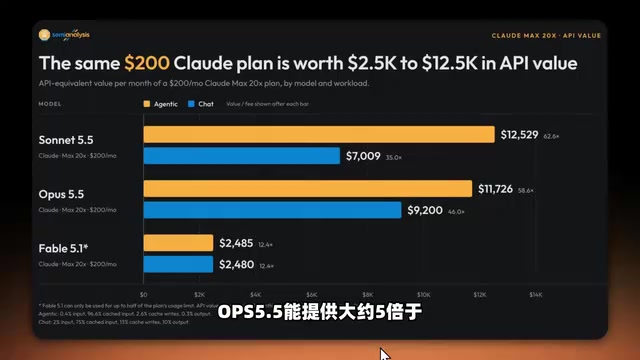
The report also notes that OpenAI recently cut the capacity quota of the $200 ChatGPT plan by about half, citing GPT-6.1's higher efficiency—seen as one of its moves to pave the way for an IPO. There are exceptions at the high end: ChatGPT Pro provides slightly more GPT-6 Aster usage than Anthropic's corresponding plan.
A bucket of cold water is needed: API-equivalent cost only answers "how much raw usage you get for your money," not "which subscription is better." Model quality, speed, context length, coding and agent capabilities, built-in tools, and ecosystem integration are all absent from these numbers. Anthropic's advantage in raw compute does not mean Claude Max is automatically five times better in experience.
API-equivalent value is a common conversion method in subscription value assessments: the available token volume in a subscription plan is converted to dollars at the official API's per-million-token price, then compared with the subscription fee. Its advantage is being intuitive and cross-vendor comparable, but its limitations are also obvious—it assumes all tokens are equal in value, ignoring differences in model quality, rate limits, context windows, tool-call quotas, and peak-hour throttling. In addition, subscription terms typically prohibit resale or bulk API-style calls, so "equivalent value" is only a theoretical ceiling, and actual usable volume is often lower than the converted figure. Artificial Analysis specifically notes in the report that this metric only reflects raw compute quotas and does not constitute a basis for judging experience quality.
Other Notable Developments
Text watermarking: To comply with the EU AI Act, OpenAI will embed an invisible watermark called TextString in text generated through ChatGPT and Codex in the EU. It doesn't insert hidden markers but embeds statistical signals into the model's word choices, detectable after the fact. OpenAI claims TextString matches or exceeds Google's SynthID in text watermarking tests without noticeably harming output quality, and plans to open-source it. Its limitations are also obvious: paraphrasing and translation can both break the watermark.
Open-source model Beam: New US lab Reflection AI released Beam, with about 501 billion total parameters and only 23 billion active parameters, designed specifically for reasoning, coding, and agent workloads.

According to the company, Beam was trained end-to-end from scratch rather than modified from an existing open-source model, and full weights will be released later this month.
Toolchain updates: Google AI subscribers can use GPT-5.5 Medium and Sonnet 5.5 Medium in Anti-Gravity, but with limited quotas. Claude Code added a Mode feature, where the Cache Control mode displays the 5-minute prompt cache window with a visual progress bar and sends notifications, helping maintain cache warmth and reduce token consumption. Claude Projects now supports directly connecting local folders, allowing cloud sessions to be authorized to read and write specified local files.
Fable 5.5 demo: Someone used a single-word prompt to have Fable 5.5 build a Pokémon mashup card game, producing a playable result in about an hour with complete mechanics. Such demos have limited persuasive power, but they do demonstrate the model's completion rate on long tasks.
Text watermarking (TextString) is a type of statistical watermarking: when generating each token, the model slightly biases the probability distribution of candidate words based on a key known only to the detector, so that the output contains word-choice patterns that are hard for humans to notice but statistically detectable. Detection requires no original model—only the key and sufficiently long text to compute a likelihood ratio and determine whether the text was generated by that model. Compared with inserting zero-width characters or specific markers into text, statistical watermarks are harder to spot with the naked eye and don't change readability. Their core weakness is limited robustness: synonym paraphrasing, translation, inserting distractor text, or having another model paraphrase can all break the watermark signal. OpenAI claims TextString matches or exceeds Google's SynthID in tests and plans to open-source the detection tool, but the EU AI Act's specific technical requirements for watermarking are still being refined.
Mixture-of-Experts (MoE) architecture is key to understanding Beam's parameter scale. Beam has about 501 billion total parameters, but each forward inference activates only about 23 billion parameters—a typical MoE characteristic: the model consists of multiple "expert" subnetworks, and a router dynamically selects a few experts to participate in computation based on the input token. This allows expanding total parameter count without significantly increasing per-inference cost, thereby improving knowledge capacity and reasoning ability. MoE's challenges lie in load balancing, expert utilization, and training stability; training a 500-billion-scale MoE end-to-end from scratch places extremely high demands on data and compute. Reflection AI emphasizes that Beam is not modified from an existing open-source model; if full weights are released as scheduled, it will become a rare ultra-large-scale MoE reasoning model in the open-source community.
Summary
The common thread in this round of news is accelerating competition: OpenAI is forcing itself to ship with a 28-day pledge, Google is shortening its release cycle with dense checkpoints, and Anthropic has scored high on a third-party report for usage economics. Whether GPT-Next is really as cheap as estimated, whether Argon can deliver polished completeness, and whether RSI is real or not—the next few weeks should bring clearer answers.
Related articles

Amphibious Transforming Drone: Beyond 100x Power Savings, What Are the Real Needs?
Is the amphibious transforming drone just a gimmick? Starting from the 100x power difference of the M4 Morphobot, explore real application scenarios and thesis topic ideas, analyzing boundary conditions where pure drones and pure ground robots both fail.

Warhound Raises $200 Million: Genetically Engineered "War Dogs" Paired with Anduril Gear
Warhound raises $200M, backed by Ben Lamm and Palmer Luckey, to genetically engineer dogs for military and law enforcement use and equip them with Anduril gear. This article analyzes its technology direction, funding logic, and ethical controversy.

Claude API Comes to Google Cloud: IAM Integration and SDK Access Guide
Anthropic hosts the full Claude API on Google Cloud with IAM-controlled permissions and unified billing. This guide covers the Vertex AI and Anthropic-hosted entry points, IAM role configuration, and SDK access.