GPT-OSS 120B/20B Open-Source Model In-Depth Review: Comprehensive Testing on Hallucination, Reasoning, and Code

In-depth evaluation of OpenAI's open-source GPT-OSS 120B and 20B models across reasoning, code, and hallucination tests.
OpenAI released open-source models GPT-OSS 120B and 20B under Apache 2.0, both using MoE architecture with 128K context support. Testing covered hallucinations, logical reasoning, code generation, and SQL queries: both passed all six hallucination trap questions; 120B excels at complex reasoning and document analysis while 20B surprisingly outperforms on SQL optimization and code quality; Mermaid flowchart generation is their shared weakness. 20B suits resource-limited scenarios; 120B handles complex tasks better.
OpenAI recently released two open-source large language models — GPT-OSS 120B and GPT-OSS 20B — under the Apache 2.0 license with support for local deployment. Both models demonstrated impressive comprehensive capabilities across multiple tests. This article provides an in-depth evaluation of the GPT-OSS series across multiple dimensions including hallucination testing, logical reasoning, code generation, and SQL queries, helping you determine which model best suits your use case.
GPT-OSS Model Specifications and Deployment Options
Core Specifications Comparison
GPT-OSS 120B has 117B total parameters with 5.1B active parameters, capable of running on a single H100 GPU. GPT-OSS 20B contains 21B total parameters with 3.6B active parameters. Both models support 128K context length, equivalent to processing 400-500 pages of an English novel or 180-200 pages of a Chinese novel.
The enormous gap between total parameters and active parameters reveals the Mixture of Experts (MoE) architecture employed by both models. The core idea behind MoE is dividing the model into multiple "expert" sub-networks, where a Gating Network determines which experts should process each input token during inference, activating only a small subset of experts for computation rather than engaging all parameters. This means that while the model possesses vast knowledge capacity (determined by total parameter count), the actual computational overhead during inference is far less than a dense model of equivalent size — this is the key reason why the 120B model can run on a single H100 GPU.
The 128K context length is also noteworthy. Early Transformer models were limited to 2K-4K context lengths due to the quadratic computational complexity of self-attention mechanisms. In recent years, techniques such as Rotary Position Embedding (RoPE) and its extensions, FlashAttention and other efficient attention algorithms, and sliding window attention have significantly improved long-context processing capabilities. The 128K context window enables the model to process entire research papers, complete codebases, or lengthy conversation histories in a single pass, greatly expanding practical application scenarios.
Both models support adjustable reasoning levels: low level for everyday conversations with fast response times; medium level for balancing speed and detail; and high level for deep, detailed analysis. This flexible reasoning level configuration allows users to make trade-offs between speed and quality based on actual needs.
Multi-Platform Deployment Support
For deployment, GPT-OSS supports Transformers, vLLM, PyTorch, Ollama, and LM Studio among other options. In Ollama, a single ollama run command downloads and runs GPT-OSS 20B; in LM Studio, searching for the model name enables one-click deployment. Additionally, OpenAI provides an official demo for users to test online directly.
These deployment tools each have their strengths: vLLM is a high-performance inference engine developed at UC Berkeley, whose core innovation PagedAttention borrows from the virtual memory paging concept in operating systems, dividing the KV Cache into fixed-size blocks for dynamic allocation, dramatically reducing memory waste and achieving several to dozens of times throughput improvement compared to native HuggingFace Transformers inference. Ollama targets individual users with a minimalist local deployment experience, built on llama.cpp for CPU and GPU hybrid inference. LM Studio provides a graphical interface, lowering the barrier for non-technical users. Together, these tools constitute the mainstream technology stack for local large model deployment.
Strategic Significance of the Apache 2.0 License
Apache 2.0 is one of the most permissive open-source licenses available, allowing users to freely use, modify, distribute, and commercialize derivative works, with the only core requirement being retention of the original copyright notice and license text. By comparison, Meta's Llama series previously used a restrictive community license (with additional restrictions for companies with over 700 million monthly active users), while some models use the GPL license which requires derivative works to also be open-sourced. OpenAI's choice of Apache 2.0 means enterprises can build closed-source commercial products based on GPT-OSS without additional authorization, which has significant implications for driving model adoption in enterprise scenarios.
Hallucination Testing: All Six Trap Questions Passed
Hallucination has been a core pain point for large language models. Hallucination refers to LLMs generating content that appears plausible but is actually incorrect or entirely fabricated. The root cause lies in the fact that LLMs are fundamentally statistical probability-based text generation systems — they learn language patterns rather than true factual knowledge. Hallucinations are typically categorized into two types: factual hallucinations (generating information inconsistent with reality) and faithfulness hallucinations (generating content inconsistent with the input context). The industry currently mitigates this issue through Retrieval-Augmented Generation (RAG), Reinforcement Learning from Human Feedback (RLHF), factual consistency training, and other methods.
The evaluation carefully designed six trap questions involving non-existent animals, fictional events, temporal errors, fabricated literature, and fictional historical events, sending them simultaneously to both models. This trap question design featuring fabricated entities and incorrect timelines is the standard method for testing whether models will "make up" answers when lacking real knowledge.
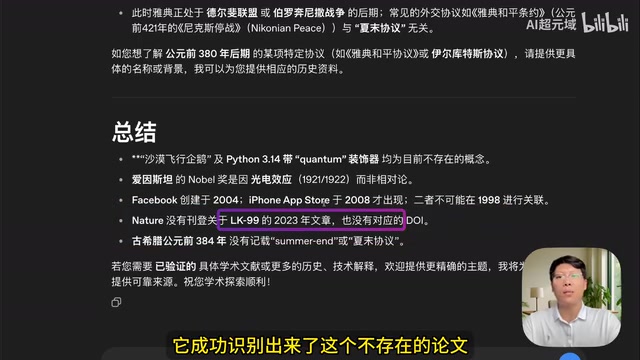
GPT-OSS 120B's performance was exemplary: it successfully identified the desert penguin and a non-existent Python decorator, correctly provided Einstein's Nobel Prize year, accurately identified the Facebook and App Store timeline issues, and recognized both the fabricated paper and fictional historical event. GPT-OSS 20B also answered all questions correctly, accurately pointing out that the penguin question belonged to science fiction, correctly giving Einstein's Nobel Prize year, and identifying all fictional content.
Both models have a knowledge cutoff date of June 2024, which corresponds with the Python version number they provided (3.12.1). Six carefully designed hallucination trap questions failed to trip up either model — a remarkable achievement among open-source models.
Logical Reasoning and Spatial Reasoning Test Results
Bottle Exchange Problem
This is a classic mathematical reasoning problem: buying drinks with 12 yuan, large bottles cost 3 yuan and small bottles cost 1 yuan, with empty bottles exchangeable for more drinks according to specific rules. GPT-OSS 120B thought for over a minute before providing the correct answer of 2700ml, complete with detailed reasoning steps, tables, and formulas. GPT-OSS 20B, however, failed to produce an answer in two attempts (thinking for 29 and 28 seconds respectively), with the reasoning process interrupting midway — this problem genuinely stumped the 20B model.
Frog Climbing a Well Problem
A well is 16 meters deep, a frog's daily climbing distance decreases by 0.5 meters, and its nightly sliding distance increases by 0.5 meters. The 120B model quickly provided detailed solution steps, correctly determining that the frog cannot escape the well. The 20B model also performed well, precisely identifying that from day nine onward, the frog can no longer make upward progress.
Spatial Reasoning: Cube Number Problem
A cube has numbers 1-6 written on its six faces, with multiple constraints given, asking which number is opposite to 5. Both GPT-OSS models correctly answered that the number opposite to 5 is 3.

Code Capability Evaluation: From Understanding to Generation
Code Understanding
Given a function's code, the models were asked to identify its functionality and calculate the output for input 10. Both models successfully identified the Fibonacci sequence and correctly provided the answer 55.
Algorithm Programming
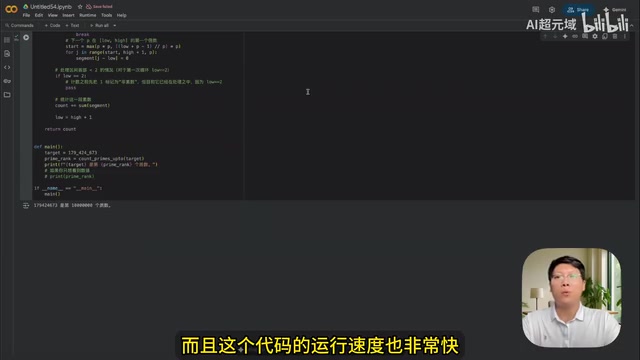
The task was to write a Python program to find the 10 millionth prime number without importing external libraries. Both GPT-OSS 120B and 20B produced correct and efficient code, with runtime of only about ten seconds each. You might not have noticed that 20B's code had more complete comments and better readability.
Frontend Development
The task required creating a complete responsive navigation bar using Bootstrap with a logo, navigation menu, product dropdown, and login/register buttons in a dark theme. Both models generated fully functional HTML code with working product dropdown menus and good mobile adaptation.
Mermaid Flowchart Generation (Failed Case)
When asked to generate a Mermaid flowchart based on code, both models produced code with syntax errors that triggered errors in the Mermaid parser. This was the one test where both GPT-OSS 120B and 20B failed together. Mermaid is a text-based diagram description language with strict requirements for indentation, symbols, and keywords. LLMs tend to make formatting errors when generating such structured markup languages, representing an area where current large models still need improvement in code generation.
SQL Query Capability: From Simple Aggregation to Complex Multi-Table Joins
Aggregation Query
Given a customers table and an orders table, the task was to calculate the total order amount per city for each customer and sort the results. Both models produced completely correct SQL statements.
Complex Multi-Table Query
This involved a complex query spanning students, courses, grades, and classes tables — finding the student with the highest math score in each class along with their score and average across all subjects (rounded to two decimal places).
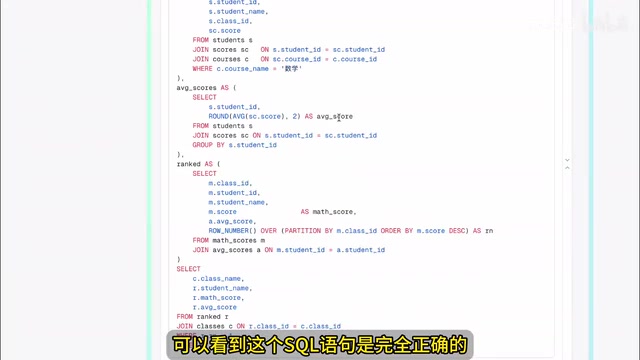
The 120B produced a completely correct SQL statement. The 20B's performance was even more impressive — its SQL statement was more concise, more readable, and easier to maintain, actually surpassing 120B in code quality. This result demonstrates that parameter count isn't everything, and smaller models can absolutely outperform larger ones on specific tasks.
This "smaller model outperforming larger model" phenomenon is not uncommon in LLM research. Several factors are at play: smaller models may have more concentrated training data distribution in specific domains, developing stronger specialized capabilities; differences in expert routing strategies across different model sizes in MoE architectures may lead to more precise expert selection for certain tasks in smaller models; furthermore, Knowledge Distillation techniques allow smaller models to learn compressed knowledge representations from larger models, sometimes resulting in cleaner, more structured outputs. This also confirms an industry consensus: model selection shouldn't be based solely on parameter count but should be evaluated based on specific tasks.
Advanced Capabilities: Document Analysis and Prompt Following
Research Paper Analysis
After uploading a lengthy paper on large language models, GPT-OSS 120B successfully retrieved key information including the number of Transformer layers (32), hidden state dimensions, and other details. It even identified a potential typographical error in the paper (the text stated 3072, but the model corrected it to 3272), demonstrating powerful document comprehension and self-correction capabilities. The 20B model failed to produce a response for this test.
Prompt Following and Probabilistic Reasoning
With complex JSON format output requirements set, the models were asked the classic coin probability question (the probability of the 101st flip after 100 consecutive heads). The 120B strictly followed the JSON structure output, providing a Bayesian analysis with probability greater than 0.99. The 20B's answer was more comprehensive, offering two answers: 0.5 under normal conditions (independent events), and approximately 0.99 under Bayesian thinking (considering the coin might be biased), while also strictly adhering to JSON format requirements.
The 20B's approach of providing both analytical frameworks is particularly noteworthy. Classical probability theory (frequentist approach) holds that each flip of a fair coin is an independent event — regardless of how many heads appeared previously, the probability of the next head remains 0.5. However, Bayesian reasoning introduces a crucial cognitive shift: if 100 consecutive heads are observed, one should update their confidence in the hypothesis "this coin is fair." According to Bayes' theorem, after observing such extreme evidence, the posterior probability that the coin is biased rises dramatically, thus the predicted probability of the 101st flip being heads also approaches 1. The model's ability to distinguish between these two reasoning paradigms demonstrates its deep understanding of probabilistic reasoning.
GPT-OSS Selection Guide: 120B or 20B?
Through multi-dimensional evaluation, the GPT-OSS series demonstrates top-tier comprehensive capabilities among open-source models:
- GPT-OSS 120B performs more consistently on complex reasoning (such as the bottle exchange problem), document analysis, and high-difficulty tasks
- GPT-OSS 20B actually surpasses 120B in areas like SQL optimization, code comment quality, and comprehensiveness of probability analysis
- Both models perform excellently in hallucination resistance, basic reasoning, and code generation
- Mermaid flowchart generation is a shared weakness of both models
For users with limited resources seeking high-quality output, GPT-OSS 20B offers exceptional value; for scenarios requiring complex reasoning and long document analysis, GPT-OSS 120B is more reliable. The Apache 2.0 license makes both models highly attractive for commercial applications as well.
Key Takeaways
- GPT-OSS 120B (117B params/5.1B active) and GPT-OSS 20B (21B params/3.6B active) both employ MoE architecture, support 128K context, and use the Apache 2.0 license
- Both models correctly identified all six hallucination trap questions, demonstrating excellent factual judgment
- The 120B is more stable on complex reasoning tasks, while the 20B performs better on specific tasks like SQL optimization and code quality
- Both models support deployment via Ollama, LM Studio, vLLM, and other methods, with adjustable low/medium/high reasoning levels
- Mermaid flowchart generation is a shared weakness, while all other code generation and comprehension capabilities are excellent
Related articles
 Product Reviews
The Programmer's Desk Setup Guide: Building a Workspace That Feels Like Home
Discover how programmers build productive, comfortable workspaces. From multi-monitor setups to ergonomic design, explore the desk philosophy that drives focus and flow.
 Product Reviews
Qoder vs Cursor Real-World Comparison: Which $20/Month AI IDE Is Better?
Hands-on comparison of Qoder vs Cursor AI IDEs: Agent autonomy, human interaction count, and architecture decisions. Qoder needed only 2 interactions vs Cursor's 8.
 Product Reviews
Cursor Cloud Agent Demo: Eliminating Bottlenecks Across the Entire Software Development Lifecycle
Deep analysis of Cursor's Cloud Agent demo showing how cloud VMs, automated test artifacts, and a full-chain control plane systematically eliminate human bottlenecks across the software development lifecycle.