GPT-OSS Open-Source Model Local Deployment Tutorial: Real-World Performance and VRAM Usage Analysis

OpenAI open-sources GPT-OSS model with MoE architecture enabling low-cost local deployment and strong reasoning.
OpenAI open-sourced GPT-OSS, a MoE-based model in 20B and 120B versions approaching O3-mini and O4-mini performance respectively. The 20B version activates only 3.6B parameters during inference and runs on just 16GB VRAM. Real-world testing shows solid Chinese semantic understanding and logical reasoning capabilities, with support for tool calling and structured output. Deployable via Ollama in minutes, it's ideal for enterprise private deployment and AI Agent development.
OpenAI quietly open-sourced the GPT-OSS model late at night, sending shockwaves through the developer community. This model adopts a MoE (Mixture of Experts) architecture, dramatically reducing inference costs while maintaining powerful capabilities. This article provides a complete record of GPT-OSS 20B's real-world performance running locally, from deployment to benchmarking.
Model Architecture and Hardware Requirements
GPT-OSS currently comes in two versions, targeting different hardware conditions and performance needs:
- GPT-OSS 120B: Uses MoE architecture, activating only 5.1B parameters during inference, with performance approaching O4-mini
- GPT-OSS 20B: Also uses MoE architecture, activating only 3.6B parameters during inference, with performance approaching O3-mini
Core Principles of MoE Architecture
MoE (Mixture of Experts) is a sparse activation neural network design paradigm, first proposed by Jacobs et al. in 1991 and recently brought back into the mainstream by models like Google's Switch Transformer and Mixtral. Its core idea is to split the model's feed-forward network layers (FFN layers) into multiple independent "expert" sub-networks, with a Gating Network dynamically selecting a small number of experts to participate in computation during each inference pass.
Specifically for GPT-OSS 20B, although the model has 20B total parameters distributed across multiple expert networks, inference for each token only activates the expert combination corresponding to 3.6B parameters. This means the actual compute (FLOPs) is equivalent to a 3.6B dense model, while the model's knowledge capacity and expressiveness far exceeds a dense architecture of equivalent compute. This "large capacity, low compute" characteristic is the fundamental advantage of MoE architecture in inference efficiency — you get the knowledge reserves of a 20B model while only paying the computational cost of a 3.6B model.
The GPT-OSS 20B version requires only 16GB of VRAM to run locally — a consumer-grade RTX 4060 Ti 16GB is sufficient. The 120B version naturally requires more VRAM, but considering its O4-mini-level performance, the overall cost-effectiveness remains impressive.
Performance Benchmarks: O3-mini and O4-mini
O3-mini and O4-mini are inference-optimized models from OpenAI's "o-series" (reasoning series) product line. O3-mini delivers near GPT-4-level reasoning capabilities at lower computational cost, excelling particularly in math, coding, and logical reasoning tasks; O4-mini is its iterative upgrade, with further improvements in multi-step reasoning and complex task planning. Benchmarking GPT-OSS against these two models means the open-source community has, for the first time, gained the ability to run models approaching OpenAI's commercial reasoning model capabilities on local hardware — a significant development for scenarios requiring data privacy or offline operation.
Complete Local Deployment Walkthrough
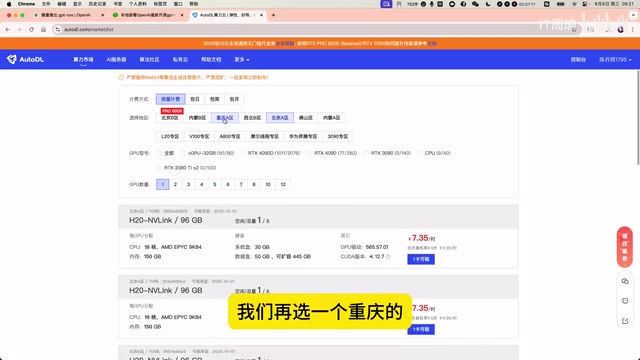
For this test, an RTX 4090 (24GB VRAM) was rented on the AutoDL platform, and the entire deployment process was remarkably straightforward.
AutoDL is one of China's leading GPU compute rental platforms, offering developers pay-as-you-go GPU server instances. The platform supports various GPU models from RTX 3090 to A100, with hourly billing that avoids the upfront investment of purchasing expensive hardware. For LLM developers, the value of such platforms lies in quickly validating deployment solutions — confirm the model runs properly and meets requirements in the cloud before deciding whether to invest in local hardware. The RTX 4090 features 24GB of GDDR6X VRAM and over 80 TFLOPS of FP16 compute, making it one of the best consumer GPUs for running large models.
Step 1: Install Ollama
First, install Ollama as the model runtime framework. Ollama is an open-source inference framework specifically designed for running large language models locally. It wraps underlying inference engines like llama.cpp and provides a Docker-like model management experience. Users don't need to manually handle complex details like model quantization, memory mapping, or KV Cache management — simple pull and run commands are all that's needed for model deployment.
Ollama supports GGUF-format quantized models and includes built-in automatic VRAM/RAM allocation strategies that automatically select GPU offload layers based on hardware conditions. Its architecture uses a client-server model, where the server launched by ollama serve provides a REST API interface compatible with the OpenAI API format, allowing existing applications built with the OpenAI SDK to migrate to local models with near-zero cost.
After entering the GPU server terminal, simply execute Ollama's installation command. Some Warning messages may appear during installation, but as long as there are no Errors, normal operation won't be affected.
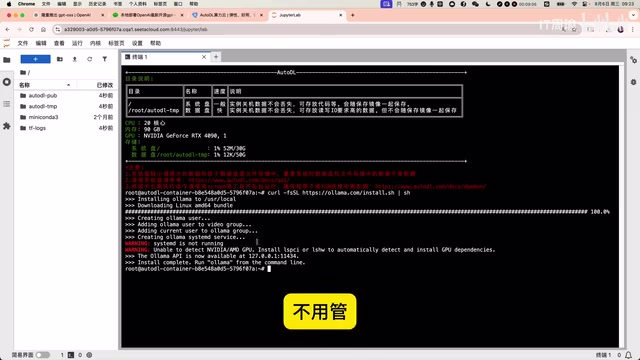
Step 2: Start the Service and Download the Model
After Ollama is installed, run the ollama serve command to start the server. Then open a new terminal window and pull the GPT-OSS 20B model directly. The model file is approximately 13GB, so the download will take some time.
The entire GPT-OSS local deployment process boils down to three steps:
- Install Ollama
- Start the Ollama service
- Pull the GPT-OSS model
For developers with Linux experience, the entire process takes no more than 10 minutes (excluding model download time).
Real-World Performance Testing
After deployment, the model was tested across four dimensions: basic Q&A, Chinese semantic understanding, logical reasoning, and creative generation.
Basic Q&A Capability
First, a simple time-awareness question was tested — "What's today's date?" GPT-OSS responded extremely quickly, almost instantaneously, and provided the correct date. Basic knowledge and time awareness capabilities are solid.
Chinese Semantic Understanding
Next, a nuanced Chinese comprehension question was tested: What does "背" (bèi) mean in the sentence "他背着老板做的这件事情" (He did this thing behind the boss's back)?
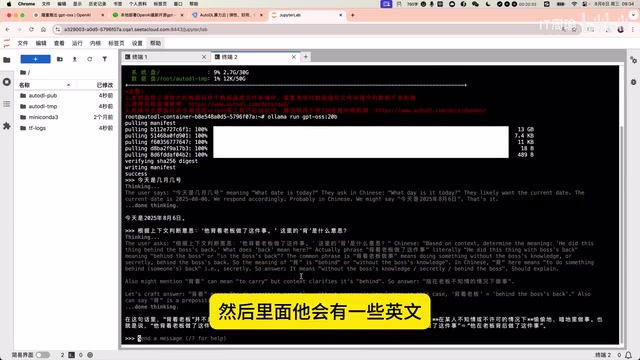
The model demonstrated a complete reasoning process (with some English mixed into the reasoning chain) and ultimately correctly determined that "背" here does not mean its literal sense of "carrying on one's back," but rather refers to doing something without the boss's knowledge. GPT-OSS's performance in Chinese polysemy understanding and contextual inference is quite solid.
Logical Reasoning Capability
For the logical reasoning test, a classic syllogism variant was used: "If all A are B, and some B are C, then must some A be C?"
The model engaged its reasoning process and ultimately gave the correct answer — not necessarily — accompanied by detailed explanations and counterexamples. This question easily traps people with intuition (intuition suggests "some A are C" holds, but in reality the B elements that are C might not overlap with A at all). GPT-OSS's ability to answer correctly demonstrates well-trained logical reasoning capabilities.
Chain-of-Thought Reasoning Mechanism Explained
The reasoning process demonstrated in the above tests reflects the Chain-of-Thought (CoT) reasoning mechanism. This concept was systematically proposed by the Google Brain team in a 2022 paper and has been proven to significantly improve model accuracy in mathematical reasoning, logical judgment, and multi-step problem solving. GPT-OSS's built-in reasoning chain mechanism means the model internally generates a series of thinking steps (sometimes visible to users) and then derives final conclusions based on these intermediate reasoning steps. Notably, reasoning chains increase output token count, but thanks to the MoE architecture's efficient inference characteristics, overall latency remains within acceptable ranges.
ASCII Art Generation
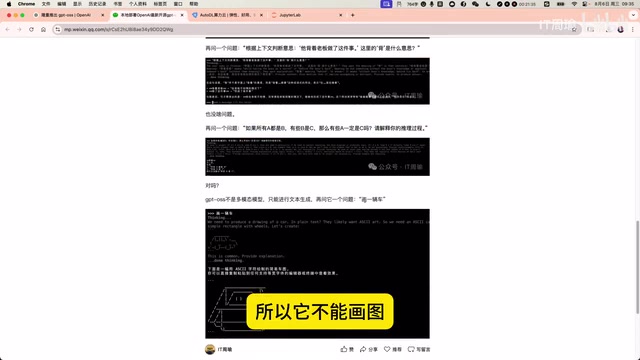
GPT-OSS is not a multimodal model and doesn't support true image generation. However, when asked to "draw a car," the model "drew" a car using ASCII character art, with quite interesting results.
Resource Usage and Performance Analysis
During testing, GPT-OSS 20B's VRAM usage was approximately 15GB, staying below the 16GB threshold. This is thanks to both Ollama's framework optimizations (including efficient KV Cache management and automatic quantization strategies) and the MoE architecture's characteristic of only activating partial parameters during inference.
Specifically:
- Consumer GPUs with 16GB VRAM (such as the RTX 4060 Ti 16GB) can indeed run GPT-OSS 20B smoothly
- Inference speed is extremely fast, with near-instantaneous responses
- Actual VRAM usage is even slightly below the officially stated 16GB requirement
For developers without high-end GPUs, this VRAM threshold is quite accessible. For comparison, dense models of equivalent capability (such as the full-precision version of Llama 3 8B) often require more VRAM to achieve similar inference quality.
Features and Use Cases
Beyond basic conversational ability, GPT-OSS supports the following practical features:
- Tool Use: Supports function calling, enabling integration with external APIs and tools
- Structured Output: Can output structured data like JSON in specified formats
- Chain-of-Thought Reasoning: Built-in reasoning process, suitable for complex problem solving
- Few-Shot Learning: Supports few-shot prompting for quick adaptation to specific tasks
Tool Use and the AI Agent Ecosystem
Tool Use (Function Calling) refers to a large language model's ability to autonomously decide to call external tools or APIs to complete tasks after identifying user intent. This is the core technical foundation for building AI Agents. A typical AI Agent workflow is: receive user instruction → analyze which tools are needed → generate tool call parameters → execute tools → integrate results → return to user.
GPT-OSS's support for this capability means developers can build autonomous agents capable of querying databases, calling search engines, executing code, manipulating file systems, and other complex tasks — all within a local private environment without sending sensitive data to external APIs. Combined with Ollama's OpenAI API-compatible format, existing Agent frameworks like LangChain and CrewAI can interface with GPT-OSS almost seamlessly.
These capabilities give GPT-OSS high practical value in the following scenarios:
- Edge Device Deployment: Low VRAM requirements enable running on edge computing devices, suitable for industrial IoT, smart retail terminals, and other scenarios requiring local AI inference
- AI Agent Development: Tool calling and structured output capabilities are ideal for building AI agents and automated workflow orchestration
- Enterprise Private Deployment: The open-source license allows enterprises to deploy independently within intranet environments, keeping data on-premises to meet compliance requirements in finance, healthcare, government, and other industries
- Rapid Prototyping: Simple deployment and fast inference make it ideal for quickly validating AI application ideas, reducing time from concept to prototype
Conclusion
OpenAI's open-source GPT-OSS model achieves an excellent balance between performance and efficiency through its MoE architecture. The 20B version approaches O3-mini levels, while the 120B version approaches O4-mini, all with dramatically lowered hardware requirements. Based on real-world testing, core capabilities including Chinese comprehension, logical reasoning, and tool calling all perform solidly, and the Ollama-based deployment process is sufficiently straightforward.
This open-source move also signals a shift in the competitive landscape of large models — when OpenAI begins releasing capabilities approaching its commercial model levels in open-source form, the technology barrier across the entire industry will further decrease, giving more small teams and independent developers the opportunity to build innovative applications on high-quality models.
If you're looking for a high-quality open-source LLM that can run in local or private environments, GPT-OSS is worth trying.
Related articles
 Tutorials
ChatGPT Plus Subscription Guide: Are GPT-5.5, image-2, and Codex Worth the Upgrade?
A detailed look at ChatGPT Plus features — GPT-5.5, image-2, and Codex — with a Plus vs Pro comparison and a complete step-by-step subscription guide for users outside the US.
 Tutorials
Harness AI Engineering in Practice: Using Claude Code to Master Enterprise-Level E-Commerce Development
Deep dive into Harness AI Engineering: master enterprise e-commerce development with Claude Code using the Rules, Skills, Wiki, and Changes framework.
 Tutorials
Cursor + Codex Dual-IDE Collaboration: A Practical Methodology for Open-Source Project Customization
A complete methodology for open-source project customization based on real-world experience, detailing the Cursor+Codex dual-IDE workflow, seven-stage process, MVP validation, and AI source code reading techniques.