GPU Repatriation: How Private Clusters Beat Cloud Giants and Save Millions

When steady-state GPU utilization exceeds 65%, enterprise self-built clusters break even in 24 months, saving $288K over cloud reserved instances.
Based on an architecture briefing by Logic42 founder Asif Muhammad Iqbal, the article systematically argues the financial and engineering logic of repatriating enterprise GPUs from cloud to private clusters. The core conclusion: when steady-state utilization exceeds approximately 65%, the payback point for self-purchased 8x H100 nodes is about 14 months, and the 36-month net TCO is significantly lower than cloud reserved and on-demand options. Using four nodes with 32 H100s as a sample, the article breaks down all cost items including power, colocation, networking, maintenance, transit, and residual value, finding that private colocation's net TCO of approximately $1.487M saves nearly $290K compared to cloud reserved at $1.775M, and nearly $1M compared to on-demand. The article also emphasizes that repatriation is not a universal solution, requiring three core capabilities: 40kW+ liquid-cooled colocation, 50GB/s NVMe-oF storage with InfiniBand networking, and Kubernetes/Slurm automated failover, recommending a hybrid model as the best practice.
Enterprise AI training and inference is facing a critical turning point: when annual cloud GPU rental costs exceed the capital expenditure of self-owned hardware, "GPU Repatriation" is no longer a step backward—it becomes a financially rational choice. Logic42 founder Asif Muhammad Iqbal presents a quantified roadmap based on a real enterprise model in the latest architecture briefing.
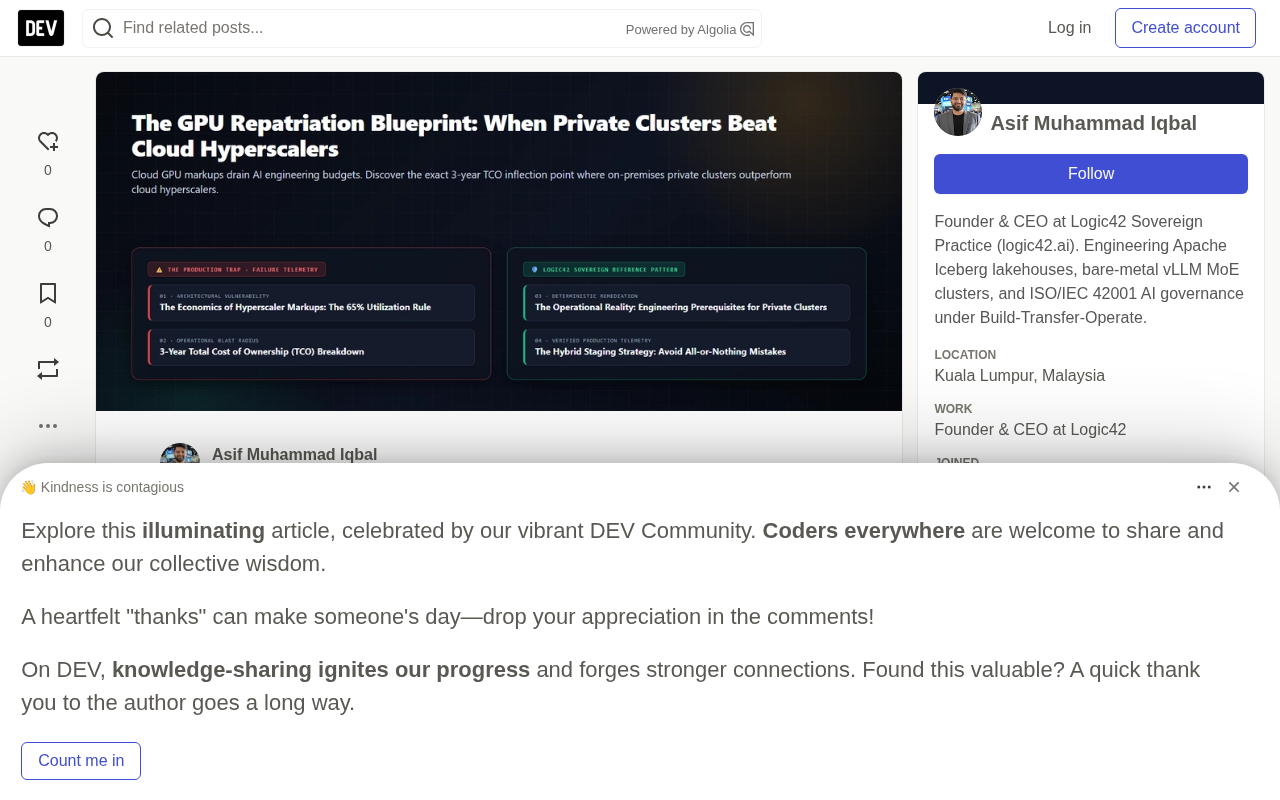
The Core Economics: The 65% Utilization Rule
Cloud vendors sell flexibility and zero capital expenditure, which is perfectly reasonable for rapid experimentation or seasonal peak scenarios. But when teams transition from exploratory R&D to 24/7 inference services and continuous fine-tuning, cloud rental costs reveal their punitive nature.
According to Logic42 estimates, renting an 8x NVIDIA H100 SXM5 node on-demand from a top-tier cloud provider costs approximately $28 to $34 per hour. Even with a 3-year reserved instance, the rate remains as high as $14 to $18 per hour. Over 36 months, the total contract spend for a single node ranges from $367,000 to $473,000. In comparison, purchasing an enterprise-grade 8x H100 server outright (including InfiniBand NICs and dual redundant enterprise SSD arrays) costs only about $310,000 to $335,000.
The breakeven point arrives at approximately 14 months. When steady-state cluster utilization exceeds 65%, continuing to rent compute becomes a significant financial burden.
Key Threshold
The breakeven point for GPU repatriation falls within the range of approximately 62% to 68% steady-state utilization over a 24-month period. For AI workloads that continuously serve low-latency APIs or batch embedding vectors, owning silicon in a colocation data center can reduce total compute spending by 42% (compared to 3-year cloud reserved instances).
Reserved Instance is a discounted billing model offered by cloud providers: users commit to a 1-year or 3-year term in exchange for a 30%–60% reduction from on-demand rates. It is fundamentally still a lease, not an asset purchase, so it does not appear as a fixed asset on the balance sheet and generates no residual value. This is the key difference in the article's comparison—while cloud reservations can lower the per-hour cost, the cumulative 36-month spend cannot be recovered through hardware residual value, whereas a self-purchased server can still be liquidated at approximately 15%–25% of its original value at month 36. When evaluating payback periods, readers should understand "reserved discounts" as reducing the slope of rental costs, not changing the nature of the lease.
Steady-state utilization refers to the average GPU occupancy rate of a cluster over consecutive weeks or even months, rather than the instantaneous occupancy at a peak moment. The distinction from "peak utilization" is crucial: most enterprise inference service load curves exhibit bimodal or long-tail distributions—high during the day, low at night—and looking only at peaks will overestimate actual utilization. The 65% threshold derives from comprehensive amortization calculations covering power, colocation, depreciation, and operational overhead. Below this value, fixed costs cannot be effectively diluted, making self-hosting more expensive than renting. Teams are advised to export at least 90 days of GPU utilization time series via Prometheus or DCGM, and use P50 and P90 percentiles to verify whether the threshold is consistently exceeded, rather than relying on single-day dashboard data.
3-Year TCO Breakdown: A Real Enterprise Comparison
A rigorous repatriation financial model goes far beyond the server purchase price. Without accounting for Tier III data center power density, cooling distribution units, network transit, OEM support contracts, and SRE operational overhead, the budget is inaccurate. Many organizations assume colocation costs are low, only to be blindsided by cooling retrofit expenses.
Below is a real comparison of four 8x H100 nodes (32 GPUs total) over a three-year lifecycle:
| Cost Item | Cloud On-Demand | Cloud 3-Year Reserved | Private Colocation (Self-Owned) |
|---|---|---|---|
| Hardware CapEx | $0 | $0 | $1,280,000 (amortized) |
| Compute rental/instance fees | $2,320,000 | $1,680,000 | $0 |
| Power & colocation space (40kW, PUE 1.25) | Included | Included | $216,000 ($6,000/month) |
| 800Gbps InfiniBand & ToR switching | Included | Included | $95,000 |
| Hardware maintenance & 24/7 OEM support | Included | Included | $140,000 |
| Internet transit & cross-connects | $145,000 (egress) | $95,000 | $36,000 ($1,000/month) |
| 3-Year Total Spend | $2,465,000 | $1,775,000 | $1,767,000 |
| Hardware residual value (month 36) | $0 | $0 | ($280,000) |
| Net 3-Year TCO | $2,465,000 | $1,775,000 | $1,487,000 |
After accounting for the residual value liquidation of enterprise hardware at 36 months, private colocation saves a net $288,000 compared to cloud reserved contracts—for just four nodes—and nearly $1 million compared to on-demand rates. When scaled to 16 or more nodes, annual savings accumulate to the millions of dollars.
Operational Reality: Engineering Prerequisites for Private Clusters
Repatriation is not a universal solution. If a team lacks the operational tools and expertise to manage hardware failures, thermal limits, and distributed cluster scheduling, private infrastructure quickly becomes an operational liability.
The enterprise private cluster stack needs to span from the application orchestration layer and dynamic model serving (vLLM/TensorRT-LLM), through Kubernetes with GPU Operator/Slurm orchestration, all the way down to 800Gbps NDR InfiniBand/RoCEv2 network fabric and high-density liquid-cooled hardware.
Three Core Capabilities
High-Density Power & Cooling Colocation: Modern AI servers with 8-GPU chassis draw between 10.2kW and 14.5kW each. Standard enterprise server rooms cannot dissipate this thermal load. Organizations must partner with professional colocation facilities that can provide 40kW to 100kW per rack, equipped with direct-to-chip liquid cooling or rear-door heat exchangers.
High-Throughput Storage & Network Fabric: Distributed training and rapid checkpointing demand extreme data throughput. Private deployments require dedicated RoCEv2 or NVIDIA Quantum-2 InfiniBand switches, paired with NVMe-oF storage nodes delivering sequential read speeds of at least 50GB/s.
Automated Failover & Orchestration: In a 32-GPU cluster, memory ECC errors, optical module degradation, and power fluctuations occur periodically. Using Kubernetes with NVIDIA GPU Operator or Slurm workload manager ensures failed nodes are automatically isolated and tasks rescheduled without engineer intervention.
Hybrid Phased Strategy: Avoiding All-or-Nothing
Logic42 advises clients against a binary, full-scale repatriation. The most resilient enterprise architecture is a disciplined hybrid model: private on-premises/colocation facilities handle baseline continuous workloads (high-traffic customer inference APIs, embedding generation, scheduled fine-tuning); cloud giant burst capacity is strictly reserved for exploratory experiments, failover redundancy, and unexpected traffic spikes that exceed physical cluster capacity.
This hybrid approach achieves maximum economic efficiency on baseline capacity while retaining elastic agility when burst demand arises.
Next Steps for Enterprises
If your organization spends six to seven figures annually on cloud GPU compute:
- Calculate precise MoE VRAM requirements and 24-month payback period: Use the Sovereign MoE Silicon X-Ray and Cloud GPU Repatriation Calculator to map token volumes to dedicated 8-GPU HGX clusters.
- Assess organizational readiness: Run a Data & AI Maturity Assessment to examine cluster engineering capabilities.
- Engage infrastructure architects: Book a consultation with the Logic42 FinOps practice team for a customized 3-year TCO financial model and colocation deployment plan.
The repatriation window is opening. When utilization consistently crosses the 65% threshold, owning silicon shifts from a "heavy-asset burden" to a "profit engine"—provided your team is ready to take on the operational responsibility.
Supplementary Background
NVMe-oF (NVMe over Fabrics) is a protocol that extends the access semantics of local NVMe SSDs to remote storage nodes over RDMA networks, enabling compute nodes to access shared storage pools as if they were local disks. In distributed training, it solves the bottleneck of checkpoint writes and dataset reads: traditional NFS becomes the weakest link at tens of GB/s, while NVMe-oF combined with RoCEv2 or InfiniBand can easily achieve sequential throughput above 50GB/s. RoCEv2 (RDMA over Converged Ethernet v2) is the mainstream approach for carrying RDMA traffic over Ethernet. It is lower cost and more open than InfiniBand, but has higher requirements for lossless network configuration (PFC, ECN). Enterprises must weigh InfiniBand's high determinism against RoCEv2's lower cost when making selections.
Related articles

AI Reverse-Engineers Monitor Firmware in 15 Minutes — Has the Hacking Barrier Been Flattened?
A security researcher used AI to reverse-engineer Dell monitor firmware in 15 minutes—entropy analysis, key extraction, MD5 verification—revealing encryption design flaws.

Mistral Voxtral 3: Real-Time Voice at 4 Cents per Minute, Challenging OpenAI
Mistral Voxtral 3 cuts real-time voice agent costs to 4 cents per minute, bundling three speech recognition models, a speech generation model, and a real-time voice toolkit, supporting 50+ languages and self-hosting. This article analyzes its pricing structure, sub-second response performance, and its strategic divergence from OpenAI and Gemini on data privacy versus out-of-the-box convenience.

WebMCP: Every Website as Its Own MCP Server, So AI Agents No Longer Rely on Screenshots
WebMCP lets websites expose tools via the document.modelcontext API, becoming directly callable MCP servers. This article explains its architecture, the Claude Code remote-debugging demo, Chrome's current support stage, and its impact on the agent ecosystem.