GPU Selection Painful? Developer Builds a Price Comparison Platform

Fragmentation in the GPU cloud market has spawned the comparison tool whosellsgpu.com, where the author trades compute for feedback.
The article centers on a Reddit discussion started by a developer, highlighting that discovering providers, comparing prices, and confirming availability in the GPU cloud market are three disconnected tasks with no unified entry point. The author built whosellsgpu.com, offering provider browsing, vetted on-demand pricing comparisons, hardware spec lookups, and filtering by model/region/price, with pricing linked back to original sources for trust and plans for a real-time capacity dashboard. The post poses four questions to gather feedback and offers sponsored GPU compute for honest reviews. The article concludes that supply fragmentation is both an opportunity and a barrier, and whether real-time capacity data can be delivered will decide if such tools evolve from price directories into decision-making tools.
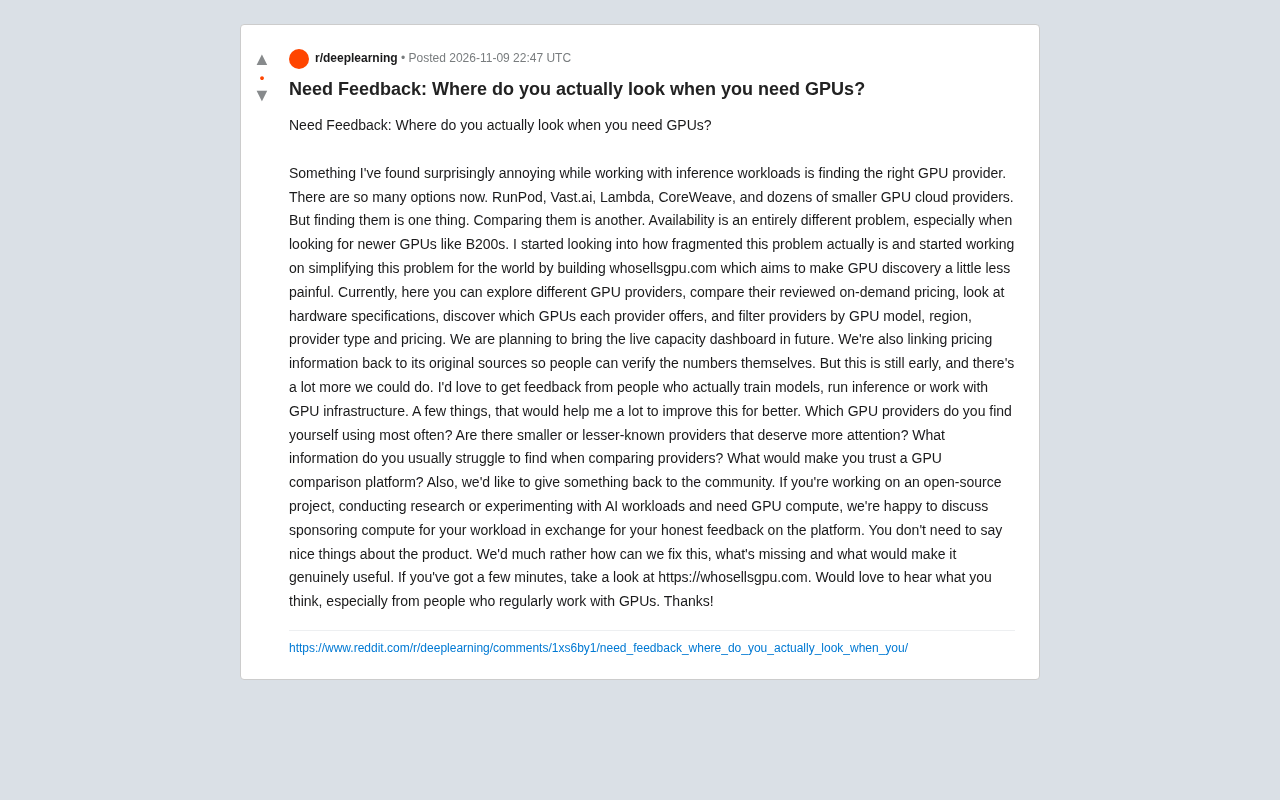
The Real Dilemma of Choosing GPU Cloud Services
Developers running inference workloads have likely all been through this: you need a GPU to run a task, you open a search engine, and you find RunPod, Vast.ai, Lambda, CoreWeave, plus dozens of small GPU cloud providers whose names you can't even recall—each claiming to offer the best price and the best availability.
The problem isn't "finding" them—it's "comparing" them. A developer who started a discussion on Reddit broke this down into three layers: discovering providers is one thing, comparing prices and configurations across them is another, and figuring out the actual availability of a specific GPU (especially new cards like the B200) is an entirely different dimension of difficulty.
This description resonated because the GPU compute market has expanded rapidly over the past while, but the information infrastructure hasn't kept up. The number of providers has grown, yet aggregation and comparison tools are almost nonexistent. Developers often rely on community word-of-mouth, friend recommendations, or signing up and trying each one individually to decide where to host their training jobs and inference workloads.
GPU cloud providers can be roughly grouped into three categories: hyperscale clouds (AWS, GCP, Azure), specialized GPU clouds (CoreWeave, Lambda, RunPod), and decentralized compute marketplaces (Vast.ai, Akash). Their pricing logic differs significantly—hyperscale clouds bundle CPU/memory/storage into instance families, specialized GPU clouds bill by card-hour with bare metal or Kubernetes-native offerings, and decentralized marketplaces set prices through supply-and-demand bidding. This inconsistency in billing units is the technical root of the "can't compare" problem: even with quotes in hand, it's hard to do a direct side-by-side comparison.
An Early Tool's Attempt: Laying GPU Providers Out in One Table
The developer therefore built whosellsgpu.com, with a straightforward goal—to make GPU discovery a little less painful.
The site currently offers the ability to: browse different GPU providers, compare vetted on-demand pricing, view hardware specs, see which GPU models each provider offers, and filter by GPU model, region, provider type, and price.
Two design details are worth noting. First, all pricing information links back to the original source so users can verify the numbers themselves—a crucial trust mechanism in a market where quotes change frequently. Second, the team plans to add a real-time capacity dashboard in the future, directly addressing the pain point of "cards exist but you can't grab one."
The project is still at an early stage, and the author's purpose in posting on Reddit isn't promotion but collecting real feedback.
On-demand pricing refers to a model with no long-term commitment, billed by actual usage time—as opposed to reserved instances and spot instances. For inference workloads, on-demand pricing is the most flexible but has the highest unit price; training jobs often mix in reserved capacity to spread costs. A comparison platform that covers only on-demand prices would miss the discounts and committed contracts in many real procurement scenarios—an inherent limitation of such tools in terms of data coverage.
The Four Questions Developers Really Want Answered
The post raises several specific questions, each pointing to a weak link in the GPU selection chain:
- Which GPU providers do you use most often?
- Are there smaller or lesser-known providers that deserve more attention?
- When comparing providers, what information do you usually find hardest to find?
- What would make you trust a GPU price comparison platform?
Taken together, these four questions are essentially asking the same thing: what should the basis for GPU procurement decisions actually be? Price, availability, regional coverage, provider reliability—each could be a decisive factor, but no single entry point presents all of them at once.
Interestingly, the question of "trust" is raised separately. The value of a comparison platform rests entirely on data accuracy—once pricing is outdated or listings don't match reality, users will leave immediately. The author responds to this with "links back to the original source," which also shows he understands that the core asset of such a tool is credibility, not the number of features.
Trading Compute for Feedback: A Pragmatic Community Cold Start
There's another noteworthy move at the end of the post: if anyone is working on an open-source project, research, or AI experiment and needs GPU compute, the author is willing to discuss sponsoring compute in exchange for honest feedback on the platform.
He specifically emphasizes "you don't need to say nice things about the product"—he'd rather hear "how to fix it, what's missing, and what would actually make it useful." This kind of exchange is common in the cold-start phase of early tools, but using compute as the bargaining chip fits the audience particularly well—GPUs are themselves the scarcest resource in this community.
Fragmentation Is Both an Opportunity and a Barrier
From a broader perspective, this project reflects a structural characteristic of the GPU compute market: supply is highly fragmented, while information aggregation lags far behind.
For providers, fragmentation means customer acquisition depends on word-of-mouth and exposure; for developers, fragmentation means selection costs are implicitly raised. If an aggregation layer can achieve accurate data, timely updates, and sufficiently broad coverage, it genuinely has value. That's also where the difficulty lies—pricing and inventory information from small providers is often not public, and real-time capacity data is each company's core secret. The depth of data the aggregation layer can obtain determines the upper limit of the decision-making value it can provide.
The project can currently answer "who sells which cards and roughly at what price," but it's still some distance from "can I get a card right now, and where's the best deal." Whether the real-time capacity dashboard can be delivered will be the key step in its evolution from a price comparison directory to a decision-making tool.
For developers who deal with GPU infrastructure daily, this kind of tool is worth watching—and worth shaping with feedback. After all, the pain points of GPU selection are universal.
Real-time capacity data is hard to obtain, partly because GPU supply itself is highly time-sensitive: the window from when an H100 or B200 is released to when it's snapped up may be just a few minutes, and providers typically don't expose inventory APIs. There have been some unofficial attempts in the community—for example, periodically probing each platform's instance creation endpoints to infer allocatable capacity—but such methods have limited coverage and are easily rate-limited. As a result, the "can I get a card right now" layer of information is more likely to emerge in the short term through crowdsourced reporting rather than automated collection.
One-line Summary
Fragmentation in the GPU cloud market has spawned the comparison tool whosellsgpu.com, where the author trades compute for feedback.
Paragraph Summary
The article centers on a Reddit discussion started by a developer, pointing out that the core pain point of the GPU cloud services market is that discovering providers, comparing prices, and confirming availability are three disconnected tasks with no unified entry point. The author therefore built whosellsgpu.com, offering provider browsing, vetted on-demand pricing comparisons, hardware spec lookups, and filtering by model/region/price, with pricing linked back to the original source to build trust, and plans to add a real-time capacity dashboard. The post poses four questions to solicit feedback and offers sponsored GPU compute in exchange for honest reviews. The article concludes that supply fragmentation is both an opportunity and a barrier for the aggregation layer, and whether real-time capacity data can be delivered will determine whether such tools can upgrade from a price comparison directory to a decision-making tool.
Related articles

OpenAI to Shut Down Agent Builder and Two Other Services on November 30, Developers Must Migrate Urgently
OpenAI will shut down Agent Builder, the evals dashboard, and reusable prompts on November 30; evals is already read-only. Here's the scope, OpenAI's migration paths (Agent SDK, PromptFu, your own code), and what developers should export and rebuild this week.

RankSpot: A Pay-Per-Use SEO & AI Search Execution Layer That Lets Agents Write, Publish, and Build Backlinks for You
RankSpot is an SEO & AI search execution layer for AI Agents. Connect via MCP to Claude or ChatGPT to write, publish & build backlinks. Pay-per-use, $3/article.

Appxiom: Giving AI Coding Assistants Production Context
Appxiom gives AI coding agents production context—crashes, jank, memory leaks, failed network calls—across Android, iOS, Flutter, KMP, and Web, ranking bugs by Goal Friction Impact.