Graduate Student Proves Quantum Uncertainty Principle on Fractals: A Breakthrough Bridging Fourier Analysis and Geometry

A graduate student proves the quantum uncertainty principle holds on fractal structures, bridging Fourier analysis and geometry.
A graduate student achieved a major breakthrough by proving a quantum uncertainty principle for fractal structures, establishing quantitative constraints showing that a function and its Fourier transform cannot both concentrate on overly sparse fractal sets. This work extends classical harmonic analysis into the fractal domain, blending techniques from Fourier analysis, measure theory, and additive combinatorics, with potential implications for compressed sensing and quantum information.
A Breakthrough Spanning Quantum Mechanics and Geometry
The Heisenberg uncertainty principle is one of the cornerstones of modern physics, revealing a profound limitation in the microscopic world: we cannot simultaneously know a particle's position and momentum with perfect precision. This principle holds not only at the physical level but also has an elegant mathematical expression—it is essentially a theorem stating that a function and its Fourier transform cannot both be "highly concentrated" at the same time.
The Fourier transform is a mathematical tool that converts a function from its original domain (such as the time or spatial domain) to the frequency domain. Intuitively, it decomposes a complex signal into a sum of sine waves at different frequencies. In quantum mechanics, a particle's position wave function and momentum wave function are precisely Fourier transform pairs of each other—this is the mathematical root of Heisenberg's uncertainty principle. A core property of the Fourier transform is: the "sharper" the original function (concentrated in a small region), the "flatter" its transformed result (spread over a large range), and vice versa. This complementary relationship is ubiquitous in signal processing, image analysis, quantum physics, and beyond.
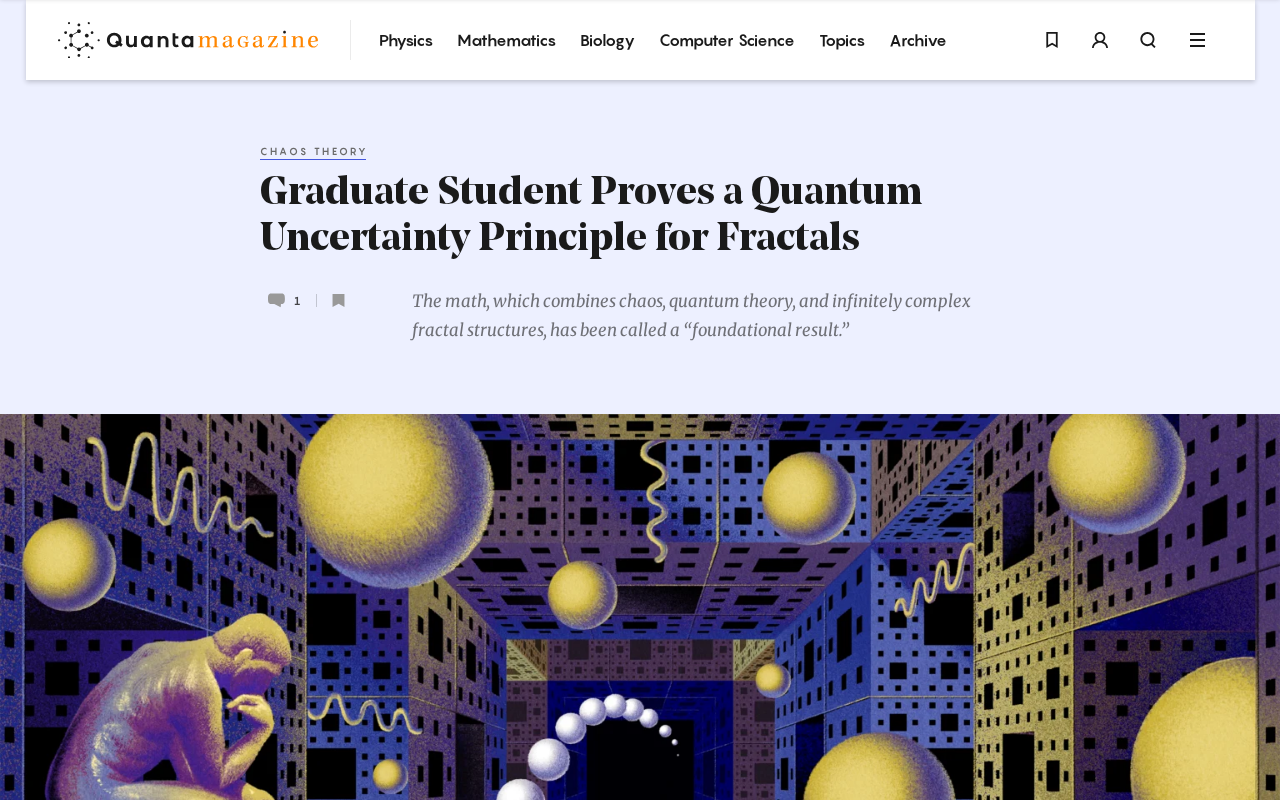
Recently, a graduate student achieved remarkable progress on this classical problem: he proved a quantum uncertainty principle for fractal structures. After this work was reported by Quanta Magazine, it quickly attracted widespread attention from researchers at the intersection of mathematics and physics.
What Is the Mathematical Essence of the Uncertainty Principle?
In mathematical analysis, the uncertainty principle has multiple formulations. The most widely known is the Heisenberg form, but there are stronger versions, such as the "support set uncertainty principle"—which states that a non-zero function and its Fourier transform cannot both be confined to "very small" sets. Here, "small" is typically measured by measure or dimension.
In other words, if a signal is highly localized in the time (or spatial) domain, then it must be spread out in the frequency domain, and vice versa. This principle is not merely a physical limitation but an inherent mathematical tension between waves and frequencies. In more precise mathematical language, these types of uncertainty principles trace back to the work of Hardy, Benedicks, Amrein-Berthier, and others, who proved from different angles that the support sets of a function and its Fourier transform cannot both have finite measure (unless the function itself is zero). These results form the foundational framework for uncertainty principle research in modern harmonic analysis.
Why Fractals Pose a Special Challenge
The "Broken" Geometric Nature of Fractals
Traditional uncertainty principle research is typically built on regular, smooth sets. Fractals, however, are a class of complex geometric objects with self-similarity and non-integer dimension (fractal dimension)—they are neither regular structures like points, lines, and surfaces, nor completely random chaos.
Fractal dimension (also called Hausdorff dimension) is the key tool for measuring fractal complexity. Unlike the topological dimensions we're familiar with (points are 0-dimensional, lines are 1-dimensional, surfaces are 2-dimensional), fractal dimension can take non-integer values. For example, the classic Koch snowflake curve has a fractal dimension of approximately 1.26, meaning it is "more complex" than a line but not enough to fill a surface. The Cantor set has a fractal dimension of approximately 0.63. Fractal dimension is typically calculated using covering methods: covering the set with increasingly smaller balls and observing how the number of required balls grows as the radius shrinks. This dimension precisely characterizes the "density" of a set at different scales and is the core parameter for understanding the strength of uncertainty principle constraints on fractals.
The "fragmented" nature of fractals makes related analysis extraordinarily difficult. Defining Fourier transforms on fractal sets and measuring the degree of function concentration both require entirely new mathematical tools. Measure theory plays an irreplaceable role here: for regular sets, we can use length, area, and volume to measure their size, but fractal sets often have zero traditional Lebesgue measure (for example, the Cantor set has zero Lebesgue measure) while still not being empty sets. Hausdorff measure provides a more refined way of measurement, assigning meaningful "size" to fractal sets. In the fractal generalization of the uncertainty principle, Hausdorff measure and related Frostman measures are needed to precisely describe the mass distribution of functions on fractal sets, thereby converting the intuitive statement "a function is concentrated on a fractal" into rigorous mathematical conditions.
The core question researchers have long been concerned with is: when functions are restricted to fractal sets, does the uncertainty principle still hold? And how strong are the constraints?
The Gap Between Physical Intuition and Rigorous Mathematical Proof
Physical intuition suggests that the complex structure of fractals should impose stricter limitations on the "localization" of functions. But between intuition and mathematical proof there often lies an enormous gulf. To extend the uncertainty principle to the fractal setting, one must precisely characterize the deep relationships between fractal dimension, Fourier spectral decay, and measure theory.
Specifically, Fourier spectral decay describes the rate at which the Fourier transform of a measure supported on a fractal set decays at high frequencies. If a measure supported on a set has good Fourier decay properties, it means that the set's "projection" in frequency space is relatively uniform, providing a key condition for establishing the uncertainty principle. However, not all fractal sets possess such properties, making the problem more subtle—one needs to find the right geometric conditions to guarantee that the uncertainty principle holds.
The Graduate Student's Key Breakthrough: A Quantitative Uncertainty Principle on Fractals
Establishing Quantitative Constraints on Fractal Sets
According to Quanta Magazine's report, this graduate student successfully proved a quantum uncertainty principle for fractal structures. The core result lies in establishing quantitative constraints between the degree to which a function concentrates on a fractal set and its Fourier transform—proving that both cannot simultaneously be confined to overly "sparse" fractal sets.
The significance of this result is that it successfully extends classical Fourier analysis tools to the previously intractable fractal domain, opening new doors for cross-disciplinary research between harmonic analysis and geometric measure theory. Harmonic analysis is the branch of mathematics studying how functions decompose into fundamental oscillations (such as sine waves and wavelets), with the Fourier transform and its various generalizations as its core tools. This field has deep connections to partial differential equations, number theory, geometric analysis, and other branches, and the establishment of a fractal uncertainty principle adds new dimensions to these connections.
The Methodological Value of Multi-Disciplinary Fusion
You might not have noticed, but proofs of this type often require blending techniques from multiple mathematical branches: Fourier analysis, measure theory, additive combinatorics, and more. Additive combinatorics is a branch of mathematics studying additive structure in sets of integers or more general abelian groups. Its core questions include: how a set grows under addition (such as the size of sum sets and difference sets), and whether sets contain structures like arithmetic progressions. Mathematicians like Tao and Green have made epoch-making contributions in this field. In the proof of the fractal uncertainty principle, additive combinatorics provides the crucial "structure vs. randomness" dichotomy tool—if a set has certain additive structure, this structure can be exploited to obtain Fourier estimates; if it is sufficiently "random," probabilistic methods can be applied. This kind of cross-disciplinary methodological fusion is a hallmark of modern mathematics.
That a young researcher can achieve a breakthrough in such a technically intensive field itself demonstrates the power of cross-disciplinary methodological integration.
Research Significance and Future Outlook
Contributions to Foundational Mathematics and Harmonic Analysis
The fractal generalization of the uncertainty principle, though it sounds abstract, touches on one of the most fundamental questions in analysis: how functions distribute between space and frequency. Fractals are ubiquitous in nature and mathematical models, from coastlines to turbulence, from stock prices to the energy spectra of quantum systems.
The prevalence of fractal structures in nature far exceeds most people's imagination. Beyond the classic examples of coastlines and snowflakes, fractals appear in the branching patterns of vascular networks, the structure of pulmonary bronchial trees, the discharge paths of lightning, and the distribution of river systems. In physics, the energy spectra of quantum systems under certain conditions exhibit fractal characteristics (such as the Hofstadter butterfly—a fractal pattern describing the energy level structure of electrons in a two-dimensional lattice under magnetic field influence), and wave functions at the Anderson localization critical point in disordered systems display multifractal distributions. In finance, Mandelbrot was the first to point out that stock price fluctuations exhibit fractal self-similarity. Understanding the uncertainty principle on fractals means we may gain deeper insight into the fundamental limitations on information propagation and energy distribution in these systems.
Potential Applications in Signal Processing and Compressed Sensing
Although this work currently belongs primarily to the realm of pure mathematics, generalizations of the uncertainty principle may have long-term impact in signal processing, compressed sensing, quantum information, and other fields.
Compressed Sensing is a signal processing theory developed in the early 21st century by Candès, Romberg, Tao, Donoho, and others. Its core idea is: if a signal is sparse in some basis (such as the Fourier basis or wavelet basis), meaning most coefficients are zero or near zero, then the signal can be precisely reconstructed using far fewer measurements than required by the Nyquist sampling theorem. The mathematical foundation of this theory is precisely various generalized forms of the uncertainty principle—it guarantees that sparse signals do not "vanish" in the measurement domain. The fractal uncertainty principle provides theoretical limits for understanding more extreme sparse structures (such as signals supported on fractal sets) and may inspire new sampling strategies and reconstruction algorithms.
For example, the core of compressed sensing theory leverages the sparsity of signals in some domain—and the fractal uncertainty principle precisely characterizes the limits of such sparsity.
Inspiration from Young Researchers Challenging Classical Problems
This achievement once again confirms a fact: major breakthroughs in mathematics and theoretical physics often come from young researchers who dare to challenge "old problems." When a graduate student can add a new fractal dimension to the nearly century-old uncertainty principle, this is not only a personal academic achievement but also signals the continued vitality and innovative potential of fundamental science.
It is worth mentioning that the research history of the uncertainty principle itself is filled with precedents of young people creating breakthroughs. Heisenberg was only 25 years old when he proposed the uncertainty principle, and Norbert Wiener, who drove the mathematical rigorization of the principle, also completed his foundational work in his youth. This seems to suggest that maintaining a fresh perspective on fundamental concepts and the courage to question existing frameworks is sometimes more critical than deep accumulated experience.
Conclusion
From Heisenberg to fractals, the evolution of the uncertainty principle is a microcosm of mathematics continually expanding its own boundaries. This graduate student's work combines the profound intuitions of the quantum world with the complex beauty of fractal geometry, offering new perspectives on our understanding of the relationships between waves, frequencies, and geometric structures. Although the complete technical details of the relevant paper still require careful reading by specialist audiences, this breakthrough itself is enough to fill us with anticipation for the future of fundamental science.
Related articles

"Black October": Did AI Uncover 3% of All Critical Vulnerabilities Ever?
A Reddit post claims 3% of all critical software vulnerabilities ever were found in the past month, dubbed 'Black October.' We break down the statistical issues, how AI-assisted code auditing accelerates discovery, and how developers should respond.

Microsoft Project Gecko: Using AI to Bridge Language Gaps for African Farmers
Microsoft's Project Gecko launches PharmaChat, letting African farmers ask questions in their native language and get precise video clips and farming book chapters via AI. The project also releases three interactive manuals to advance inclusive AI.

Musk's Space Dominance: How Starlink Throttling Undermines Ukraine's Defense
SpaceX's Starshield throttling disabled Ukraine's high-speed interceptor drones, exposing how Musk's private control over low Earth orbit communications affects battlefield dynamics and national security, and highlighting the risks of commercial space militarization and space governance dilemmas.