Grammar Lens Benchmark: Quantifiably Distinguishing GPT-5.5 Reasoning Levels

Formal grammar benchmark shows higher GPT-5.5 reasoning levels boost computation but widen divergence from humans.
The article introduces a formal-grammar-lens benchmark from computation theory that generates data at different computational tiers to probe internal model capability without fixed question banks. Testing GPT-5.5 and its Pro-Medium, Pro-High, and Pro-XHigh levels, researchers found data acceptance rises stepwise with reasoning level, confirming test-time compute gains and fine-grained tier discrimination. Yet divergence from human answers also widens, suggesting a capability-alignment tension and arguing evaluations should track both capability and alignment.
Title
Grammar Lens Benchmark: Quantifiably Distinguishing GPT-5.5 Reasoning Levels
Meta Description
A formal-grammar-lens benchmark derived from computation theory generates data at different computational capability tiers, successfully distinguishing GPT-5.5 and its Pro-Medium, High, and XHigh reasoning levels. Tests show that higher reasoning levels yield higher data acceptance rates, but the divergence between model and human answers also widens, revealing a potential conflict between capability and alignment.
Article Content
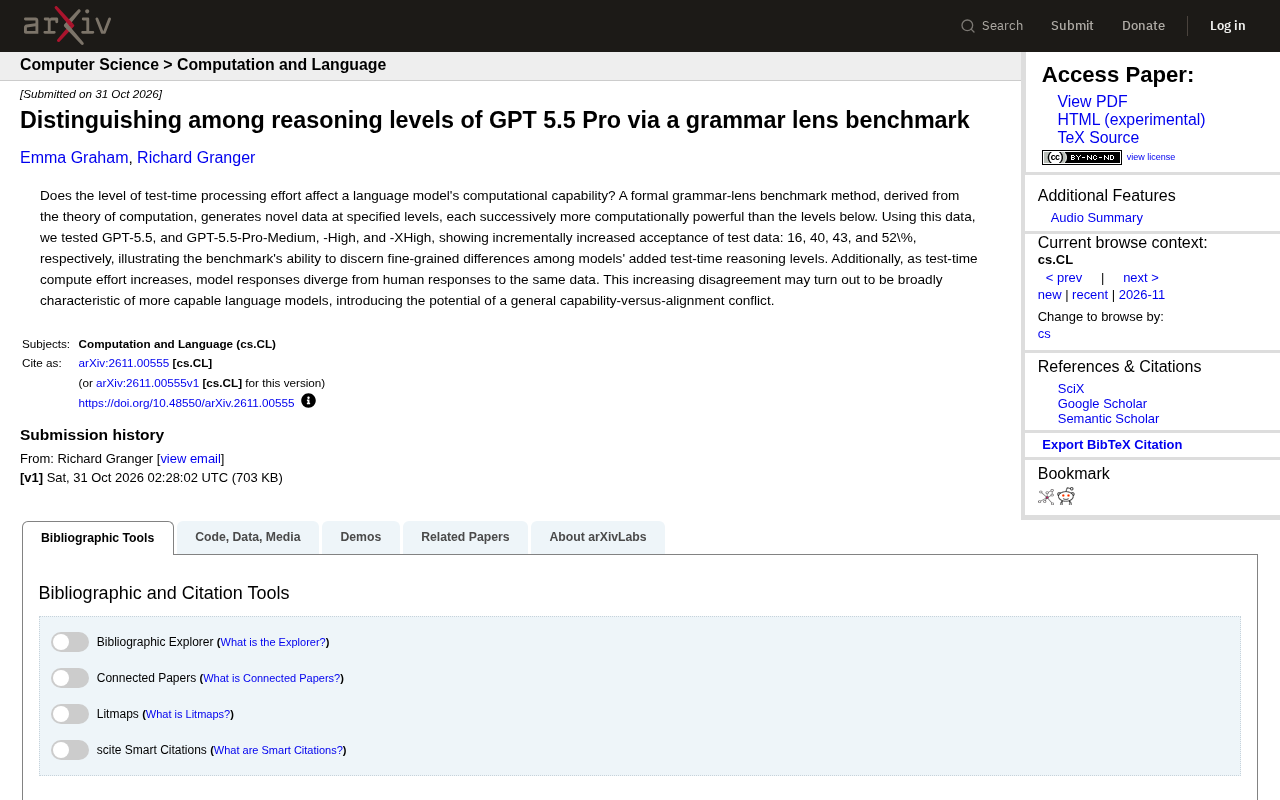
Does a reasoning model's longer "thinking time" mean greater computational capability? A formal-grammar-lens benchmark derived from computation theory offers a quantifiable observation window into this question. Researchers used the benchmark to generate new data at different computational capability tiers and tested GPT-5.5 along with its Pro-Medium, Pro-High, and Pro-XHigh reasoning-level variants. They found that the model's acceptance rate on the test data increases with reasoning level, and the differences between levels are clearly distinguishable.
Benchmark Design: Measuring Computational Capability with Formal Grammars
The core of this method lies in the combination of formal grammars and computation theory. Researchers construct data according to computational capability tiers, where each tier possesses greater computational capability than the one below it. If a model can respond correctly to data at a higher tier, it indicates that its internal computational capability has reached the corresponding level. This approach does not rely on traditional question-bank-style evaluation; instead, it dynamically generates new data, avoiding memorization and overfitting to fixed questions.
The original text notes that the benchmark can "distinguish differences in models' test-time reasoning levels at fine granularity." In other words, it does not merely produce a single total score but can determine which tier a model's computational capability falls into—offering reference value for assessing the true capability boundaries of reasoning models.
Formal Grammars and the Chomsky Hierarchy
A formal grammar is a formalized system in computation theory that describes the generation rules of a language (a set of strings). The most classic classification is the Chomsky hierarchy: regular grammars, context-free grammars, context-sensitive grammars, and unrestricted grammars, which correspond respectively to the language classes recognizable by finite-state automata, pushdown automata, linear-bounded automata, and Turing machines. The higher the tier, the more complex the structures the grammar can express, and the more computational resources are required for recognition. The article's phrase "constructing data according to computational capability tiers" leverages precisely this hierarchical structure: strings generated by lower-tier grammars require only finite memory or a stack to decide, while higher-tier grammars require stronger computational mechanisms. Therefore, whether a model can correctly accept or reject samples at a given tier can serve as a lower-bound probe of its internal computational capability, rather than inferring capability solely from question difficulty or knowledge coverage.
Test-time Compute
Test-time compute refers to the additional computation a model invests during the inference stage (rather than the training stage) to generate an answer. Typical forms include extended chain-of-thought, multiple sampling followed by selection, search, or self-verification. It is contrasted with training-time compute and has been one of the main levers for capability improvements in recent reasoning models (such as the OpenAI o series and the Pro variants of GPT-5.5 mentioned in the article). Different "reasoning levels" are essentially reasoning-budget tiers exposed at the product level: the higher the level, the more thinking tokens or steps the model is allowed to consume before giving a final answer. Understanding this is crucial because the article measures not model parameter scale but performance differences of the same model under different reasoning budgets, thereby turning the relationship between "more thinking" and "stronger computation" into an experimentally testable question.
Empirical Results: Higher Reasoning Levels Yield Higher Data Acceptance Rates
Researchers used the benchmark to test GPT-5.5 and the four versions GPT-5.5-Pro-Medium, GPT-5.5-Pro-High, and GPT-5.5-Pro-XHigh. Results show that as the reasoning level increases, the model's acceptance rate on the test data rises in turn, presenting a clear stepwise increase from the base version to the highest reasoning level.
This result demonstrates two points. First, increased test-time reasoning investment does indeed bring improvements in computational capability, rather than merely changing output style. Second, the benchmark is capable of distinguishing subtle level differences—although the gaps among the four versions are not order-of-magnitude jumps, they are sufficient to be stably observed.
Potential Conflict Between Capability and Alignment
The study also reveals a trend more worthy of attention: as test-time compute investment increases, the divergence between model answers and human answers also widens. The original text describes this phenomenon as "possibly a general characteristic of stronger language models" and notes that it introduces "a potential general conflict between capability and alignment."
The significance of this finding lies in placing capability improvement and behavioral alignment in the same coordinate system for observation. The stronger the model, the more likely it is to make judgments different from humans on the same data. Such divergence is not necessarily an error in itself, but if it is widespread, it means that pursuing reasoning capability improvements alone may lead model behavior further and further from human expectations.
Alignment and "Divergence from Human Answers"
Alignment typically refers to making a model's behavior, judgments, and outputs conform to human intent and values. Common methods include reinforcement learning from human feedback, preference optimization, and behavioral norm constraints. The article uses "divergence between model answers and human answers" as a proxy observational metric for alignment: on the same input, the higher the proportion of cases where the model's judgment deviates from human judgment, the lower the degree of alignment can be roughly considered to be. It is important to distinguish that divergence is not equivalent to error—on some questions humans themselves may be wrong, and a model's "disagreement" may be an independent judgment brought about by capability. But when divergence systematically expands with reasoning capability, it shows that capability improvement and behavioral convergence do not automatically proceed in sync. This constitutes the empirical basis for the capability–alignment tension and also suggests that evaluation cannot rely solely on the single dimension of accuracy.
Implications for Reasoning Model Evaluation
Existing evaluations mostly focus on accuracy or pass rates, while this grammar-lens benchmark provides another dimension: tier localization of computational capability. For model products offering multiple reasoning levels, this kind of evaluation can help users understand "what extra reasoning time buys" and can also provide model developers with reference for allocating reasoning budgets.
At the same time, the finding that divergence expands as capability rises suggests that evaluation systems need to pay attention to both capability metrics and alignment metrics. If a model that is stronger in computational capability deviates further from human judgment, its actual deployment value needs to be assessed more cautiously. The original text calls this tension "a potential conflict between capability and alignment," which may be one of the core issues that need continuous tracking in the era of reasoning models.
One-line Summary
A formal grammar benchmark shows that higher GPT-5.5 reasoning levels yield stronger computational capability, but divergence from humans widens in tandem.
Paragraph Summary
The article introduces a "grammar lens" benchmark based on computation theory and formal grammars, which dynamically generates data at different computational capability tiers to probe a model's internal computational capability and avoid memorization and overfitting caused by fixed question banks. Researchers used the benchmark to test GPT-5.5 and four reasoning levels—Pro-Medium, Pro-High, and Pro-XHigh—and found that the acceptance rate on test data increases stepwise with reasoning level, indicating that test-time compute investment indeed brings computational capability improvements and that the benchmark can stably distinguish subtle level differences. However, the study also found that as computational investment increases, the divergence between model answers and human answers also widens. The article views this as a potential general conflict between capability and alignment and argues that evaluation systems should attend to both capability-tier localization and alignment metrics.
Related articles

Open-Source LLMs Erupt: Kimi K3.1 Weights Released and New Breakthroughs in Computer Control
This week's open-source releases: Moonshot opens Kimi K3.1 Pro weights, Bipo AI debuts computer-control model North Kua, Pruna AI turns Minimax H3 into efficient image model PH3, Pika H3 Flex tops open text-to-video, plus MIT science model and more.

Breaking the AI Memory Wall: Five Stacked Memory Utilization Strategies
NVIDIA breaks down five ways to break the AI memory wall: NVFP4 quantization compresses weights to 4 bits, WideEP and NVLink distribute MoE experts, Dynamo reuses context, Vera CPU shortens tool-call idle time, and CMX enables cross-server context reuse—improving memory utilization across what to store, where to place it, and how much to reuse.

TED Speaker's Visual Secrets: When and How to Use Slides
TED speaking course reveals how to use visual aids effectively: when slides are needed, the three elements of strong visuals (revelation, explanatory power, aesthetic appeal), and how to avoid distraction for greater impact.