GrapheneOS May Ship Pre-installed: A Signal That Privacy Phones Are Going Mainstream

GrapheneOS hints that pre-installed devices are coming, potentially bringing privacy phones to mainstream users.
GrapheneOS has signaled that devices shipping with it pre-installed are increasingly likely, drawing wide attention from the tech community. Previously, users had to manually flash a Pixel device — a high barrier for most. Known for strict sandboxing, a hardened memory allocator, granular permissions, and sandboxed Google Play, GrapheneOS is a favorite among privacy-conscious users and security researchers. The biggest challenge for pre-installed shipping is hardware compatibility and Verified Boot, since only Pixel devices currently support re-locking the bootloader after a custom OS flash. Commercial, compliance, and after-sales questions also remain open. Overall, the signal reflects a trend of privacy phones moving from geek niche to mainstream consumer option.
The privacy-focused Android distribution GrapheneOS recently sent a notable signal on social media: the possibility of devices shipping with GrapheneOS pre-installed is rising significantly. The news earned 268 upvotes and hundreds of comments on Hacker News, reflecting strong interest from the tech community in the future of mobile privacy.
What the Announcement Actually Said
GrapheneOS officially stated on its social accounts that devices shipping with GrapheneOS pre-installed are quite likely to happen. For a project that has long relied on users manually flashing their own devices, this represents a meaningful shift in direction.
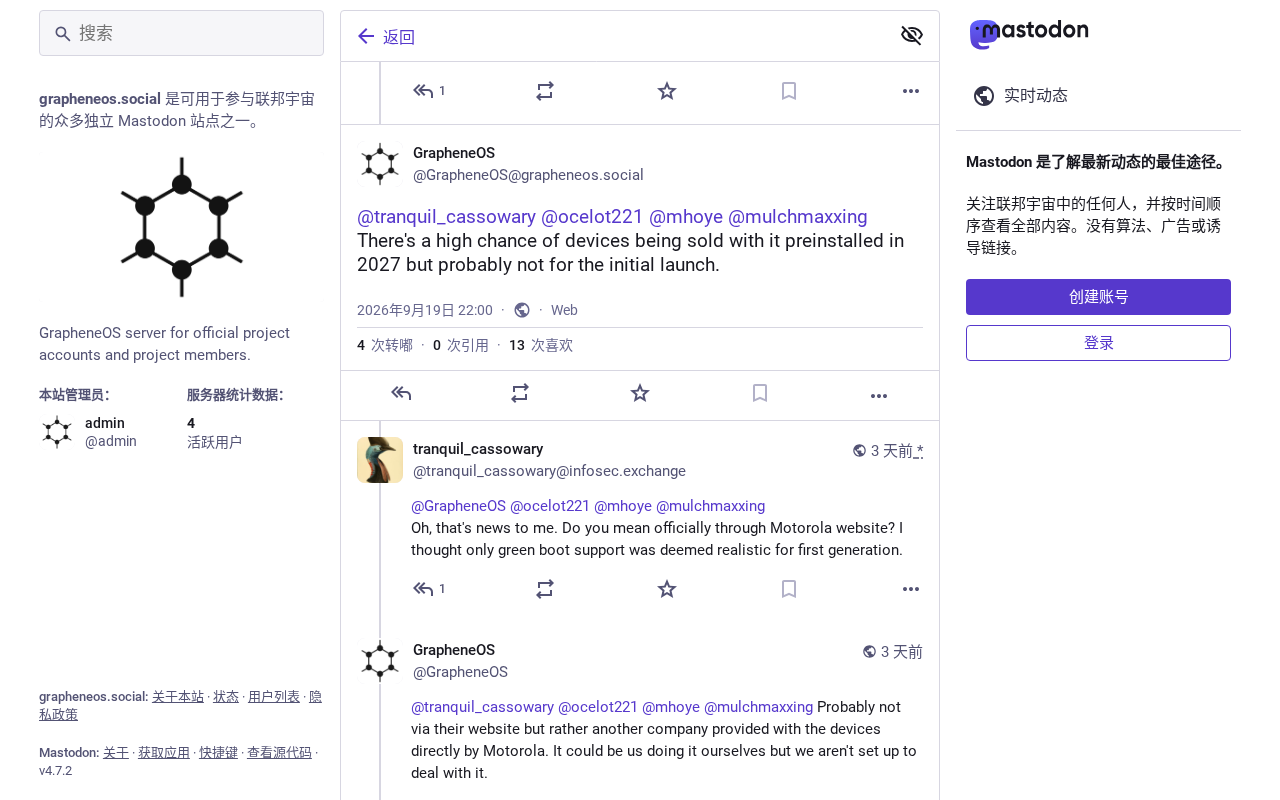
Previously, anyone who wanted to run GrapheneOS had to purchase a supported device (primarily from the Google Pixel lineup), manually unlock the bootloader, and flash the OS themselves. While that process poses no real barrier for technically inclined users, it has kept the vast majority of everyday users out of reach. A device that ships with GrapheneOS pre-installed would dramatically lower that barrier.
Why This Matters
GrapheneOS is widely regarded as one of the best privacy- and security-focused Android distributions available today. It builds on top of stock Android with extensive hardening: stricter sandboxing, a hardened memory allocator, more granular permission controls (including revocable network and sensor permissions), and a sandboxed Google Play solution that allows apps to run without granting the Google services framework system-level trust.
For privacy-conscious users, journalists, security researchers, and even certain enterprises and government agencies, the value of a system like this lies in how tightly it constrains the chain of trust. Pre-installed shipping means system integrity can be guaranteed from the supply chain itself — users don't have to do anything themselves, and the risk of errors or vulnerabilities introduced during the flashing process is eliminated.
Sandboxed Google Play is one of GrapheneOS's key design innovations. In standard Android, Google Play Services runs as a high-privilege system service with access to a wide range of low-level APIs and user data. GrapheneOS runs it as a regular app inside an isolated sandbox, stripping away its privileged status so it cannot bypass system permission controls. This allows users to run apps that depend on Google Play Services without granting the framework system-level trust — striking a balance between compatibility and privacy protection. It's one of the reasons GrapheneOS is more practical than other de-Googled systems that simply remove all Google components entirely.
The Real-World Challenges of Pre-Installed Shipping
Shipping a third-party OS pre-installed sounds straightforward, but the execution is anything but. The core difficulties lie in hardware compatibility and secure boot.
Hardware and Verified Boot
GrapheneOS has long supported only Pixel devices, largely because Pixels offer reliable Verified Boot support — allowing users to re-lock the bootloader after flashing a custom OS, thereby maintaining a complete and secure boot chain. Achieving pre-installed shipping either means continuing to build on Pixel hardware, or finding an equally open and secure hardware partner — which is rare in today's market.
Verified Boot is one of the core security mechanisms in the Android ecosystem. At each stage of the boot process, the system verifies the digital signature of the next stage's code, forming a continuous chain of trust rooted in hardware (such as keys baked into the chip) and extending all the way up to the operating system. If any link in that chain has been tampered with, the device will refuse to boot or display a warning.
What makes Pixel devices special is that their bootloader allows users to write in a custom signing key and then re-lock — meaning that even after flashing GrapheneOS, the full Verified Boot process remains intact. Most other Android devices, once unlocked, cannot be re-locked; they display a persistent warning on boot and lose hardware-level integrity verification. Pre-installed shipping sidesteps this entirely: the device leaves the factory locked with GrapheneOS's own keys, so the user receives a device that is already protected by a complete chain of trust.
Commercial and Compliance Considerations
Pre-installed shipping also involves device certification, supply chain partnerships, and potential compliance considerations related to Google. Questions around who manufactures the device, who sells it, and how after-sales support and updates are handled all need to be worked out. Voices in community discussions have also cautioned that "highly likely" is not the same as confirmed — the specific form and timeline remain subject to change.
What This Means for the Privacy Phone Ecosystem
Regardless of how this ultimately materializes, the announcement itself reflects a broader trend: privacy phones are evolving from a niche for enthusiasts into a viable consumer option. In recent years, growing user awareness around data collection, targeted advertising, and platform lock-in has created real demand for de-Googled, privacy-first mobile operating systems.
If pre-installed devices do come to fruition, they could serve as a proof of concept — demonstrating that privacy-first mobile systems are not only technically viable, but commercially viable as well. That would be a positive signal for the entire open-source mobile ecosystem, including projects like LineageOS and /e/OS.
Closing Thoughts
GrapheneOS's announcement reads more like expectation-setting than a formal product launch. It communicates a clear direction and a high degree of confidence, but the specifics remain to be seen. For users who care about mobile privacy, the questions worth following are: what hardware will it run on, at what price point, and through what channels will it reach the market — because those are the factors that will determine whether GrapheneOS can truly break out of its niche.
Related articles

WorkBuddy Full Tutorial: Build an AI Office Automation Agent from Scratch
A complete WorkBuddy tutorial: installation, three working modes, multimodal picture book video practice, expert team agent building, and workflow configuration for low-cost AI office automation.

WorkBuddy Agent Complete Guide: From Beginner to Automation in 7 Days
Based on Bilibili's 256-episode WorkBuddy masterclass, this systematically breaks down Tencent's AI office workbench core capabilities: Agent principles, Skill encapsulation, cross-platform connectors, scheduled automation, knowledge bases, and zero-code development, with learning path recommendations.

8 AI Accounts, 7 Failed: An Honest Review of Using AI to Get Work Done
Only 1 of 8 AI-run Bilibili accounts succeeded. We break down the real difference between "performing AI" and "using AI to get work done."