GraphRAG Open-Source Blueprint: An Engineering Reference Architecture for Cross-Document Knowledge Q&A

An open-source GraphRAG blueprint enabling cross-document reasoning via knowledge graphs and hybrid retrieval.
The Agentic GraphRAG Blueprint is an open-source reference architecture that goes beyond traditional chunk-based RAG by combining knowledge graphs with vector search for cross-document reasoning. Key features include incremental ingestion for cost control, dual local/global retrieval modes, domain-agnostic prompts, Leiden algorithm-based community detection, and production-ready deployment via Docker and Terraform.
From Traditional RAG to GraphRAG
Retrieval-Augmented Generation (RAG) has become the standard approach for building enterprise-level document Q&A systems. However, traditional RAG has a notable weakness: it primarily relies on "chunk retrieval"—splitting documents into segments and returning the most relevant passages through vector similarity matching. This approach works reasonably well for answering "specific fact" questions, but often falls short when questions require synthesizing and reasoning across multiple documents, connecting disparate facts.
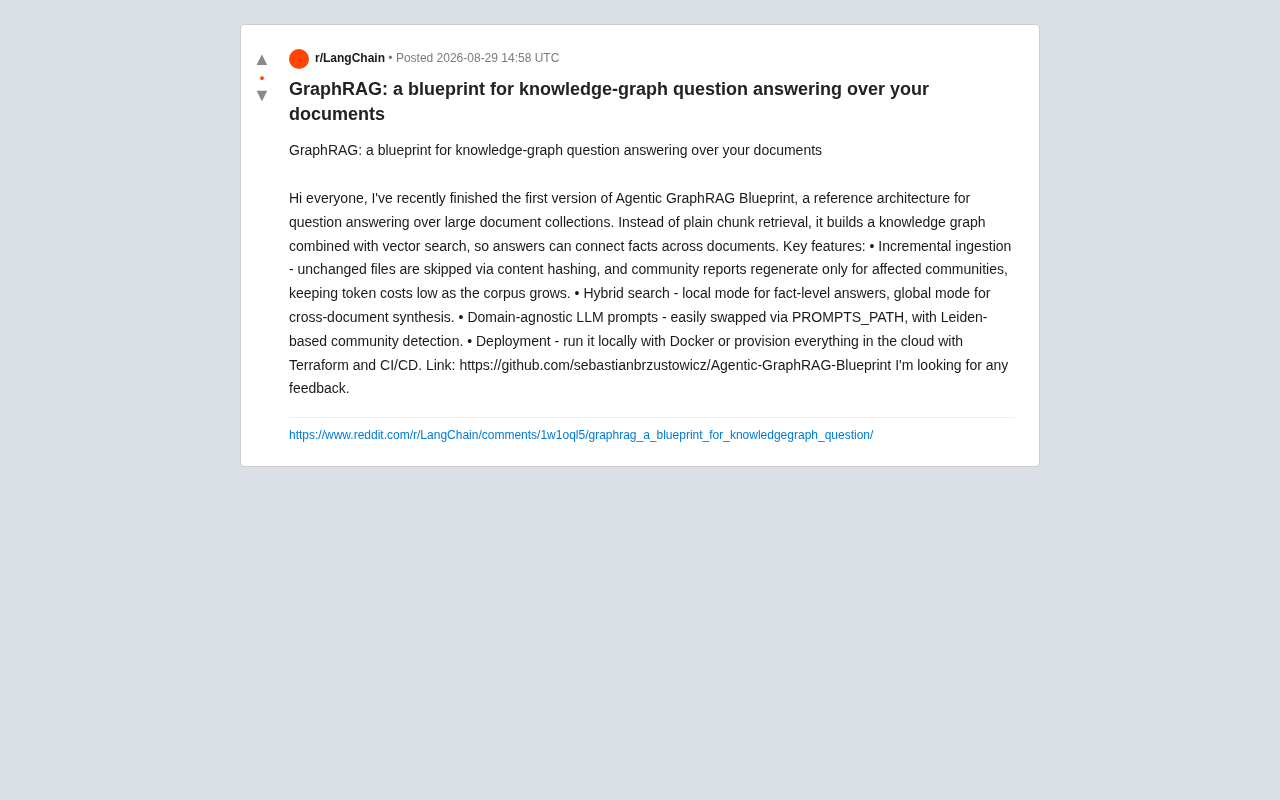
Recently, developer Sebastian Brzustowicz shared his newly completed first-version project on Reddit—Agentic GraphRAG Blueprint. This is a reference architecture designed for large-scale document collection Q&A. Its core idea: rather than relying solely on chunk retrieval, it builds a knowledge graph and combines it with vector search, enabling the system to connect facts scattered across different documents and deliver answers with a more holistic perspective.
Core Features of the GraphRAG Blueprint
This blueprint is not a simple demo—it provides a production-ready engineering reference architecture. Based on the author's disclosed information, it features thoughtful design across several key dimensions.
Incremental Ingestion: The Key to Controlling Token Costs
For any continuously growing document library, cost control is an unavoidable practical concern. GraphRAG Blueprint employs an Incremental Ingestion mechanism: through content hashing comparison, unchanged files are skipped entirely without reprocessing; meanwhile, community reports are only regenerated for affected communities.
The value of this design is clear—as the corpus scales up, the system's token consumption doesn't explode linearly. For enterprise scenarios requiring frequent document updates (such as legal document repositories or technical knowledge bases), this translates to significant operational cost optimization.
Hybrid Retrieval: Local and Global Dual Modes
The project offers two retrieval modes, each addressing different document Q&A needs:
- Local Mode: For precise, fact-level Q&A, suited for questions like "What is this specific parameter value?"
- Global Mode: For cross-document synthesis and summarization, suited for questions like "What is the overall perspective across the entire document library on a given topic?"—questions requiring a macro-level view.
This dual-mode design represents a core advantage of GraphRAG over traditional RAG—it preserves the accuracy of fine-grained retrieval while leveraging the knowledge graph's community structure to support cross-document comprehensive reasoning.
Technical Architecture and Extensibility Design
Domain-Agnostic Prompts and Graph Construction
To make this architecture adaptable across industries, the author adopted a domain-agnostic LLM prompt design. Users can easily swap prompt templates via the PROMPTS_PATH parameter, migrating the system to different verticals such as healthcare, finance, or legal—without modifying any core code.
For the critical knowledge graph construction step, the project uses the Leiden algorithm for community detection. The Leiden algorithm is a classic method in graph clustering that, compared to the earlier Louvain algorithm, produces higher-quality community partitions with better connectivity, thereby providing a more rational hierarchical structure for global-mode comprehensive Q&A.
Flexible Deployment Options
On the deployment front, the blueprint accommodates both local development and cloud production scenarios:
- Local deployment: Quick startup via Docker, making it easy for developers to validate results in local environments.
- Cloud deployment: Provides Terraform Infrastructure as Code (IaC) along with CI/CD pipeline support, enabling one-click provisioning of the full resource stack in the cloud.
This "out-of-the-box" deployment design lowers the barrier to engineering adoption, giving it genuine reference value as a "Blueprint" rather than being merely a research prototype.
Engineering Value and Outstanding Challenges
The GraphRAG concept was first systematically proposed and open-sourced by Microsoft Research, subsequently spawning numerous community-driven variant implementations. Sebastian's project, named "Agentic GraphRAG," emphasizes Agentic capabilities on top of traditional GraphRAG, implying the system goes beyond passive retrieval to potentially possess autonomous planning and multi-step reasoning abilities—though the author did not elaborate on the implementation details of this aspect in the current release.
From an engineering practice perspective, several highlights of this project deserve attention:
- Cost-consciousness permeates the design—incremental ingestion directly addresses GraphRAG's pain point of high construction costs.
- Production-ready deployment—Terraform + CI/CD signals this is more than a toy project.
- Reusable architecture template—domain-agnostic prompt design enables cross-industry portability.
Of course, as an open-source project that just released its first version, it still awaits community validation. GraphRAG solutions generally face challenges including knowledge graph construction quality, retrieval latency at scale, and how to optimally fuse knowledge graphs with vector stores. The author himself explicitly stated in the post that he is "looking for feedback"—which is precisely where the value of open-source collaboration lies.
For teams exploring enterprise-level document Q&A, reference architectures like this provide a worthwhile starting point for study. The project is open-sourced on GitHub (Agentic-GraphRAG-Blueprint). Interested developers are encouraged to deploy it hands-on and share feedback on real-world usage issues with the author.
Related articles

Amphibious Transforming Drone: Beyond 100x Power Savings, What Are the Real Needs?
Is the amphibious transforming drone just a gimmick? Starting from the 100x power difference of the M4 Morphobot, explore real application scenarios and thesis topic ideas, analyzing boundary conditions where pure drones and pure ground robots both fail.

Warhound Raises $200 Million: Genetically Engineered "War Dogs" Paired with Anduril Gear
Warhound raises $200M, backed by Ben Lamm and Palmer Luckey, to genetically engineer dogs for military and law enforcement use and equip them with Anduril gear. This article analyzes its technology direction, funding logic, and ethical controversy.

Claude API Comes to Google Cloud: IAM Integration and SDK Access Guide
Anthropic hosts the full Claude API on Google Cloud with IAM-controlled permissions and unified billing. This guide covers the Vertex AI and Anthropic-hosted entry points, IAM role configuration, and SDK access.