GrassToucher: Turning the 'Go Touch Grass' Meme into Reality with Open-Source AI

An open-source AI app that turns the 'go touch grass' meme into real outdoor habit prompts.
GrassToucher is a Hacktoberfest open-source project that transforms the developer meme 'go touch grass' into an AI-powered environmental companion. It collects GPS, time, and weather data to generate personalized outdoor micro-tasks using open-weight models like Google Gemma 2, guiding developers and remote workers back into nature. Built as a PWA with Service Worker offline support and Sentry observability, it showcases the advantages of open-source AI — local inference, privacy preservation, and community adaptability — over closed-source APIs.
An Open-Source Project That Turned a Meme into a Product
There's a running joke in developer circles — "go touch grass" — used to tease anyone who's been staring at screens too long and has lost touch with the real world. GrassToucher, a project entered in the Hacktoberfest open-source AI challenge, takes that joke and turns it into an actionable habit loop.
Its positioning is clear: an open-source AI-powered "environmental companion" that evaluates real-world parameters (GPS coordinates, current time, weather, perceived surroundings) to generate instant, context-aware outdoor micro-tasks and ecological observation suggestions. The core logic is straightforward — use an open-source model to deliver a brief insight or challenge, then prompt the user to lock their screen and step outside.
The target audience is developers, students, and remote workers — exactly the people who need a gentle nudge to reconnect with the physical world. The project is live at grasstoucher.onrender.com, and the full source code is available on GitHub at Moeen-19/grasstoucher.
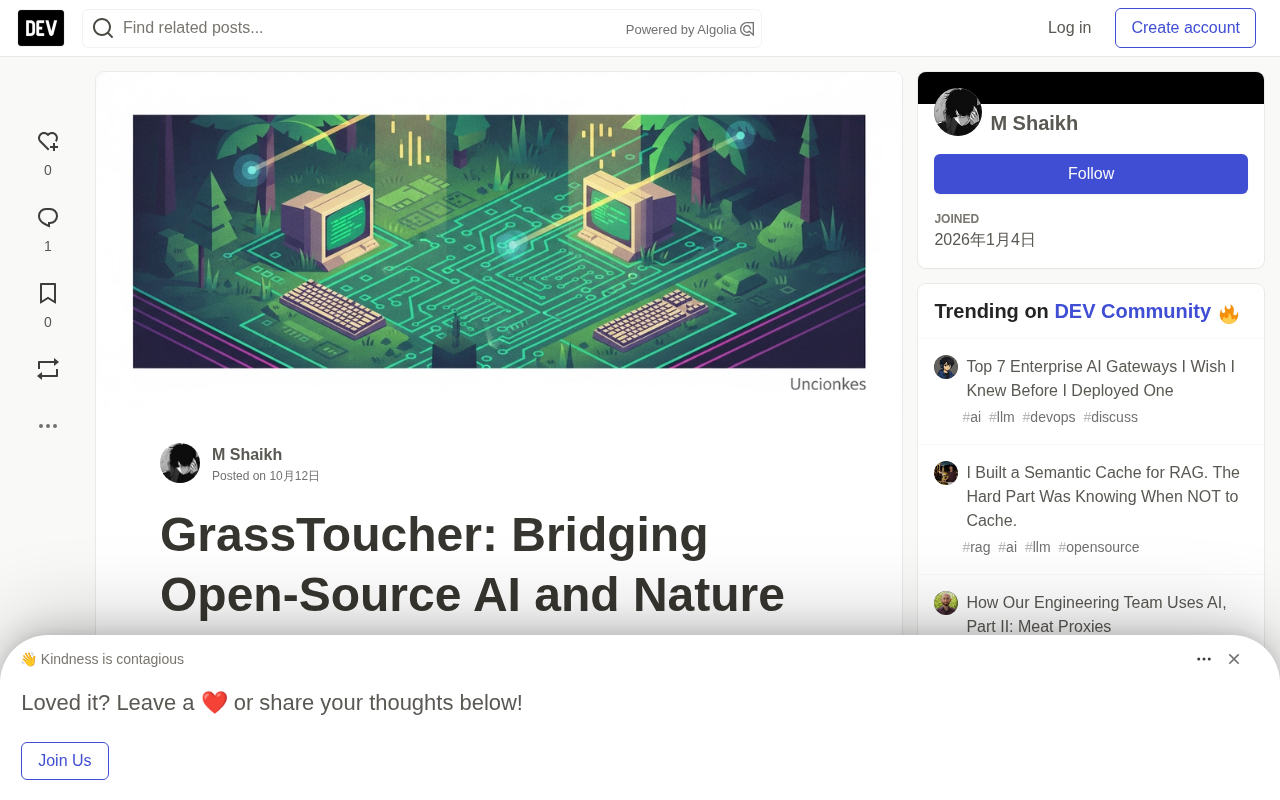
Technical Architecture: Open-Source Models + Privacy-First Full-Stack Design
The technical highlight of GrassToucher is how it bridges native Web telemetry data (geolocation, sensory data, offline status) with open-weight AI models to deliver instant, context-aware outdoor prompts — without compromising performance or privacy.
Open-Source AI Model Pipeline
At its core is a lightweight open-source AI framework designed to efficiently run open-weight models like Google Gemma 2, with support for local execution via Ollama or Transformers.js. The process has three stages:
- Context assembly: At session start, the app collects environmental metrics on the client side (latitude/longitude, daylight duration, seasonal context) and formats them into a structured system prompt.
- Open-weight inference: Instead of relying on heavyweight closed-source APIs, it uses compact open-source models fine-tuned to parse structured JSON output. The AI evaluates real-time environmental factors and generates randomized, creative micro-tasks — like "find a plant with serrated leaves within 50 meters and identify its texture," or "step away from the backlit screen for 5 minutes of silent observation."
- Deterministic guardrails: Output schema constraints ensure the AI consistently returns valid, safe outdoor challenges, avoiding unsafe instructions or unparseable formats.
Google Gemma 2 is a series of open-weight language models released by Google DeepMind in 2024, ranging from 2B to 27B parameters. The key distinction from closed-source models like GPT-4 is that Gemma 2's weights are fully public — developers can download and run them locally without sending requests to Google's servers via API. Ollama is a tool that lets everyday developers run popular open-source models like Llama and Gemma on their local machines with a single command, functioning like "Docker for local models." Transformers.js is a JavaScript library from Hugging Face that runs quantized small models directly in the browser or Node.js environment without server-side inference. Together, they form the technical foundation for GrassToucher's ability to perform inference without relying on any closed-source cloud API.
Full-Stack Web Application Design
The frontend uses vanilla modern JavaScript, HTML5, and CSS3, deliberately keeping the JS bundle small. It calls the browser's Geolocation API directly to capture precise location data and handles permission states gracefully.
Since "touching grass" often takes users to areas with weak signals, the project implements a Service Worker (sw.js) with a smart cache fallback strategy using cache.put(), keeping the app responsive and functional even without Wi-Fi or cellular coverage.
Error handling integrates Sentry client-side monitoring to capture geolocation edge cases (like GeolocationPositionError over HTTP, permission denials) and network race conditions, ensuring a reliable user experience.
A Service Worker is a background script mechanism provided by the browser, running in a separate thread that can intercept all network requests from a page and return cached content. This gives Web apps native-app-like offline capabilities and is a core technology behind Progressive Web Apps (PWAs). GrassToucher's
cache.put()strategy proactively writes critical resources (HTML, JS, CSS, and AI model weights) to local cache when a connection is available. When users wander into a dead zone, the Service Worker automatically responds from cache, keeping the entire app fully functional. This is especially critical for a scenario designed to push users into the outdoors — the places with the worst signal coverage are often exactly where you most want to "touch grass."
Why Open-Source Innovation Matters Especially Here
This seemingly lighthearted little project actually makes a sharp point about several key advantages of open-source AI over closed-source APIs — advantages that happen to align perfectly with the "go outside" use case.
Privacy and locality is the first argument. Reconnecting with nature shouldn't require continuously streaming location telemetry to closed-source enterprise servers. Open-weight models support local and edge processing, keeping sensitive GPS coordinates and personal activity logs entirely on-device.
Offline resilience is the second argument, and the philosophical core of the entire project design. Closed-source cloud APIs fail the moment you lose cellular signal — on hiking trails, in dense forests, in local parks. Open-source models can be embedded directly into mobile devices or low-power edge hardware, delivering offline intelligence in any outdoor environment.
Community ownership and adaptability is the third argument. Any open-source community member can fork the repo, swap out the underlying model, fine-tune prompts for specific regional flora and ecosystems, or extend tool-calling capabilities — without worrying about rate limits, price hikes, or sudden vendor API deprecation.
What This Project Teaches Us
GrassToucher is a Hacktoberfest submission — it's not feature-rich, but it demonstrates an interesting product philosophy: using AI to solve a problem that AI practitioners created themselves. Developers get stuck at their screens because of their tools, then use open-source tools to push themselves back outside. That self-contained loop is more memorable than a simple "take a break" reminder app.
From an engineering perspective, it's also a solid lightweight reference for PWA + open-source model integration: Gemma 2 for inference, Render for hosting, Sentry for observability, and Service Worker for offline fallback. This stack has real reference value for any developer looking to build edge AI applications.
Of course, as a hackathon submission, its actual maturity and long-term maintenance remain to be seen, and the real-world AI inference quality and local deployment experience need further validation. But as a small, elegant example of combining a meme, open-source ethos, and pragmatic engineering, it's genuinely worth a look.
A PWA (Progressive Web App) is a type of application built with standard Web technologies but delivering a native app-like experience — core capabilities include being installable on a phone's home screen, supporting offline access, and receiving push notifications. Compared to building separate iOS/Android apps, a PWA requires only a single codebase and can be distributed directly via URL without going through an app store. For a hackathon project like GrassToucher, the PWA approach dramatically lowers development and distribution costs, while the Service Worker + open-source model combination gives it offline capabilities on par with native apps — making it a technology stack worth prioritizing for small teams or solo developers building edge AI applications.
Related articles

Felix Rieseberg Personal Homepage
Felix Rieseberg's personal homepage sparks attention on Hacker News. This article covers the Slack engineer's technical background, the rise and fall of nativefier, and the value of a developer homepage as a tech calling card.

@ai-sdk/vue 3.0.306 Patch Release Syncs with [email protected] Update
@ai-sdk/vue 3.0.306 released, synced with [email protected]. A routine patch release for the Vercel AI SDK ecosystem with no public API changes; the Vue adapter layer stays version-aligned with the core package.

Gemini 4 Argon API Launches: The Era of Million-Token Output Begins
Google launches Gemini 4 Argon with sparse MoE architecture, up to 1M output tokens, and a 68.90% Vals Index score, available across API, AI Studio, and the Gemini app.