Gravity: Natural-Language Weekly Task Automation — Can It Really Promise a Refund on Failure?

Gravity generates automation agents from natural language, but trust and integration depth remain key tests.
The article starts from a Reddit post about weekly repetitive tasks and introduces Gravity: users describe tasks in natural language and select apps to generate auto-executing agents, eliminating flowchart or code configuration. It claims refunds on failed runs and requires confirmation for risky actions, both addressing AI agent trust issues. The author notes refunds compensate money rather than checking time, and failure isn't clearly defined; risky-action confirmation means human involvement at key steps. The direction is right, but the product is early-stage, lacking technical details and pricing — suitable for simple fixed tasks, not as a replacement for existing workflow tools.
The Pain of Weekly Repetitive Tasks
A post on Reddit struck a chord with many: every week we do meaningless repetitive tasks — replying to the same Slack messages, turning Notion updates into Slack summaries, backing up the same folder every night like a ritual. These tasks aren't complicated in themselves, but cumulatively they drain a lot of attention. The poster built a tool called Gravity for this, and the idea is straightforward — you describe a task in natural language, pick your commonly used apps, and it generates an automatically executing agent.
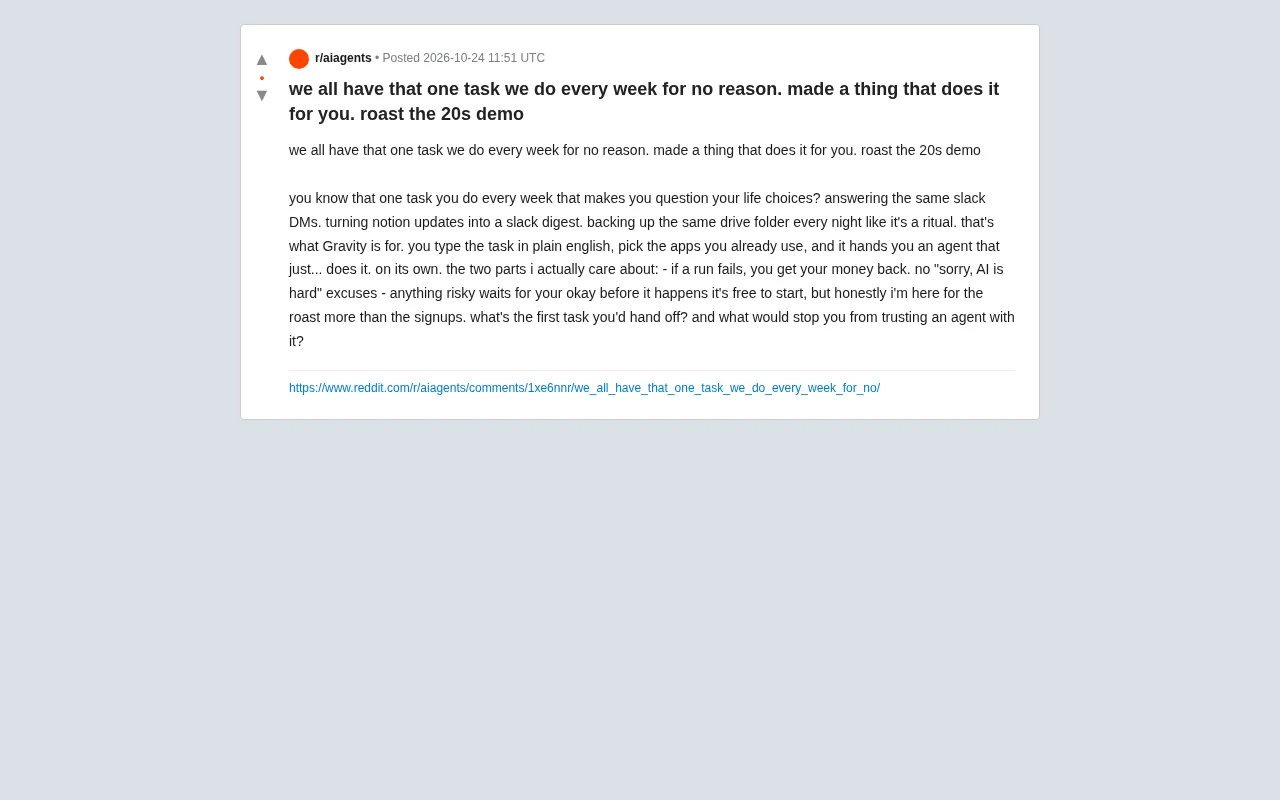
Almost every knowledge worker has experienced this pain point. Automation tools are plentiful — Zapier, Make, and n8n can all do similar things — but the barrier is configuring the flow. Gravity tries to compress the configuration process into a one-sentence description, which lowers the barrier, but whether it can actually run reliably is another matter.
Gravity's Core Mechanism: Generating Agents from Natural Language
According to the post, Gravity's workflow has three steps: input the task, select apps, get an agent. Users don't need to draw flowcharts or write code — just describe the requirement in everyday language. Behind this is most likely a large model parsing intent and mapping it to pre-built integration actions.
Two claimed features are worth noting. First, if a run fails, users can get a refund. The poster specifically emphasized "no 'sorry, AI is hard' excuses," which is clearly a response to widespread skepticism about AI agent reliability. Second, any risky operation waits for user confirmation before executing. This means the system makes a trade-off between autonomy and safety, handing irreversible actions back to human decision-making.
From a product design perspective, both points point to the same issue: trust. Getting users to confidently hand tasks to an agent requires more than a demo — it needs mechanisms as a safety net.
Agent here refers to a software entity that can perceive input, plan autonomously, and call external tools to complete multi-step tasks. Unlike traditional scripts or rule engines, agents are typically driven by large language models: the model first parses the goal described by the user in natural language, then breaks it down into executable steps and maps them onto pre-wrapped application API actions (e.g., "read a Notion page," "send a Slack message"). The advantage of this architecture is a low configuration barrier and tolerance for some degree of vague expression; the cost is that execution paths are non-deterministic — the same sentence may produce different results across runs. Therefore agent products generally need to make design trade-offs between "autonomy" and "controllability," such as introducing human confirmation nodes, setting retry limits on failure, or whitelisting high-risk actions. This is the technical background for understanding Gravity's refund and confirmation mechanisms.
The Trust Problem: Can a Refund Promise Resolve the Fundamental Contradiction?
At the end of the post, the poster asked a key question: "What task would you hand over to it? What would stop you from trusting an agent?" This actually exposes the core contradiction of automation tools.
A refund promise sounds generous, but it compensates money, not time. If the agent fails three times a week, what the user loses is the energy spent repeatedly checking and fixing — a refund can't make up for that. A more practical question: how is failure defined? Does partial completion count as failure? Does producing side effects with the wrong result count as failure? These boundaries aren't explained in the post, and they are precisely what determines the sincerity of the refund promise.
The design of requiring confirmation for risky operations is more pragmatic. It acknowledges the current capability boundaries of AI agents — they can handle highly deterministic repetitive tasks but aren't suited to making autonomous decisions. Intercepting actions like "send," "delete," and "pay" for human confirmation is a responsible approach. But it also means that so-called "automatic running" still requires human involvement at key steps — what's saved may only be the upfront configuration time, not full end-to-end management.
Judging from community reactions, common skepticism about such tools centers on integration depth and long-term stability. Which apps are supported, how maintenance works after API changes, whether error handling is transparent — these questions determine whether a product can retain users far more than a single line about "refunds on failure."
The Opportunities and Limitations of Such Tools
Gravity's direction is right. Handing repetitive tasks to agents is a clear trend, and natural language as a configuration interface is more intuitive for ordinary users than visual orchestration. The type of task it targets — "weekly repetitive, fixed logic, cross-app" — happens to be exactly where rule automation excels.
The limitations are also obvious. The post itself reads more like a demo of an early-stage product, disclosing no technical details, integration list, pricing strategy, or failure-rate data. The poster candidly said they were "mainly here for criticism, not sign-ups" — a commendable honesty, but it also shows the product is still in the validation stage. For potential users, without this information, it's hard to build long-term trust from a 20-second demo alone.
A more realistic judgment: Gravity is suitable as a supplement to automation entry points, not as a replacement for existing workflow tools. If your task happens to fall within its supported integrations and has simple, stable logic, it's worth a try; if it involves complex conditional branches or critical business data, waiting and watching is the safer choice.
Rule automation and AI automation are two types of solutions often conflated. Zapier, Make, and n8n belong to rule automation: users explicitly define "when A happens, execute B" trigger-action chains, with fully deterministic, auditable behavior — but configuration costs are high when facing tasks with complex conditional branches or variable input formats. Natural-language-driven tools like Gravity hand the parsing work to the model, making them suitable for cross-app tasks with relatively fixed logic but unstable phrasing and input forms. The two are not substitutes: rule automation is better in stability and maintainability, while AI automation is better at lowering the configuration barrier. A common practice in real deployments is to use a rule engine for core business processes and use model-generated agents for peripheral, low-risk repetitive tasks — which also explains why the article suggests viewing Gravity as a supplement to automation entry points.
One-line Summary
Gravity generates automation agents from natural language, but trust and integration depth remain key tests.
Paragraph Summary
The article starts from a Reddit post about weekly repetitive tasks and introduces the tool Gravity: users describe tasks in natural language and select commonly used apps to generate automatically executing agents, removing the configuration burden of drawing flowcharts or writing code. The product claims refunds on failed runs and requires user confirmation for risky operations — both pointing to the trust problem of AI agents. The author notes that refunds compensate money rather than the time spent repeatedly checking and fixing, and that how failure is defined isn't explained; while risky-operation confirmation is pragmatic, it means key steps still require human involvement. The article considers the direction correct, but the product is still in an early validation stage, lacking technical details, integration lists, and pricing information — suitable for trying simple, fixed tasks rather than replacing existing workflow tools.
Related articles

Qwen4 Architecture Preview Open-Sourced: 125B Parameters, 512 Experts, Designed for VRAM-Constrained Hardware
Qwen4 isn't released yet, but its architecture is previewed via open-source Qwen3.8 Flash Next: 125B params, 6B activated per token, 512 experts, 262K context, built for VRAM-limited hardware. This article covers official confirmations, key config.json metrics, and local deployment tests on 24G memory.

Run 8K Images on 6GB VRAM! Hands-On Test of Fudan's Open-Source MOSS-Image Model
Fudan OpenMouse team and Shanghai MOSS Intelligence open-source MOSS-Image, a 500M-parameter DT architecture text-to-image model that runs locally on 6GB VRAM with precise text rendering, structured layout control, and 4K Token prompt support—ideal for e-commerce posters and local deployment by individual creators.

Overseas Blogger Tests Local Deployment of 100B-Parameter MoE Model: Key Lessons on Quantization and Tool Calling
Overseas blogger tests local deployment of Alibaba's Qwen 3.8 Flash Next 100B MoE model on a Strix Halo mini PC and CUDA workstation, revealing how quantization precision affects tool-calling success and the real-world performance of the Strata and GUFO inference engines.