Greek Fire: The Ultimate Military Secret Guarded by the Byzantine Empire for a Millennium

How Greek Fire — Byzantium's secret water-burning weapon — helped an empire survive against all odds.
Greek Fire was the Byzantine Empire's ultimate military secret: an ancient flamethrower that burned even on water. Developed in the 670s, it repelled Arab sieges of Constantinople and later devastated Viking raiders. Combined with strategic territorial contraction, the Theme System's administrative reforms, and decisive leadership by figures like Leo III, Greek Fire exemplifies how technology, strategy, and resilience together enabled an empire to survive existential threats for over a millennium.
The Byzantine Empire's Fight for Survival
In a deep conversation between historian Anthony Kaldellis and Lex Fridman, a fascinating historical question emerged: How does a vast empire survive from the brink of collapse and eventually regain its footing? The answer involves not just military technology, but also strategy, administration, and sheer resilience.
The Byzantine (Eastern Roman) Empire endured an extremely difficult period during the 7th century. The relentless Arab offensives caused the empire to continuously "bleed," a process that lasted for decades. To understand the severity of this crisis, one must consider the historical context: after the death of the Prophet Muhammad in 632, the unified Arab tribes expanded at an astonishing pace during the Rashidun Caliphate. At the Battle of Yarmouk in 636, the Byzantine army suffered a devastating defeat, and Syria and Palestine quickly fell. Egypt was conquered in 642, costing the empire its wealthiest breadbasket province. Meanwhile, the empire's northern borders faced incursions from Slavs and Avars. In just over twenty years, the Byzantine Empire lost roughly two-thirds of its territory and tax revenue, shrinking rapidly from a Mediterranean superpower into a medium-sized state centered on Asia Minor and the Balkans.
As Kaldellis put it: "First, you have to stop the bleeding." This process was long and painful — it took the empire decades to barely hold a defensive line, and it wasn't until the 660s and 670s that the Romans began to truly defeat their adversaries on land.
What truly turned the tide at sea and ensured the empire's survival was a secret weapon known to posterity as "Greek Fire."
Greek Fire: The Ancient Flamethrower
As the empire began investing in building a fleet, Greek Fire came into being. Kaldellis described it as a "flamethrower" — a weapon of devastating power in naval warfare. When the Arabs twice attempted to capture Constantinople, it was Greek Fire that helped the Romans repel those assaults and preserve the empire.

So how exactly did this weapon work? Modern scholars have proposed multiple hypotheses about the exact formula of Greek Fire. The prevailing view is that its core ingredients likely included naphtha (a light petroleum distillate), sulfur, quicklime, and some type of resin. Quicklime reacts violently with water, producing intense heat — which could explain why Greek Fire could burn on the surface of water. The delivery mechanism is believed to have resembled a sealed bronze container (a siphon) that generated internal pressure through heating. When the operator opened a valve, the pressurized combustible liquid was expelled through a nozzle and ignited by an external flame, producing a continuous jet of fire. This system required precision metallurgy to manufacture high-pressure vessels and an experiential understanding of fluid dynamics. Byzantine sources attribute its invention to a Syrian refugee named Callinicus, around the 670s.
Interestingly, scholars are still debating many details of this question to this day. The reason is simple: it was a state secret. As Kaldellis noted: "The fact that we're still debating it shows just how good they were at keeping secrets."
A Fiercely Guarded State Secret
Based on available research, Greek Fire likely operated through a pressurized, heated container. A small group of specialized engineers was responsible for formulating the flammable compound — its ingredients and preparation methods were classified at the highest level. The weapon used a nozzle (a valve-and-spout structure) to spray burning liquid flame onto enemy ships.
The Byzantine Empire's secrecy around Greek Fire reached an institutionalized extreme. In the 10th century, Emperor Constantine VII explicitly warned his successors in his work De Administrando Imperio: even if allies requested the secret of Greek Fire, they must refuse by claiming it was "a sacred legacy passed down to Constantine the Great by an angel." Different components of the formula were reportedly held by separate groups of craftsmen, so that no single individual knew the complete process. This "compartmentalized secrecy" principle bears a striking resemblance to modern information classification systems used for nuclear weapons or intelligence agencies, reflecting the Byzantine Empire's highly developed bureaucratic and administrative capabilities.
What terrified enemies most was that the flames continued to burn even when they landed on water. This meant enemy soldiers could not escape even by jumping into the sea. As a naval weapon, Greek Fire's psychological deterrent effect was every bit as formidable as its actual destructive power.
From Arabs to Vikings: Centuries of Deterrence
The deterrent power of Greek Fire endured for centuries. When Vikings raided Constantinople in the 940s and again in the 1040s, the Romans once again deployed their Greek Fire fleet, setting the invaders ablaze.

The Viking raiders referred to here were primarily the Varangians from Kievan Rus'. In 860, 907, 941, and 1043, the Rus' launched multiple large-scale naval expeditions south across the Black Sea to attack Constantinople. The 941 expedition of Prince Igor was particularly notable — the Byzantine fleet used Greek Fire to incinerate a large number of Rus' ships, and the terrifying memories brought back by survivors profoundly shaped the Slavic world's perception of Byzantine military power. Ironically, it was precisely this military deterrence that ultimately fostered trade and diplomatic relations: the Rus' later became Byzantine trading partners and even formed the famous "Varangian Guard" — the Byzantine emperor's most elite bodyguard unit.
A rather dramatic observation from the conversation: if you lived in that era, you would far rather serve under the Byzantine emperor than be among those attacking him. This "nuclear-level" state secret kept generation after generation of enemies at bay.
Greek Fire in Grenade Form
Even more surprisingly, Greek Fire was eventually developed into a grenade form — a ceramic container filled with the combustible compound, fitted with an external fuse, lit and thrown at the enemy. This is a real weapon confirmed by archaeological evidence.
However, Kaldellis also offered a rational analysis of its tactical role. Using a grenade against an individual soldier wasn't cost-effective — "you're just wasting a grenade to burn one person." Its most effective use was against siege equipment, such as throwing it onto an enemy's wooden siege tower to start an unquenchable fire, thereby dismantling the enemy's siege operations.
Administrative Restructuring Behind Military Stability
Greek Fire was only one critical component of the empire's effort to "stop the bleeding." From a broader strategic perspective, the Romans withdrew their armies to Asia Minor and began defending and fortifying this core region.

But this posed an enormous challenge: how to supply, pay, and feed all these soldiers? Kaldellis described it as a "painful administrative restructuring." The central achievement of this restructuring was the establishment of the Theme System. This system divided the empire's remaining territory into several military districts (Themes), each governed by a general (Strategos) who oversaw both military and civil affairs. Soldiers received land within their Theme and became farmer-soldiers who were largely self-sufficient, drastically reducing the burden on the central treasury. This was a radical departure from the earlier Roman tradition of maintaining a professional field army funded by centralized taxation. The Theme System was essentially a total-war framework — integrating administrative, economic, and military functions, enabling the empire to maintain effective defense with far fewer resources than before. This system operated for roughly three hundred years before gradually disintegrating in the 11th century.
After prolonged adjustment, the empire ultimately evolved an entirely new strategic and logistical system — a smaller, harder, highly militarized core empire.
This contraction was not a sign of failure but a strategic refocusing. The empire decisively abandoned peripheral territories that were difficult to defend, concentrating limited resources on core areas that could be held in the long term, thereby laying the foundation for a future resurgence.
The Second Siege of Constantinople: The Empire on the Brink
In the early 8th century, the Arabs launched a second major siege of Constantinople. This time, the empire truly stood on the edge of annihilation. Yet once again, it survived.
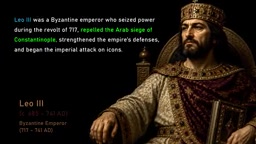
The key was that an exceptionally capable leader was in power — Leo III. He was a usurper who had just seized control. Leo III (c. 685–741) had been a military commander on the empire's eastern frontier and seized the throne through a coup in 717. He came to power just as the Arabs assembled the largest expeditionary force in their history — according to Arab sources, the fleet numbered up to 1,800 ships, with a land army exceeding 100,000 men. Kaldellis speculated that the Roman elites likely chose, at this critical juncture, to deliberately elevate a truly capable individual to take charge.
Notably, during his reign Leo III not only successfully defended the empire but also launched the far-reaching "Iconoclasm" movement, banning the veneration of religious images and sparking more than a century of theological and political controversy within the empire. The "Isaurian" dynasty name that Kaldellis mentioned stems from a historical misunderstanding — Leo III actually came from Germanikeia in northern Syria (modern Kahramanmaraş, Turkey), but medieval historians erroneously associated him with the Isaurian region of Asia Minor.
A Meticulously Planned Victory
When asked why Constantinople held — whether it was the walls, the navy, the weather, diplomacy, or luck — Kaldellis's answer was emphatic: "I don't think luck played much of a role."
Leo III had thought through nearly every aspect:
- Well-prepared city defenses: Walls and garrisons standing ready
- Support from Bulgar allies: The Bulgar allies Leo III secured were from the First Bulgarian Empire, led by Khan Tervel. The Bulgars were a Turkic people from the Central Asian steppe who had established a state on the Byzantine Empire's Danube frontier in 681 — marking the first time Byzantium formally recognized the legitimacy of a "barbarian" polity on its nominal territory. During the siege, Bulgar cavalry attacked Arab supply lines from the rear, reportedly killing tens of thousands of Arab soldiers. However, the Bulgars were by no means loyal allies of Byzantium — over the following centuries, the two states fought multiple brutal wars, until Bulgaria was completely absorbed by Byzantium in 1018.
- Strategic use of Greek Fire: Delivering devastating strikes against the enemy fleet in naval combat
- Counter-siege tactics: Using their own fleet to confine the Arabs to specific areas, gradually wearing them down through supply deprivation
All of these elements played a role, and Leo III employed them with extraordinary skill. He continued to rule for over twenty more years, and his son succeeded him, forming what later historians called the "Isaurian Dynasty" (even though they were not actually from Isauria).
The Combined Force of Technology, Strategy, and Will
The story of Greek Fire is compelling not just because of the technical mystery surrounding antiquity's most enigmatic military weapon, but because it reveals the complete logical chain of an empire's survival in extremis: first stop the bleeding, then stabilize, then restructure.
A single secret weapon is never enough to save a civilization. What truly sustained the Byzantine Empire was the synergy of multiple forces:
- Technological advantage: Naval supremacy delivered by Greek Fire
- Strategic contraction: A defense system centered on Asia Minor
- Administrative resilience: A thorough restructuring of logistics and military systems, including the Theme System
- Leadership at critical moments: Capable leaders like Leo III who turned the tide in moments of crisis
This is also a profound lesson history has left for posterity: in the face of an existential crisis, technology can buy time, but what ultimately determines success or failure is the systemic ability to unite technology, strategy, and will into a coherent whole.
Key Takeaways
Related articles

RisenX Explained: The Coding Agent Officially Recommended by DeepSeek
RisenX is a DeepSeek-native coding agent featured in DeepSeek's official API docs. It supports cache-first loops, tool-call repair, and Flash/Pro smart switching.

ChordViz Review: A Real-Time Visualization Workbench for MIDI and Audio
In-depth review of ChordViz music visualization tool with real-time MIDI and audio input, chord visualization, notation, and audio-reactive visuals, plus OBS, TouchDesigner and Resolume integration.

3D-Printed Robot Desk Lamp: How to Make a Machine Feel Alive Like a Pixar Character
See how an indie developer uses 3D printing, ROS 2, and a custom animation editor to turn Pixar's iconic desk lamp into a real robot with personality, vision, and RL-driven autonomy.