Grok 4.6 Deep Dive: The Cost of Catching Up to the GPT and Claude Top Tier

Grok 4.6 reaches top-tier intelligence but sacrifices the speed and cost advantages that made it unique.
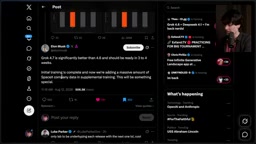
Grok 4.6 achieves a 61-point Intelligence Index score matching GPT 5.6 Sol, with Deep Suite surging from 54% to 66%. However, this comes at a steep cost: token efficiency dropped 30%, effective pricing more than doubled versus Grok 4.5, and response speed regressed noticeably. It excels at real engineering tasks and long-running agent work but struggles badly with UI design and 3D rendering. The model's pursuit of frontier intelligence sacrificed the speed and cost advantages that previously made Grok uniquely useful.
xAI's Accelerating Pursuit
Since acquiring Cursor, xAI's model iteration speed has visibly accelerated. From prolonged "quiet periods" where months would pass without a significant model release, to Grok 4.5 and 4.6 launching in rapid succession—with Elon already teasing that 4.7 will arrive within three to four weeks—this lab is charging toward the frontier at a remarkable pace.
According to an in-depth review by YouTube channel Theo, Grok 4.5 was the first non-Anthropic, non-OpenAI model he seriously considered using as his daily driver. This time, Grok 4.6 builds on that foundation by further focusing on long-running agents and more ambitious interactive, visual work. It's fast, cheap, reliable, and particularly adept at not losing its objective when coordinating large numbers of sub-agents.
This matters enormously. As the way we build applications shifts toward an agentic paradigm—where AI is no longer a simple Q&A tool but an independent executor capable of autonomously planning tasks, calling tools, observing results, and iteratively correcting itself—the ability for agents to run independently for extended periods, solve hard problems, and return usable results is more important than ever. In this architecture, models need to maintain goal consistency across thousands or even tens of thousands of tokens of context, coordinating the output of multiple sub-agents without "getting lost" or forgetting their initial instructions midway through.
Grok 4.6's Technical Core: Post-Training Is the Key
In official terms, Grok 4.6 underwent "entirely new pre-training + entirely new post-training" on top of Grok 4.5. And the biggest dividend from acquiring Cursor was precisely gaining access to Cursor's aggressive RL (reinforcement learning) and post-training tech stack.
To understand why this matters, you need to know the role post-training plays in modern large model development. During pre-training, models learn statistical patterns of language and world knowledge from massive text corpora. During post-training—including supervised fine-tuning (SFT), reinforcement learning from human feedback (RLHF), and various alignment techniques—models learn to follow instructions, generate useful responses, and excel at complex tasks. In recent years, the industry has increasingly recognized that the breakthrough performance of OpenAI's o1 series, Anthropic's Claude 3.5, and similar models is largely attributable to post-training innovations rather than simply scaling up pre-training. The fine-grained reinforcement learning reward models and trajectory filtering mechanisms that the Cursor team developed for code generation scenarios represent cutting-edge work in this domain.
Specifically, 4.6 underwent more extensive supplementary training than 4.5:
- Used carefully curated model-generated data to strengthen reasoning and advanced technical concepts
- High-quality engineering data
- Improved optimizers and training recipes
The team then used Grok 4.5 to regenerate SFT trajectories spanning different reasoning intensities, agent frameworks, and domains including STEM, software engineering, and knowledge work, filtering out problematic trajectories through model self-checking. SFT trajectories refer to the complete reasoning and action sequences a model produces while executing tasks—in agentic scenarios, a single trajectory might contain dozens of think-act-observe cycles. Using strong models to generate high-quality trajectories that then train the next generation is a popular "bootstrapping" strategy in the current industry, similar to self-play in AlphaGo: improving data quality through mass generation and filtering to break through the bottleneck of human-annotated data.
This pipeline is the core technology that makes long-running tasks and agentic work more reliable—and it typically happens during post-training rather than pre-training.
Interestingly, the official announcement also mentions that Grok 4.6 performs more self-testing and verification during long trajectory runs, checking its own work before proceeding to the next step. This addresses an old weakness of the Grok series: writing out an entire solution that sometimes runs fine and sometimes crashes.
Benchmark Comparisons: Grok 4.6 Has Genuinely Caught the Top Tier
According to Artificial Analysis's Intelligence Index, Grok 4.6 scored 61 points—on par with GPT 5.6 Sol and right behind Fable 5 and Opus 5. Artificial Analysis is an independent AI model evaluation platform whose Intelligence Index aggregates results from multiple mainstream benchmarks to provide standardized cross-model comparisons spanning reasoning, coding, math, knowledge Q&A, and more.

Even more impressive are several domain-specific jumps:
- Deep Suite: Surged from 54% to 66%, approaching Sol and Fable—a massive improvement for a single post-training iteration
- Cursor Bench: A modest jump, but already surpassing 5.6 Sol (though note the prior controversy about Cursor Bench data accidentally leaking into training)
- Frontier Code: Rose from 56.6 to 61.3, firmly between Sol and Fable
- GDP Val: Showed what Theo called "one of the biggest jumps I've ever seen"
Compared to 4.5 from just over a month ago, the Intelligence Index rose 5 points; compared to 4.3 from shortly before that, it skyrocketed 23 points. The iteration speed is genuinely "insane."
However, Theo also cautions: these numbers aren't the best way to measure a model's true intelligence or practical utility. Benchmarks always carry the risk of "Goodhart's Law"—when a metric becomes an optimization target, it ceases to be a good metric. He cites Opus 5 as an example: it looks great on every test and felt wonderful on day one, but the more he used it, the more he found himself constantly "cleaning up the garbage code it wrote," ultimately returning to Fable.
Grok 4.6 Pricing Analysis: The Hidden Price Hike
On pricing, Grok 4.6 runs at $2 per million input tokens and $6 per million output tokens—60% cheaper than Opus 5, with per-task costs around $0.84, similar to Kimi K3 but slightly more intelligent. It occupies a solid position on the cost-intelligence Pareto frontier.
The Pareto frontier is an economics concept referring to the set of optimal solutions in multi-objective optimization where improving one objective necessarily sacrifices another. In the AI model market, cost and intelligence form two key dimensions: the ideal model should be both cheap and smart, but reality usually demands tradeoffs. Models on the Pareto frontier mean there's no smarter option at the same price, or no cheaper option at the same intelligence level.
But Theo keenly points out a detail the official announcement "deliberately hid": this is more than double the cost of Grok 4.5.
The reason is a regression in token efficiency. Grok 4.6 uses over 30% more tokens per run. Even if per-token pricing stays the same, if the model needs more tokens to complete the same task, users' actual bills go up. Previously, Grok 4.5 was one of the few mainstream models more token-efficient than 5.6 Sol—that advantage is now gone.
"I was so excited before precisely because Grok 4.5 was that efficient. Seeing 4.6 lose that is genuinely disappointing."
This is noticeable in practice too: 4.5's tests came back almost instantly, fast enough to be "kind of scary"; while 4.6 returns to the familiar frontier-model rhythm of "send a prompt and go do something else." Cache read pricing also rose from 3 cents to 5 cents per million tokens.
Real-World Weaknesses: UI Design and 3D Rendering Are Painful
In UI design tests, Grok 4.6's performance was distinctly mediocre. Theo critiqued its output one by one: ugly noise textures, text too sharp clashing with blurred backgrounds, too many cards looking like old Tailwind templates, stale layouts... "This feels like old-era AI slop, like GPT 5.0 vibes."
For comparison, Fable's design was "absurdly good," and even the often-criticized 5.6 Sol was clearly stronger.
Worse still was the 3D game porting test. Theo has an aquarium clone game called "fish slop" built with Opus, and he routinely asks new models to rebuild it from the existing codebase to test end-to-end comprehension. The results:
- 2D version: Element sizes were all wrong—fish too small, food too large, interaction highlighting broken, pacing off. Even the open-source Kimi K3 did noticeably better.
- 3D version: Complete black screen failure. This was the first new model Theo tested that couldn't even render a 3D environment—even GPT 5.4 could get a 3D scene running. After providing screenshots for it to fix, left and right directions were bizarrely reversed, ground object positions were all wrong, and the fish models were "absolute garbage."
He stated bluntly: "This is the worst 3D attempt I've seen in a long time—like last year's level." By comparison, open-source Kimi showed what felt like a "generational gap" in 3D modeling superiority.
Real Engineering Tasks: Where Grok 4.6 Truly Shines
But on real engineering tasks, Grok 4.6 redeemed itself considerably.
During a security audit, it even found previous audit records in the git history, identified real issues with the auth broker, worker isolation, and storage control plane, and offered reasonable suggestions like locking down endpoints and removing identity tokens from URLs.
Even more valuable was a complex migration task from ACP to Cursor SDK. ACP (Agent Communication Protocol) is a standardized protocol for communication between AI agents, while Cursor SDK is the developer toolkit provided by the Cursor editor that allows third-party applications to deeply integrate with Cursor's AI capabilities. Migrating from ACP to Cursor SDK means moving from a general agent communication framework to a Cursor ecosystem-specific integration approach, typically involving event stream handling, bindings rewrites, and API adaptation—substantial engineering work.
Theo asked it to audit T3 Chat's Cursor implementation, and it accurately identified the real pain points in the current bindings. Though the process encountered issues like "getting stuck in plan mode" and event stream handling anomalies at the CLI level, in the final real-world execution, it completed a PR of nearly a thousand lines of code, addressed multiple functionality gaps in the website, and followed Theo's rules (noting which model was responding on his behalf at the top of PR comments).
Theo then pushed it further: digging through actual operation history on a real machine, finding gaps in event handling, and stacking a new PR on top of the original one. This requires the model to coordinate massive amounts of competing context without losing its way—exactly the capability that made Grok 4.5 impress him, and the most critical capability dimension for long-running agent tasks.
It's worth noting that the official Grok Build CLI itself offers a quite polished experience, with nice touches like image rendering.
Overall Assessment: Caught the Top Tier, But Lost Its Uniqueness
Theo compared Grok 4.6, Fable 5, and 5.6 Sol across several dimensions:
| Dimension | Grok 4.6 Change |
|---|---|
| Cost | Regression (~6 points, more expensive due to token efficiency decline) |
| Intelligence | Improved (~6.5 points, noticeably smarter) |
| Speed | Clear regression (~5.5 points, more tokens = slower) |
| Thoroughness | Slight improvement (still misses things) |
| Orchestration | Slightly stronger than most models (5.5 points) |
The core contradiction: Grok's previous sole leading advantages—speed and cost—both regressed this time. Its unique value before wasn't in matching the frontier on certain tasks, but in creating enough distance from the frontier on speed and cost to be "uniquely useful." Grok 4.6 sacrificed that uniqueness in pursuit of frontier intelligence.
This reflects a deeper tension in AI model competition: when all labs sprint toward the same benchmark scores, differentiation may actually come from seemingly "secondary" dimensions—speed, cost, extreme optimization for specific scenarios. A model ranked fourth on benchmarks but three times faster may deliver more value for many real-world workflows than the number-one model that's too slow to tolerate.
Looking Ahead: The Real Excitement Is Grok 4.7
Theo admits that Grok 4.6 isn't his favorite and he probably won't use it regularly after finishing the video. But it makes him very excited for Grok 4.7—which also explains why Elon is now more willing to talk about 4.7 than 4.6. Reportedly, 4.7's initial training is complete and is currently being supplemented with "massive SpaceX company data."
The future direction is clear: Grok is catching up extremely fast. And for the industry as a whole, this is good news—we need more competition, more good models, more players fighting to drive prices down. Intelligence is indeed getting cheaper; it's just that this generation of Grok temporarily couldn't hold onto both its "cheap" and "fast" trump cards simultaneously.
Key Takeaways
Related articles

Gaussian Process Bandit Optimization: Exploration Strategies and Inference Regret Guarantees
Cumulative regret guarantees in Bayesian optimization fail to reflect final recommendation quality. This article examines a new study that provides inference regret guarantees for Gaussian process bandit optimization through exploration query strategies and fill distance analysis, validated on hyperparameter optimization and control tasks.
The Most Detailed Codex Guide on Bilibili: From Installation to Real-World Practice
The most detailed Codex guide on Bilibili: from app store installation to daily work mode configuration, with a real coffee shop project demonstrating file organization, data extraction, dashboard creation, and other practical tasks. Learn to use Plan Mode and desktop pets to leverage Codex efficiently.

Appearance Compensation in Volume Rendering: Why RGB Accuracy Cannot Guarantee Density Correctness
Volume rendering research reveals that volumetric data perfectly reproducing external RGB views may still contain density errors: appearance compensation can double central density and keep external rays unchanged even when L2 error exceeds 14.52%. Density recovery depends on appearance capacity, spatial resolution, and measurement design.