Grok 4.6 Hands-On Review: Performance, Pricing, and Deep Dive into the Cursor Acquisition
Grok 4.6 emerges as xAI's competitive answer to OpenAI and Anthropic through Cursor acquisition and compute power
xAI's Grok 4.6 represents a major leap in the AI race, combining Cursor's programming data with xAI's 200K GPU cluster. The iterative upgrade delivers strong benchmark results, competitive pricing at $2/2M input tokens, and rapid development cycles. While trailing GPT-5.6 Sol in design tasks, it excels in code and knowledge work, positioning xAI as the third major AI lab.
Over the past two years, the global AI foundation model market has seemed to be dominated by just two players: OpenAI and Anthropic. Grok (xAI), despite its strong debut, quickly faded into the background, lingering in the third tier. But in recent days, the situation has fundamentally changed—with xAI's acquisition of Cursor and the release of the new Grok 4.6 model, the company is catching up to the leading pack at an astonishing pace. This article combines hands-on analysis from tech blogger Matthew Berman to provide an in-depth examination of Grok 4.6's performance, pricing strategy, and the strategic logic behind the Cursor acquisition.
Grok 4.6 Performance Analysis: From Iterative Upgrade to Comprehensive Improvement
Grok 4.6 is not a completely new training result, but rather an iterative upgrade (dot upgrade) based on Grok 4.5. In the foundation model industry, there's a fundamental difference between a "dot upgrade" and a "completely new model." A new model means pre-training from scratch, consuming hundreds of millions to tens of billions of dollars in compute. A point version upgrade, on the other hand, builds on an existing base model through post-training techniques like supervised fine-tuning (SFT), reinforcement learning from human feedback (RLHF), or direct preference optimization (DPO), strengthening specific capability domains—lower cost, faster iteration, but limited by the base model's "ceiling." This is why xAI was able to release a significantly improved new version shortly after acquiring Cursor.
As xAI emphasized in their official blog, this is a "massive improvement." The core focus is crystal clear—coding capabilities and knowledge work—all stemming from the Cursor acquisition.
Interestingly, Grok 4.5 had already become the default sub-agent model in Cursor for many developers, favored for its strong capabilities and fast speed. Grok 4.6 not only delivers comprehensive performance improvements on this foundation but is also even faster, which is a pleasant surprise for users who prioritize response speed.
Benchmark Results: Leading in Multiple Areas, Still Gaps in Others
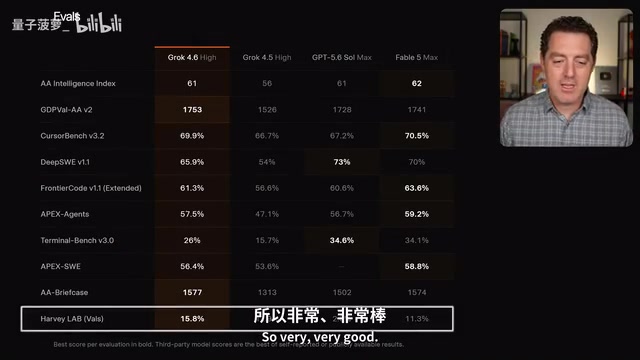
Looking at several authoritative benchmarks, Grok 4.6's performance is quite impressive:
- GDPVal (OpenAI's knowledge work evaluation): Grok 4.6 High takes first place, surpassing competitors;
- Harvey Lab (legal scenario evaluation): Leads significantly with 15.8%, far ahead of competitors at 2.5% and 11.3%;
- Terminal Bench: Jumps from 15% in the previous generation to 26%;
- Cursor Bench: Roughly tied with Fable 5 Max, unable to claim the top spot;
- DeepSuite (considered the most realistic programming experience evaluation): Ranks third with 65.9 points, behind GPT-5.6 Sol Max (73 points) and Fable 5 (70%).
This point warrants caution: many models perform excellently on benchmarks but feel "off" in real programming use. Behind this lies the AI industry's long-standing problem of "benchmark overfitting"—models achieve targeted training to inflate specific test scores without necessarily improving real capabilities. DeepSuite is more valuable because it simulates complete software engineering task flows: understanding requirements, breaking down problems, generating code, handling edge cases, debugging and fixing, rather than simple code completion or algorithm problems. These "end-to-end task evaluations" are harder to game because they require models to perform consistently across multiple dimensions simultaneously. Grok 4.6 still has some distance from top-tier models here, indicating its comprehensive capabilities in real programming scenarios still have room for improvement.
Grok 4.6 Cost Analysis: The Real Battle of Value for Money
Matthew Berman repeatedly emphasizes one viewpoint: looking at quality scores alone isn't enough—cost matters equally. He recommends using Artificial Analysis's Intelligence Index as a comprehensive reference.
In this ranking, Grok 4.6 High jumps from its previous generation's position to fourth place, tied with GPT-5.6 Sol—Claude Opus 5 ranks first, Fable 5 second. But what truly determines value is the "cost per task" dimension.
There's an important analytical framework here: cost per task depends on two factors—how many tokens the model consumes and the price per token. Foundation models charge by "per million tokens," but looking only at unit price can be misleading because different models consume significantly different numbers of tokens completing the same task. Especially "Chain-of-Thought" reasoning models, which often generate extensive intermediate reasoning steps, consuming far more output tokens than regular models. Third-party organizations like Artificial Analysis construct standardized task sets, uniformly measure each model's token consumption, and calculate the real cost per task. Taking Kimi K3 Max as an example, while its unit price is only half that of Sol and Fable, it consumes twice the tokens, so the actual total cost is nearly the same. For high-frequency calling scenarios, differences in cost per task amplify exponentially with call volume, so this metric often has more decision-making value than raw performance scores in production environment selection.
From the data, Grok 4.5 High's cost per task is about 36 cents with an intelligence index around 55-56; while Grok 4.6 has an intelligence index improved to about 60, the cost also rises to about 83 cents. By comparison, it's cheaper than GPT-5.6 Sol Max at the same intelligence level, priced similarly to Kimi K3 but slightly more intelligent. The ideal model should be in the upper-left green quadrant of "high intelligence, low cost." While Grok 4.6 is more expensive, it's still competitive overall.
Hands-On Comparison: Grok 4.6's Design Capabilities Remain a Weakness
In a test using the same prompt to generate a "design-focused profile card," three top-tier models showed varying performance:
- Fable 5: Terrible performance, the generated image described as "the worst SVG drawing work";
- GPT-5.6 Sol: Beautiful design, clean, visually attractive, clearly wins;
- Grok 4.6: Decent but not perfect, image acceptable, but buttons are cropped, lacking padding, text spacing slightly odd.

The conclusion is clear: in subjectively demanding design tasks, GPT-5.6 Sol still leads, with Grok 4.6 in the middle tier. Design evaluations are difficult to quantify, but the gaps are visible to the naked eye. These tasks place extremely high demands on models' spatial reasoning abilities, aesthetic understanding, and attention to detail—often the areas where code generation capability improvements are hardest to directly transfer.
Grok 4.6 Pricing and Product Ecosystem: Targeting a Broader Market
Grok 4.6's pricing is highly competitive: 2 million input tokens for $2, 6 million output tokens for $6. For comparison, GPT-5.6 Sol costs several times more, and Fable is even pricier. This makes Grok 4.6 an efficient and inexpensive "workhorse" model.
Additionally, xAI offers a Fast variant with double the speed (at double the price) and provides double usage credits during the first week for Cursor and Grok Build users. The model is currently accessible through Cursor, Grok Build, API, and OpenRouter.
More noteworthy is the new product Grok Bot—a Cursor offering aimed at broader, non-technical users. It completely strips away model selection functionality (users don't even know which model they're using) and displays no code, only presenting text and knowledge work outputs like PowerPoint and Word. Each conversation thread is an independent Agent, complete with a cute mascot. This signals xAI is targeting a much larger general user market beyond developers.
The Strategic Logic Behind xAI's Cursor Acquisition: Perfect Marriage of Data and Compute
To understand xAI's position today, we must review this history. In April this year, xAI acquired Cursor—the company that completely changed how programming works. Cursor is an AI-native code editor deeply modified from VS Code, launched by Anysphere, which quickly became one of the most influential AI programming tools in the developer community. Its core innovation lies in deeply embedding large language models into editor workflows: not just code completion, but multi-file context understanding, natural language code generation, conversational debugging, and "Agent mode"—allowing AI to autonomously complete complex multi-step programming tasks under user supervision. As Claude Code and Codex rose, it gradually lost some developer favor, but the massive real programming interaction data it accumulated remains an extremely valuable strategic asset.
The value of this acquisition lies in complementarity:
- Cursor has massive valuable programming data but lacks data centers and GPUs to train its own models;
- xAI built a 200,000 GPU cluster in 122 days (the "Colossus" cluster), at astonishing speed, but suffered from lack of good models, leaving much compute idle.
In the foundation model era, compute and data are the two most critical production factors, and both are indispensable. Programming data is especially scarce—real code-natural language interaction data, user feedback on modifying AI-generated code, long-context programming task data spanning multiple files—none of this can be directly obtained from public corpora; it must be accumulated through actual products. Cursor processes millions of real developer programming requests daily, accumulating datasets xAI cannot obtain by crawling the internet. The combination of data + compute has given birth to powerful next-generation programming models.
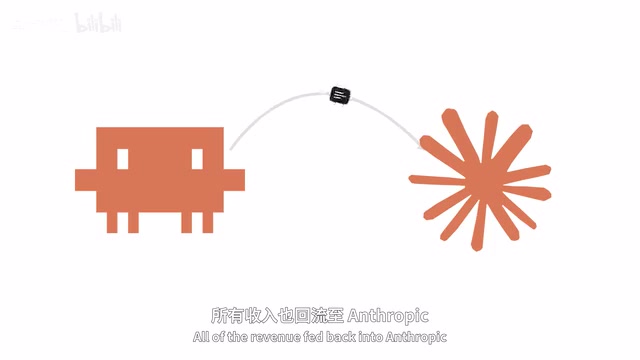
This also confirms the current foundation model "winning formula"—relentless focus on programming scenarios, and the resulting flywheel effect. This flywheel's structure is: developers extensively using programming tools generate real interaction data, data trains stronger programming models, stronger models attract more developers, forming a closed loop. This flywheel was first systematically constructed by Anthropic: developers use Claude Code, data and revenue feed back to Anthropic, then programming models train the next generation of models. OpenAI subsequently replicated this model by acquiring Windsurf and launching Codex CLI, closing the gap; now xAI has taken the same path. The strategic significance of this model is: it binds product revenue, user growth, and model capability improvement together, building extremely high competitive barriers—latecomers must not only catch up in model capabilities but simultaneously catch up in data accumulation.
Signals of Recursive Self-Improvement
xAI explicitly stated in their blog that they used Grok 4.5 to train Grok 4.6—using 4.5 to regenerate SFT trajectories (covering reasoning, Agent frameworks, and domains like STEM, software engineering, knowledge work).
"SFT trajectories" specifically refer to training samples containing complete reasoning processes—not just final answers, but step-by-step thought chains, tool call sequences, or Agent action records. Using previous-generation models to generate SFT trajectories for training next-generation models is based on a variant of "knowledge distillation": strong models' output distributions are often superior to simple human-annotated answers, so using them to generate training data brings quality improvements. This is the embryonic form of "recursive self-improvement"—the path of AI capability enhancement is evolving from "human data-driven" to "model bootstrapping." While not yet a fully closed-loop self-evolving AI, major labs are currently using previous-generation models to train next-generation models, and Grok is no exception.
AI Competitive Landscape: xAI's Compute Leverage and Future Outlook

An intriguing detail: because Anthropic underestimated demand for its own models, it turned to purchasing compute from xAI. Matthew Berman vividly compared this to "selling weapons to the enemy"—considering Musk's many previous negative comments about Anthropic, this deal must be emotionally complex for him.
But a potential concern exists: once Grok 4.6 starts attracting significant demand, after contracts with Anthropic expire, xAI will likely redirect all GPU compute toward its own Cursor and Grok. For Anthropic's Dario, this may be a signal worth watching.
And xAI's pace hasn't stopped. Musk has already tweeted that Grok 4.7 is significantly stronger than 4.6, expected ready in three to four weeks—initial training is complete, and substantial SpaceX company data will be added for supplementary training next.
Conclusion: Rise of the Third Major AI Lab
The release of Grok 4.6 marks the official arrival of a third major lab in the U.S. AI market—following OpenAI and Anthropic, xAI is rapidly closing the gap leveraging data advantages from the Cursor acquisition and its own massive compute reserves. While there's still distance from top models in design capabilities and some real programming experiences, its low price, high efficiency, and speed characteristics, along with the Grok Bot product strategy targeting mass markets, make it a force that cannot be ignored.
As Matthew Berman said: competition is a good thing. Whether it's competition among open-source models or closed-source frontier models, it ultimately means better models and lower prices, which is a blessing for all users.
Key Takeaways
Related articles
Fable 5.1 Hands-On: AI One-Click 3D Game Scene Generation Crushes GPT and Grok
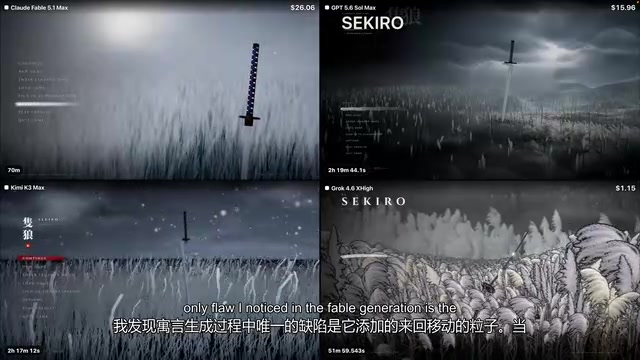
Hands-on comparison of Fable 5.1, GPT-5.6 Sol, Grok 4.6, and Kimi K3 in 3D game scene generation — from Gothic architecture to Sekiro menus, analyzing real gaps in detail fidelity, speed, and interaction.
AFK Agent: Let AI Code Autonomously While You're Away From the Keyboard
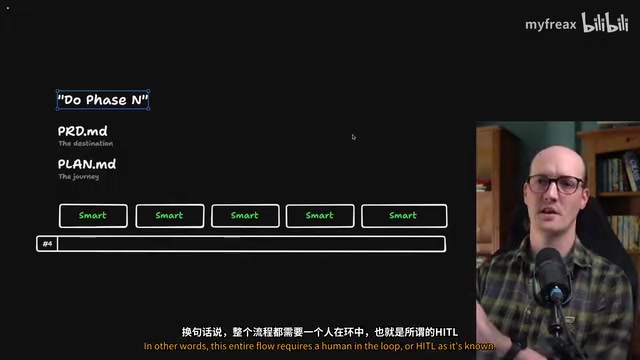
Explore how AFK Agent mode elevates AI coding from Human-In-The-Loop to autonomous unattended execution through multi-phase plan decomposition and automation loops.
Free Data Science Learning Resources Guide: An Efficient Path to Getting Started on Zero Budget
How to learn data science on a tight budget? This guide covers free resources like Kaggle Learn, freeCodeCamp, and Fast.ai with a complete self-study roadmap from Python basics to machine learning.