Grok 4.7 Intelligence, Performance, and Pricing: A Deep Dive

A rational framework for evaluating Grok 4.7's intelligence, performance, and pricing amid limited public data.
Using a Hacker News discussion on Grok 4.7 as a starting point — where only a title exists and no benchmark data is available — this article builds a general LLM evaluation framework across three dimensions: intelligence (via benchmarks like GSM8K, MMLU, SWE-bench), performance (inference speed, latency, throughput), and pricing (per-token costs compared to GPT, Claude, and Gemini). Readers are advised to cross-verify sources and withhold firm conclusions until more data emerges.
About This Analysis of Grok 4.7
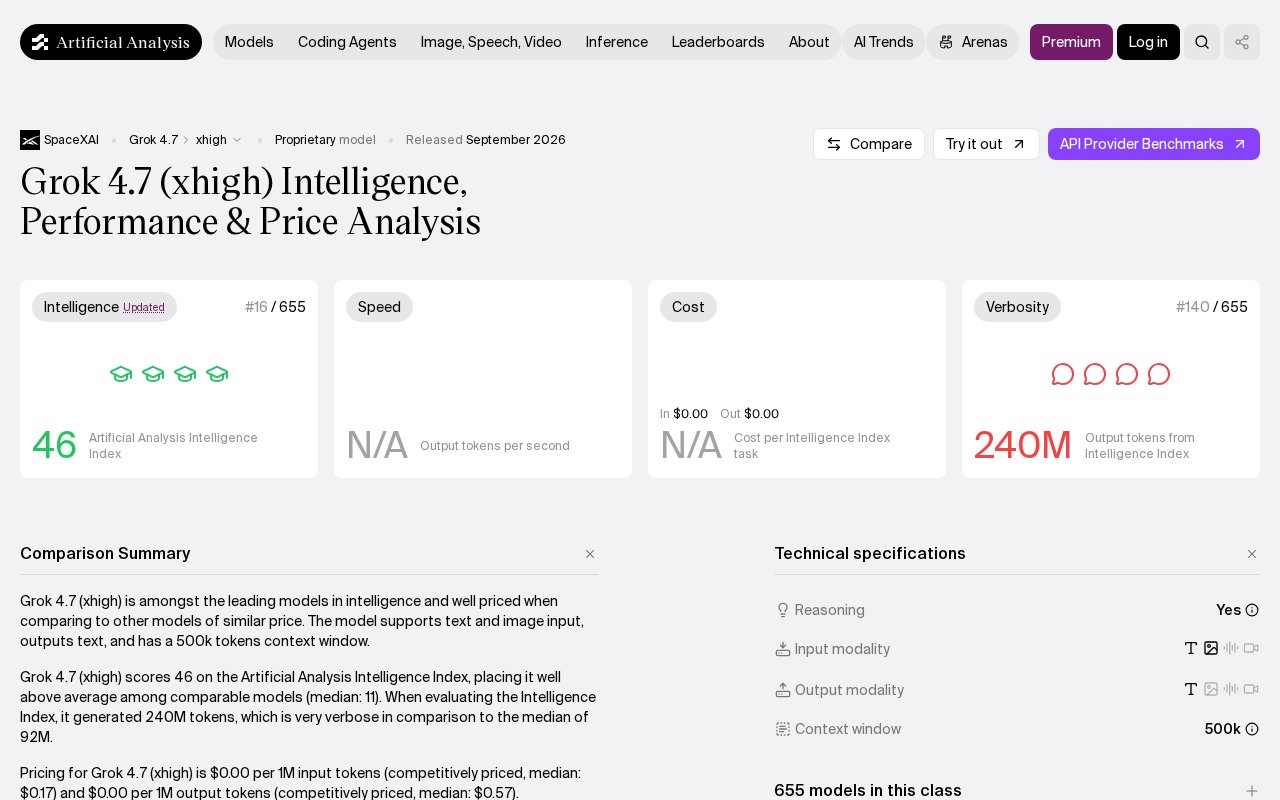
A discussion recently surfaced on Hacker News about an analysis of Grok 4.7 covering intelligence, performance, and pricing. Unfortunately, the only publicly available material is the title — there are no specific benchmark data, evaluation scores, or pricing breakdowns. Given these limitations, this article outlines the core dimensions that this type of model analysis typically covers, providing readers with a rational evaluation framework and explaining why caution is warranted until more complete data becomes available.
How to Evaluate an LLM's "Intelligence"
Measuring an LLM's intelligence level typically relies on a set of standardized benchmarks. These tests span multiple dimensions: mathematical reasoning (e.g., GSM8K, MATH), code generation (e.g., HumanEval, SWE-bench), commonsense reasoning (e.g., MMLU), and long-context comprehension. For the Grok family specifically, its real-time data access capability backed by xAI is a differentiating feature that theoretically enables better performance on time-sensitive questions.
That said, a single benchmark score rarely reflects real-world usability. There can be a significant gap between a model's ability to ace specific test tasks and its reliability in open-ended conversations or complex engineering work. When evaluating Grok 4.7, readers should look at its aggregate performance across multiple independent third-party evaluations rather than relying solely on officially advertised numbers.
It's worth clarifying what each benchmark actually measures: GSM8K and MATH test elementary-level and competition-level mathematical reasoning, respectively; HumanEval asks models to generate correct code from function signatures and docstrings, while SWE-bench goes further by testing whether a model can autonomously fix bugs in real GitHub repositories — a significantly harder challenge; MMLU (Massive Multitask Language Understanding) spans 57 subject areas including law, medicine, and history, measuring breadth of knowledge coverage. The Grok family's "real-time data access" refers to its ability to retrieve up-to-date information via X (formerly Twitter), which can be a unique advantage for current-events Q&A but has limited impact on static reasoning tasks like math or coding.
Multiple Angles for Measuring Performance
Performance isn't just about how "smart" a model is — it also encompasses inference speed (tokens/sec), time to first token, concurrent request handling, and stability under long-context inputs. For developers and enterprise users, these engineering metrics often have a more direct impact on production costs and user experience than benchmark scores.
A model may lead in reasoning quality, but if it suffers from high response latency or low throughput, its practical utility in production environments diminishes considerably. A complete performance analysis should therefore present the quality-versus-speed tradeoff curve, helping users determine whether the model suits their specific use case.
Pricing and Value Considerations
Pricing is an essential factor in model selection. Most major providers today use a per-token billing model, with input and output tokens typically priced separately. Evaluating cost-effectiveness requires combining a model's capability level with its per-unit cost — a higher-priced but more capable model may actually be more economical for complex tasks, since it can reduce the hidden costs of repeated retries and manual corrections.
For a thorough pricing analysis of Grok 4.7, the ideal approach would compare it against similarly positioned competitors (such as GPT, Claude, and Gemini families) to assess its market positioning. Whether it targets the premium flagship segment or the cost-efficiency segment directly determines its intended audience.
Mainstream LLM API token pricing is typically quoted per million tokens (MTok). As a reference point based on late 2024 market rates: GPT-4o input was approximately $2.5/MTok, Claude 3.5 Sonnet input was approximately $3/MTok, Gemini 1.5 Pro input was approximately $1.25/MTok, and some open-source models via self-hosting can bring costs close to zero. Output token pricing is typically 3–5× higher than input pricing, since generation consumes more compute than reading. In real business scenarios, you also need to account for how context window size affects total token usage — longer contexts increase the cost per request but may reduce the total number of API calls across a multi-turn conversation.
Keeping Community Buzz in Perspective
The Hacker News discussion around this analysis currently has limited traction (6 upvotes, 0 comments), suggesting the conversation is still in its early stages with no clear community consensus yet. For analysis articles about newly released models like this, readers are advised to cross-reference evaluation results from multiple sources — especially independent institutions and real-user feedback — rather than letting a single source shape their judgment.
Until more data is available, any definitive conclusions about Grok 4.7 should be held loosely. As more benchmarks and real-world use cases accumulate, its true intelligence level, performance characteristics, and value proposition will gradually come into focus.
Related articles

Random Pruning of the DPO Computation Graph: 1.4x Training Speedup and Lower Peak Memory
DPO training too slow and memory-hungry? This paper proposes a random pruning framework for the DPO computation graph, sampling independently across position, sequence, and branch dimensions; branch pruning achieves a 1.426x step-time speedup and cuts training time by about 30%, with in-depth attribution of memory and time gains.

Why Does JEPA Underperform MLM in Longitudinal EHR Representation Learning?
New study compares JEPA and MLM for longitudinal EHR representation learning on MIMIC-IV: three JEPA variants train stably without collapse but underperform MLM; target size, not heterogeneity, drives prediction error.

Transfer Learning + Visible Light Communication: A New Approach to Energy-Efficient Indoor Positioning
A study proposes a transfer learning-based visible light communication indoor positioning method, achieving 47% accuracy improvement on the BOSCH factory dataset, 67.5% model efficiency under high noise, and introducing the ME composite metric for energy-efficient positioning in energy-constrained industrial IoT scenarios.