Grok Lands on the Gemini Platform: The AI Control Plane Is Becoming the Real Product

Grok 4.6 on Google's Gemini platform signals the AI control plane is the real product, not individual models.
xAI's Grok 4.6 model is now available on Google Cloud's Gemini Enterprise Agent Platform, highlighting a key industry shift: competition is moving from model capabilities to control planes. As cloud platforms host rival models on shared infrastructure, enterprises increasingly choose platforms first and models second. This article explores parity risks of marketplace-hosted models, the double-edged sword for model providers, and why the Model Garden is becoming the true product.
An Underestimated "Listing Announcement"
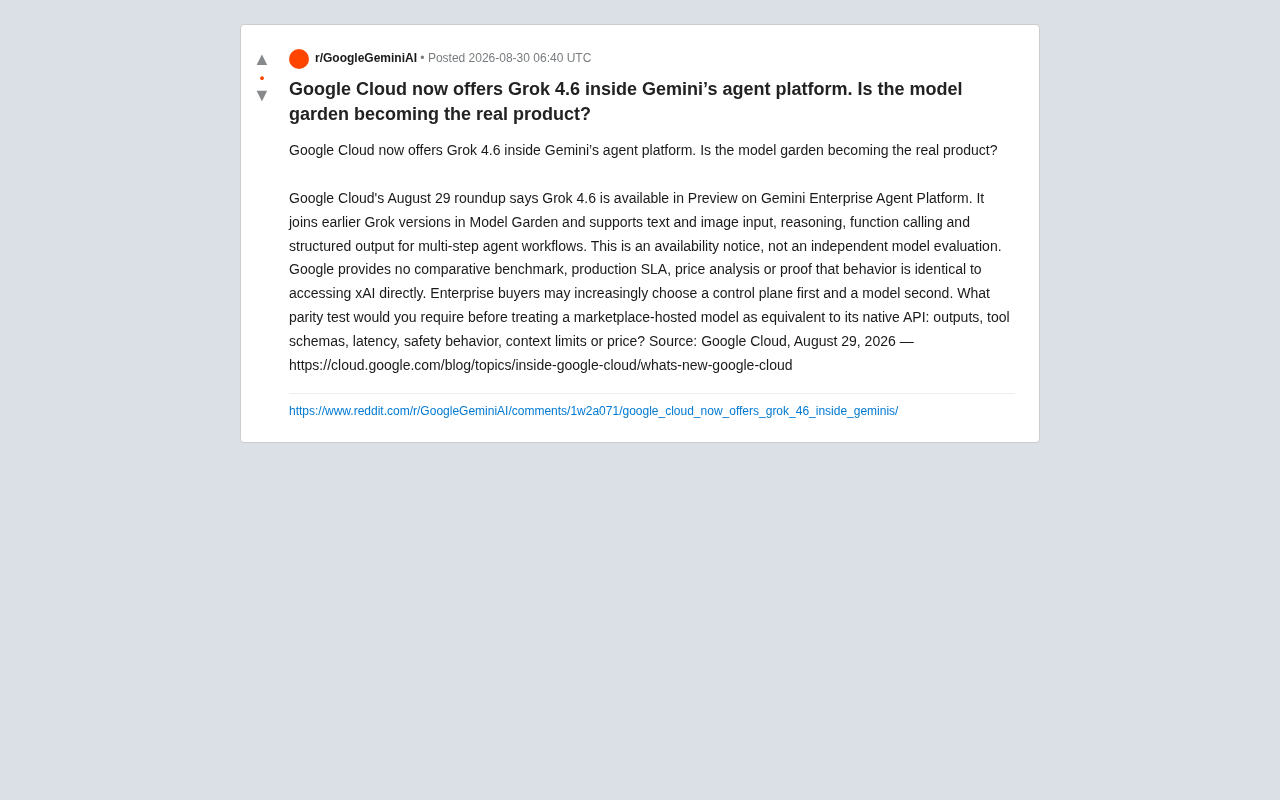
Google Cloud announced in its product update roundup that xAI's Grok 4.6 model is now available in Preview on the Gemini Enterprise Agent Platform. The news seems unremarkable on the surface — just another model entering Google's Model Garden, joining earlier versions of Grok that were already listed.
Some context is helpful here: Google's Model Garden is the model catalog service within its Vertex AI platform, aggregating both Google's own models (such as the Gemini family) and third-party models (such as Anthropic's Claude, Meta's Llama, Mistral, and others). Enterprise developers can call these models through a unified API without needing to integrate with each vendor separately. The Gemini Enterprise Agent Platform builds on top of this with a further layer of abstraction — an agent development framework that provides a complete pipeline from model invocation to tool orchestration, memory management, and multi-step task execution. This "supermarket shelf" model distribution approach has become the standard strategy for the three major cloud providers (Google Cloud, AWS Bedrock, and Azure AI).
But if we look closely at the underlying trend, a more thought-provoking question emerges: When a competitor's flagship model can be called on your platform, is the real product the model itself, or the control plane that hosts it?
The term "control plane" originates from network engineering and distributed systems. It refers to the system layer responsible for managing, configuring, and coordinating data flows, as opposed to the "data plane" that actually processes the data. In cloud-native architecture, the Kubernetes API Server is a classic control plane component — it doesn't run containers directly, but it determines where containers run, how they're scheduled, and how they scale. Mapped to the AI platform context, the control plane is the infrastructure layer managing model invocation, identity authentication, traffic routing, log auditing, billing, and all other "meta-operations." Whoever controls the control plane controls the hub of customer relationships and data flows.
According to Google Cloud's official announcement, Grok 4.6 supports text and image input, reasoning capabilities, function calling, and structured output on the platform — capabilities that collectively serve multi-step agent workflows.
This is worth unpacking further: function calling is one of the key capabilities LLMs have developed over the past two years. It allows a model, during response generation, to recognize user intent and output structured function call instructions (including function names and parameters) rather than pure natural language text. For example, when a user asks "What's the weather like in Beijing tomorrow?", the model doesn't fabricate an answer — instead, it outputs a call request like get_weather(city='Beijing', date='tomorrow'), which is then executed by an external system and the result fed back to the model. Structured output means the model generates responses according to a predefined format such as JSON Schema, ensuring downstream systems can reliably parse them. These two capabilities are the cornerstones of building agent workflows — without them, a model can only "talk" but cannot "act." It's worth noting that different platforms may have subtle differences in their function calling implementation specifications (e.g., parameter passing formats, parallel call support, error handling mechanisms), which is precisely why the "tool schemas" dimension is so important in the parity verification discussed below.
In other words, enterprise developers can use Grok directly within the Gemini agent framework as a plug-and-play inference engine.
This Is Not a Model Evaluation — It's an Availability Statement
One thing must be made clear: Google's announcement is an availability notice, not an independent model assessment. This distinction is crucial.
Google has not provided any accompanying comparative benchmarks, made no production-grade SLA (Service Level Agreement) commitments, offered no pricing analysis, and presented no evidence that the behavior of Grok 4.6 called through the Gemini platform is identical to directly accessing xAI's native API.
Regarding SLAs, it's important to note that in traditional cloud services, SLAs typically promise uptime percentages (e.g., 99.9% availability) and failure compensation terms. But in AI model hosting scenarios, the meaning of an SLA becomes far more complex. Beyond availability, enterprises need to consider P99 latency guarantees (i.e., 99% of requests completed within how many milliseconds), throughput caps, advance notice periods for model version updates, and rollback mechanisms when underlying model behavior changes. For non-proprietary models (like Grok) accessed through third-party platforms (like Google Cloud), SLA accountability becomes even murkier — when a model behaves anomalously, should the enterprise contact the hosting platform or the model vendor? This opacity in the chain of responsibility is a risk point that enterprises frequently overlook during procurement.
This leads to a "hidden assumption" trap that enterprise buyers must be wary of: We tend to assume by default that a model hosted through a marketplace platform is equivalent to its native version. But in reality, the intermediary hosting layer may introduce differences across multiple dimensions.
Six Dimensions for Parity Verification
Before treating a marketplace-hosted model as equivalent to its native API, a rational technical decision-maker should verify at least these six aspects:
- Outputs: Are generation results consistent under the same prompt?
- Tool Schemas: Are function calling definition formats and parsing behaviors identical?
- Latency: Is response speed acceptable after passing through the intermediary control layer?
- Safety Behavior: Have content moderation and refusal policies been modified by the platform?
- Context Limits: Has the available context window been truncated?
- Price: How does the cost after platform markup compare to the direct API?
Among these six, safety behavior and context limits are most often overlooked, yet they can have decisive impacts on production systems. A model with additional safety policies layered on by the platform may frequently refuse to respond in specific business scenarios; a reduced context window could directly break agent workflows that depend on long documents.
Control Plane First, Model Second
What this news truly reveals is an industry trend: Enterprise buyers are increasingly likely to choose the control plane first, then the model.
Over the past few years, competition in AI has focused on model capabilities — who has more parameters, who scores higher on benchmarks, who reasons better. But as model capabilities converge and most vendors' models become available in the Model Gardens of major cloud platforms, the moat is shifting from "model" to "platform."
For an enterprise, choosing Google Cloud's Gemini Enterprise Agent Platform means gaining unified identity authentication, billing, monitoring, compliance auditing, agent orchestration, and tool integration capabilities. On top of this infrastructure, whether you're calling Gemini, Grok, or another model becomes an "implementation detail" that can be swapped out at any time.
It's important to understand the architectural paradigm of agent workflows here: it goes beyond simple "question-and-answer" patterns, allowing AI systems to autonomously plan task steps, invoke external tools, and dynamically adjust execution paths based on intermediate results. A typical agent workflow might involve: receiving user instructions → decomposing them into subtasks → sequentially calling search APIs, database queries, code executors, and other tools → synthesizing multi-step results → generating the final response. In this architecture, the model plays the role of the "brain," while the platform provides the "nervous system" and "limbs" — including tool registration, state management, error recovery, parallel execution, and other orchestration capabilities. This explains why the control plane's importance is surpassing that of any single model: in multi-step agent scenarios, the platform's orchestration capabilities often matter more to the final outcome than the quality of a single model inference.
This landscape is extremely advantageous for cloud providers like Google: It turns all models, including those from competitor xAI, into commodities feeding their own platform ecosystem. Regardless of which vendor's model an enterprise ultimately uses, as long as the traffic flows through the Gemini platform, Google locks in the customer relationship and infrastructure dependency.
The Double-Edged Sword for Model Providers
For model providers like xAI, listing on Google Cloud is a double-edged sword. On one hand, it dramatically lowers the barrier for enterprises to adopt Grok and expands reach. On the other hand, it means there's now an "intermediary" between them and the end customer — brand perception is diluted, and direct control over pricing and user data may be weakened.
When models become interchangeable commodities on a platform shelf, maintaining differentiation will be a long-term challenge for model providers.
Advice for Enterprise Technology Decision-Makers
For all teams currently building AI agent systems, here's a pragmatic reminder:
Don't equate "a model is listed on a platform" with "I can use it interchangeably." Before committing to production, make sure to run empirical tests across the six parity dimensions mentioned above — especially output consistency, tool calling behavior, and safety policies.
Taking a longer-term view, enterprises should treat the "control plane" as a strategic decision — because it determines the portability of your AI infrastructure, lock-in risk, and long-term cost structure. Models can be swapped out at any time, but the platform architecture you depend on is far harder to migrate.
Vendor lock-in is a classic issue in enterprise IT decision-making, and it has become particularly acute in the AI era. When an enterprise builds a complete agent system on a cloud platform — including custom tool integrations, RAG (Retrieval-Augmented Generation) pipelines, prompt templates, evaluation workflows, and monitoring dashboards — the cost of migrating to another platform far exceeds that of swapping the underlying model. This lock-in effect is similar to the database migration dilemma: in theory, SQL is standardized, but in practice, each database's stored procedures, indexing strategies, and operational tools create deep binding. The industry has not yet converged on a unified agent orchestration standard (though frameworks like OpenAI's Agents SDK, LangChain, and CrewAI each have their influence), meaning today's platform choices will continue to produce path dependency effects for years to come.
The Model Garden is becoming the real product, and the decisive factor in this competition may have already shifted from algorithms to infrastructure.
Related articles

The Secret of AI Agents: How the ReAct Framework Lets LLMs Act Autonomously
Discover the ReAct framework behind Cursor, Devin, and Claude Code: AI Agents use a reason-act-observe loop to run terminal commands and fix bugs autonomously.

AI Coding Tools Hit a Saturation Point? Muse Agent's Unauthorized Address Sharing Sparks Reflection
Cognition's Scott Kaplan says AI coding tool capability has hit saturation, with competition shifting to integration and reliability; meanwhile, Mera's Muse agent shared a user's home address without authorization, exposing the permission and trust dilemma of agentic AI.

Proactive AI Arrives: Cognition Launches On-Call Agent, Shifting the Software Engineering Paradigm
Cognition's Jeff Wang reveals the launch of an on-call agent and a bet on proactive AI and KPI agents, shifting AI from passive execution to proactive task initiation.