Groot Releases Four Small Models: New Options for Reasoning, Coding, and Tool Calling
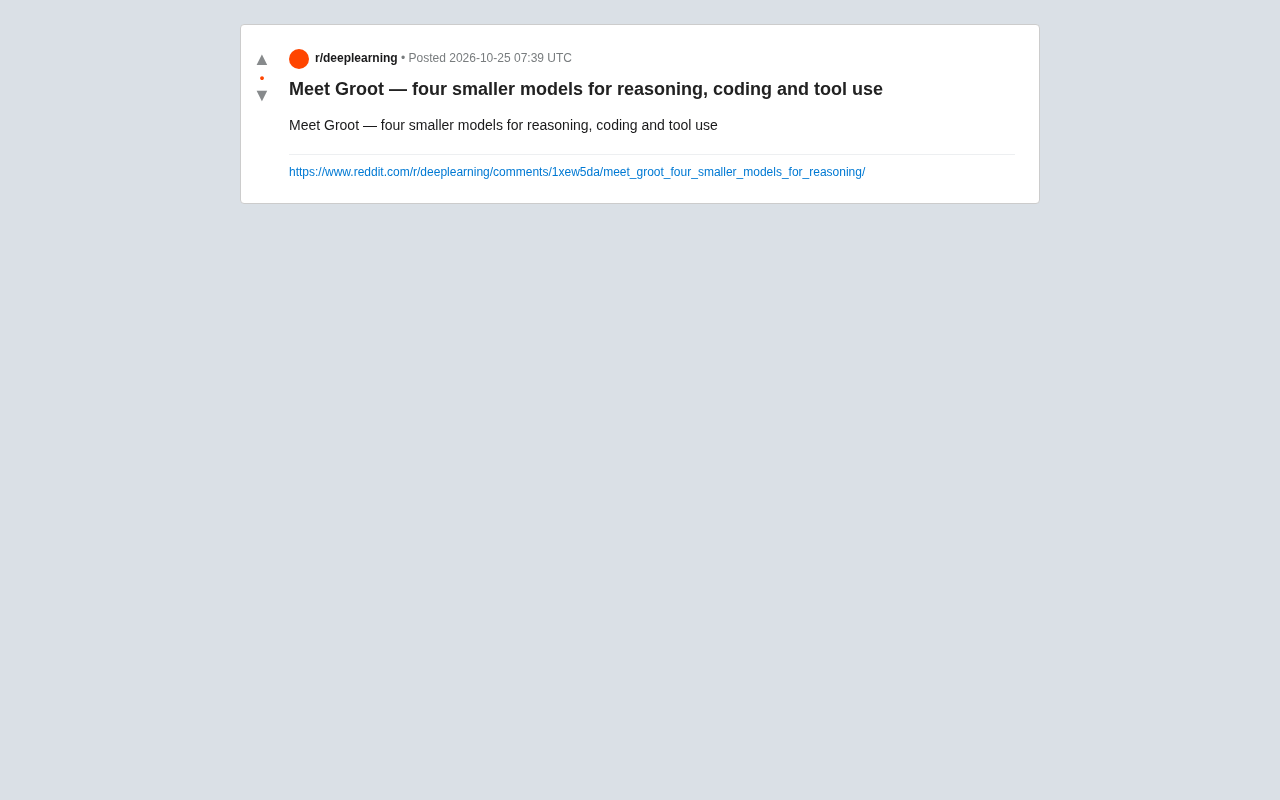
Groot launches four small models covering reasoning, coding, and tool calling, targeting Agent workflows.
Groot's small model series features four independent models for reasoning, coding, and tool calling, positioned as productivity components for Agent workflows. The splitting strategy fits multi-step Agent orchestration but adds selection complexity. Parameter counts, licenses, benchmarks, and tool calling protocol support remain undisclosed.
As AI models continue to grow in scale, a small model series called Groot has quietly emerged, aiming to cover three high-frequency scenarios—reasoning, coding, and tool calling—with smaller parameter counts. The original information includes only a title and a Reddit screenshot, lacking technical details, but this positioning alone is worth discussing.
The value of small models lies not in being "bigger," but in being "sufficient and deployable." While cloud-based large models still hold advantages in complex reasoning, localized, low-latency, low-cost vertical small models are becoming a supplement to developers' toolchains. Groot's choice to cover reasoning, coding, and tool calling simultaneously indicates that its design goal is not general-purpose chat, but productivity components for Agent workflows.
The Division of Labor Among the Four Models
Inferring from the title, Groot splits capabilities into four independent models. This splitting approach is not uncommon in recent small model releases: rather than having one model handle all tasks, it is better to optimize separately for reasoning, code generation, and tool calling, letting callers route by scenario.
The benefit of splitting is more controllable inference cost and response speed. The downside is increased selection complexity, as developers need to determine which model should handle the current task. For teams building multi-step Agents, this division of labor actually aligns better with practical orchestration needs.
The Competitive Focus of the Small Model Track
Groot's release timing falls within a window of intensive small model iteration. Reasoning capability, code accuracy, and tool calling reliability are the three main battlegrounds in current small model competition. Tool calling especially tests a model's understanding of function signatures and the stability of parameter filling, while coding scenarios are sensitive to context length and syntax correctness.
Since the source material provides no benchmark data, it is impossible to judge Groot's actual performance on these three dimensions. However, the strategy of running four models in parallel suggests that the team believes a single small model cannot simultaneously meet the precision requirements of these three task types.
Function Calling is the core mechanism that enables large language models to interact with external tools. The model outputs structured JSON specifying the function name and parameters to be called, which an external program executes and returns results for. Mainstream formats such as OpenAI's tools parameter and Anthropic's tool_use blocks all require the model to accurately understand the type constraints of function signatures. The reliability of tool calling is reflected in: whether it can correctly identify which function to call from natural language, whether parameter values match types, and whether it can adjust the next step based on returned results in multi-turn calls. Due to limited parameter capacity, small models are more prone to errors when function names are similar or parameter nesting is complex, so tool calling capability is often regarded as a key bottleneck for small model deployment.
Practical Significance for Developers
If Groot's tool calling model is sufficiently stable in function selection and multi-turn calling, it could become a lightweight execution layer in Agent frameworks. The coding model would be suitable for embedding in IDE plugins or CI pipelines, handling code completion and unit test generation. The reasoning model could be used for latency-sensitive local Q&A.
The common prerequisite for these scenarios is that the model can run locally or be deployed with low barriers. The source material does not specify parameter counts, licenses, or inference framework support, and this information will directly determine whether Groot can be practically adopted by the community.
Local deployment of small models typically relies on quantization techniques and lightweight inference frameworks. Quantization (such as GGUF, AWQ) compresses weights from 16-bit to 4-bit or 8-bit, significantly reducing VRAM usage and enabling models under 7B to run on consumer-grade GPUs or even CPUs. Inference frameworks such as llama.cpp, Ollama, and vLLM provide different levels of optimization: llama.cpp focuses on CPU/edge devices, while vLLM targets high-throughput serving. For Agent workflows, local small models offer clear low-latency advantages, but the accuracy loss from quantization must be weighed—especially since tool calling has high requirements for structured output stability, and excessive quantization may increase JSON format error rates.
Key Questions to Be Verified
Current information gaps are obvious: model parameter scale, training data composition, evaluation results, and open-source license have all not been disclosed. For small models, licenses often affect adoption more than performance. In addition, the specific protocol support for "tool calling" (whether it is compatible with mainstream function calling formats) is also key to deployment.
Overall, Groot's four-model positioning aligns with the division-of-labor trend in Agent workflows, but whether it can establish a foothold in the crowded small model track depends on technical details disclosed later and community verification results.
One-line Summary
Groot releases four small models covering reasoning, coding, and tool calling, targeting Agent workflows.
Paragraph Summary
The Groot small model series has emerged, with four independent models covering reasoning, coding, and tool calling scenarios, positioned as productivity components for Agent workflows rather than general-purpose chat. The article argues that this splitting strategy aligns with the division-of-labor orchestration needs of multi-step Agents, enabling more precise control over inference cost and response speed, but it also increases selection complexity for developers. Current competition in the small model track focuses on three main lines: reasoning capability, code accuracy, and tool calling reliability, while Groot has not yet disclosed parameter counts, licenses, evaluation data, or tool calling protocol support—its actual performance and community adoption prospects remain to be verified.
Related articles
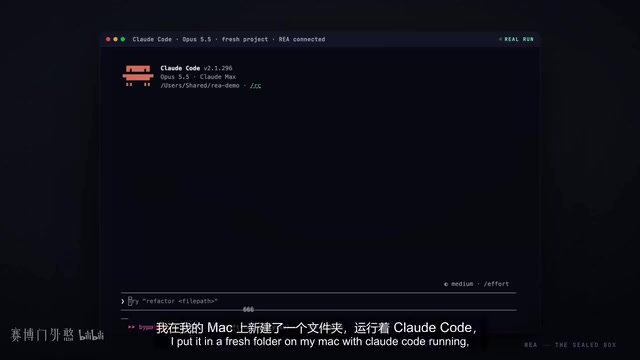
New AI Reverse Engineering Tool REA Lets Claude Clone Any App
REA (Reverse Engineer Anything), GitHub's #1 trending AI reverse engineering tool, lets Claude Code and other agents dissect any app and reproduce features—but also triggers safety blocks. This article covers its capabilities, limits, and ethical boundaries.

How to Provide Effective Context for AI Agents: Start Simple, Build a Single Source of Truth
Explore how to provide effective context for AI agents: start with simple Markdown files, gradually build a central source of truth, and bring in professional vendors at scale. Learn context management strategies for multi-agent collaboration.
6 Genuinely Free AI Coding Tools Tested: Free Tiers and Hidden Limits Explained
Six genuinely free AI coding tools tested: GitHub Copilot, Cursor, Google Antigravity, Amazon Q, Devon Desktop, and Replit. Free quotas, hidden limits, account closure risks, combined-use strategy, and when to pay.