GTA VI Developer's Union Vote Falls Short: The Industry Undercurrent Behind a Mere 25% Support Rate
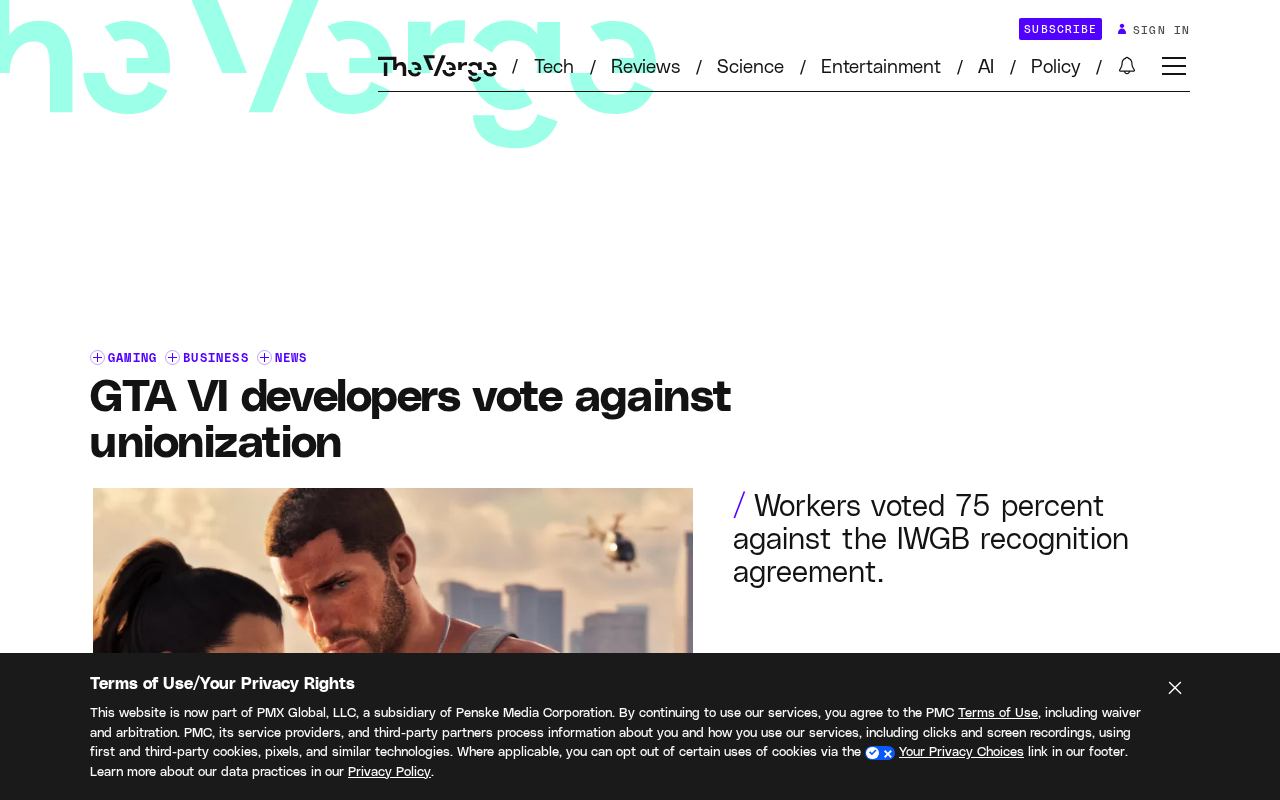
Rockstar Games' union recognition vote received only 25% support and failed, but union members will continue organizing without formal recognition.
Rockstar Games' vote on a formal union recognition agreement failed to pass, with only 25% of voters supporting unionization. The Independent Workers' Union of Great Britain (IWGB) stated that employees who have joined the union will continue to advance organizing work without formal recognition. The vote result represents a setback for the increasingly active unionization movement in the gaming industry in recent years, but also reflects clearly divergent views on unionization within the star studio. The article analyzes the difference between formal recognition and informal organizing, points out that a failed vote does not mean the end of union activity, and explores the potential impact of this event on GTA VI development and the industry ecosystem.
According to RSS feed reports, Rockstar Games, the developer of Grand Theft Auto VI (GTA VI), recently held a vote on a formal union recognition agreement, which failed to pass—only 25% of voters supported unionization. This result means that Rockstar employees will not, for the time being, engage in collective bargaining with the company in the form of a union.
Vote Results and Union Response
According to information disclosed by the Independent Workers' Union of Great Britain (IWGB), the vote centered on whether to reach a formal union recognition agreement, and the final proportion of votes in favor was only 25%, far short of the majority required for passage. Despite the failed vote, IWGB stated that Rockstar employees who have already joined the union will continue to advance organizing work without formal recognition.
The specific time span of the vote was not fully presented in the original report, but it is known that the vote continued for a period before ending. This result represents a clear setback for the increasingly active unionization movement in the gaming industry in recent years.
The Independent Workers' Union of Great Britain (IWGB) is an independent trade union in the UK, whose full name is the Independent Workers' Union of Great Britain, primarily representing gig economy workers, freelancers, and some gaming industry employees. Unlike traditional industry unions, IWGB is known for grassroots mobilization and direct action, and in recent years has been relatively active in the game development field (such as organizing work at Rockstar's UK office). Under the UK's labor relations framework, if a union wants to engage in legally binding collective bargaining with an employer, it usually needs to obtain the employer's formal recognition (union recognition). This recognition can be achieved through a voluntary agreement, or may need to be mandatorily obtained through statutory procedures (such as a vote reaching a certain turnout and majority support). Therefore, the core of this vote was not "whether we want a union," but "whether to push for a formal recognition agreement."
Why This Vote Is Worth Watching
Rockstar Games is one of the most influential studios in the gaming industry, and its flagship title GTA VI is eagerly anticipated by players worldwide. Precisely for this reason, labor relations developments within the studio carry symbolic significance beyond a single company.
From the industry background perspective, the game development field has in recent years frequently seen discussions about intense overtime, contract worker treatment, and job security. Unionization is seen as an institutional path for employees to strive for better working conditions. Rockstar's failed vote this time reflects that even at a star studio with extremely high public attention, unionization still faces significant resistance.
The 25% support rate is especially worth pondering—it is neither overwhelming opposition nor anywhere near enough to form a sufficient force for change. This "minority" state may mean that employees internally have clearly divergent views on unionization, or that the voting mechanism itself affected the result.
The unionization movement in the gaming industry has clearly heated up in the 2020s. In 2022, QA workers at Activision Blizzard's Raven Software formed the first recognized union at a major American gaming company; since then, unionization attempts have appeared at multiple studios (including Microsoft-owned ZeniMax and Sega of America). The backdrop to this wave is years of industry-wide problems: "crunch"-style intense overtime, frequent layoffs, the treatment gap between contract workers and full-time employees, and a lack of job security. However, the union recognition mechanisms in the US and the UK differ—the US uses a voting process supervised by the National Labor Relations Board (NLRB), while the UK relies more on voluntary employer recognition or a complex statutory recognition process, which means institutional differences must be noted when making cross-country comparisons. The low support rate in Rockstar's vote this time is also consistent with the overall pattern of gaming industry unionization: "local breakthroughs, slow overall progress."
The Difference Between Formal Recognition and Informal Organizing
IWGB's statement reveals a key point: a failed vote does not mean the end of union activity. Without formal recognition, union members can still continue internal organizing, communication, and collective action—they simply lack an institutional channel for formal negotiations with the employer.
This "recognition-free organizing" model is not uncommon in the labor movement. Its challenge lies in the lack of legal or procedural leverage, but its advantage lies in flexibility—employees can bypass the formal framework and gradually build consensus from the grassroots. Rockstar's union members have clearly chosen this path.
In labor law, "union recognition" refers to an employer formally agreeing to engage in collective bargaining with a union over wages, hours, and working conditions. Once recognition is obtained, the union usually enjoys statutory rights, such as access to employee information, collective bargaining, and the ability to take industrial action in disputes. An unrecognized union can still exist and carry out activities, but it lacks institutional bargaining rights, and its influence depends more on member cohesion, public opinion, and grassroots mobilization. This "recognition-free organizing" model is sometimes called "minority unionism"—that is, not pursuing legal recognition, but gradually building a membership network and consensus within the workplace, and seeking formal negotiations once strength has accumulated. IWGB's statement is precisely a manifestation of this strategy.
Potential Impact on GTA VI Development and the Industry Ecosystem
GTA VI itself is in a highly secretive and high-pressure development cycle, and labor relations tensions may have subtle effects on team morale and development pace. Although there is currently no public information indicating that the vote result will directly affect the game's release plans, the fact that employee rights issues are fermenting at a critical stage of the project is itself worth continued observation.
Looking at the gaming industry as a whole, Rockstar's case is one node in a series of recent unionization attempts. It reminds people that unionization is not a linear process decided by a single vote, but a long-term issue of repeated contention. The 25% support rate may be interpreted by supporters as a starting point rather than an endpoint, and may also be seen by opponents as a true reflection of employee sentiment.
Regardless of stance, this vote has brought a frequently overlooked question to the forefront: beneath the halo of creating the world's best-selling entertainment product, where exactly do developers' working conditions and voice stand?
One-line Summary
Rockstar Games' union recognition vote received only 25% support and failed to pass, but union members will continue organizing without formal recognition.
Paragraph Summary
Rockstar Games' vote on a formal union recognition agreement failed to pass, with only 25% of voters supporting unionization. The Independent Workers' Union of Great Britain (IWGB) stated that employees who have joined the union will continue to advance organizing work without formal recognition. The vote result represents a setback for the increasingly active unionization movement in the gaming industry in recent years, but also reflects clearly divergent views on unionization within the star studio. The article analyzes the difference between formal recognition and informal organizing, points out that a failed vote does not mean the end of union activity, and explores the potential impact of this event on GTA VI development and the industry ecosystem.
Related articles

Single Is Not Failure: Rethinking Love and Wholeness Through Faith Traditions
A Vox video explores the emotional interrogation single people face during holidays, offering two insights from a Catholic priest and nun: humans are made for love but love takes many forms, and being loved is a gift of existence, not an achievement. Learn to respond to "are you dating?" with "I am deeply loved."
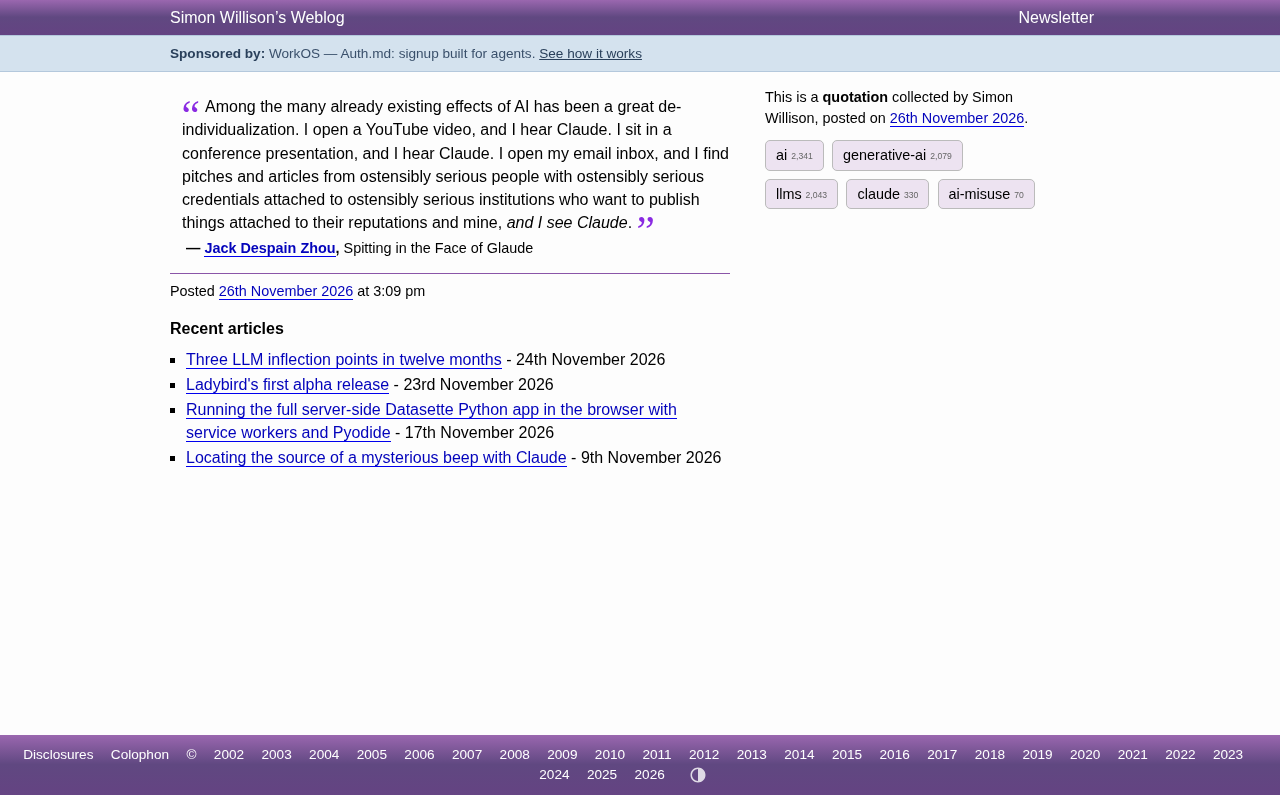
AI Makes Everyone Sound Like Claude: A Quiet De-individualization
Jack Despain Zhou notes that AI is causing a de-individualization of expression: Claude's voice echoes through YouTube videos, conference talks, and email submissions. This article analyzes the causes of this homogenization, its impact on reputation and trust structures, and how to balance efficiency with individual voice.

Black Friday Streaming Deals: Disney+, Hulu, HBO Max Discounts Over 50%
Black Friday streaming deals are here: Disney+, Hulu, HBO Max and more offer over 50% off. Here's an overview of the discounts and tips on choosing.