Guerrilla Warfare in the American Civil War: Missouri's Bloody Terror and the Origins of the Laws of War

Missouri's Civil War guerrilla warfare was a lawless terror that ultimately catalyzed the codification of modern rules of war.
During the American Civil War, Missouri experienced the conflict's bloodiest guerrilla warfare—a form of combat defined by bushwhacking, civilian massacres, and the absence of rules. The 1863 Lawrence Massacre exemplified its horror. This chaos forced Union commanders to codify the laws of war, producing the Lieber Code, which became the foundation for the Hague and Geneva Conventions that govern warfare today.
In the grand narrative of the American Civil War (1861-1865), large-scale battles like Gettysburg and Antietam typically occupy the central place in history books. However, beyond the battlefields where regular armies clashed, there existed a fundamentally different, far more brutal and chaotic form of warfare—guerrilla war. Historian Gary Gallagher, in conversation with Lex Fridman, noted that Missouri experienced the bloodiest guerrilla warfare of the entire conflict. This article examines the nature of Civil War guerrilla warfare, its geographic patterns, and its profound influence on the evolution of the rules of war.
What Was Guerrilla Warfare in the Civil War
Gallagher argues that guerrilla warfare is precisely what most Americans intuitively imagine "war" to look like. Unlike conventional battles involving tens of thousands of soldiers on each side, it was dominated by much smaller armed groups—a guerrilla band might number only a few dozen, though sometimes swelling to several hundred.
Crucially, there were virtually no true "battles" between guerrilla forces. Their method of warfare was called "bushwhacking" by contemporaries: ambushes, civilian intimidation, livestock slaughter, execution of civilians, killing of prisoners of war, and hanging of innocents. It was a form of warfare without rules, using terror as its instrument. The term "bushwhacking" originated in the American frontier era, literally meaning to hack (whack) a path through brush (bush), later evolving to mean "ambushing from the bushes." This tactic was already widespread during the "Bleeding Kansas" period (1854-1861) before the Civil War—when the Kansas Territory erupted into quasi-war violence over the slavery question, with pro-slavery "Border Ruffians" and anti-slavery "Free-Soilers" frequently clashing. After the Civil War broke out, these groups with extensive experience in violence naturally continued and escalated guerrilla tactics. Notably, the later infamous Western outlaws Jesse James and the Younger brothers received their violent "baptism" in Missouri's guerrilla war.
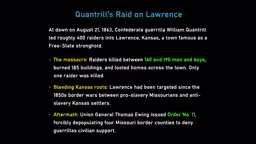
One of the most famous large-scale incidents was the raid on Lawrence, Kansas, by Confederate guerrilla leader Quantrill. William Clarke Quantrill was one of the most controversial figures of the Civil War. Born in Ohio, he drifted to the Kansas-Missouri border before the war and joined the Southern cause. The August 21, 1863 raid on Lawrence was carefully planned—Lawrence was the symbolic center of the Kansas free-state movement and the base of radical abolitionist Jim Lane. Quantrill led approximately 450 horsemen in a dawn assault on the town, systematically executing nearly all adult males, burning about 185 buildings, killing over 150 men, and engulfing the entire town in terror. This massacre directly led to the Union Army's infamous "General Order No. 11," which forcibly expelled virtually the entire civilian population from four counties in western Missouri, creating a depopulated zone to sever the guerrillas' civilian support network. Such events revealed the darkest face of guerrilla warfare: it no longer distinguished between combatants and civilians.
Terrain and the Geography of Guerrilla Warfare
Gallagher offers a particularly insightful observation: there is a clear correlation between guerrilla activity and terrain elevation. The more mountainous and hilly the landscape, the more likely guerrilla forces were to be active.
Mountainous terrain provided guerrillas with natural concealment and mobility advantages. Thus, East Tennessee, western North Carolina, southwestern Virginia, and even parts of Texas all saw guerrilla activity. This observation actually reveals a deeper socioeconomic structural issue. The regions traversed by the Appalachian Mountains—from East Tennessee to West Virginia—were precisely the areas within the Confederacy where the slave economy was weakest. Mountain farmers were mostly yeomen who rarely owned slaves and lacked identification with the secessionist movement led by plantation elites. Consequently, these areas saw extensive pro-Union guerrilla activity, creating a "Union within the Confederacy" phenomenon. West Virginia's establishment as an independent state (1863) was the institutional result of this geographic-political logic. Meanwhile, German immigrant communities in the Texas Hill Country also suffered bloody suppression by Confederate authorities for opposing slavery and conscription—the 1862 "Nueces Massacre" being one example.
The most devastating theaters of guerrilla war were concentrated in Missouri and Kentucky.
In numerical terms, guerrilla warfare's participation scale was not large. Of the approximately 3 million who served in the entire war, perhaps only about 50,000 were involved in guerrilla fighting. However, its brutality and destructiveness far exceeded what that proportion might suggest—it persisted throughout the entire war and was "very dirty, with no rules whatsoever."
How Guerrilla Warfare Gave Birth to Modern Rules of War
A fascinating historical fact: the codification of modern rules of war was partly forced into existence by the guerrilla chaos in Missouri.
Union General Henry Halleck, stationed in Missouri at the time, was deeply troubled when dealing with guerrilla activity. Henry Halleck was not merely a general but also a legal scholar who had published Elements of International Law before the war and had deep academic interest in the law of war. Facing combat opponents he could not clearly define, he realized that rules had to be established: Who is a civilian and who is not? How should one respond in this situation versus that one?
It was precisely this practical need that drove the codification of the laws of war. Halleck commissioned Francis Lieber, a professor of political philosophy at Columbia University, to draft a code of conduct for warfare. In April 1863, President Lincoln signed "General Orders No. 100, Instructions for the Government of Armies of the United States in the Field"—the famous "Lieber Code." This 157-article regulation was the first to systematically define the distinction between lawful and unlawful combatants, standards for prisoner-of-war treatment, the principle of military necessity, and limits on protection of civilian property. The Lieber Code later became the direct blueprint for the Hague Conventions of 1899 and 1907, subsequently influencing the entire modern system of international humanitarian law, including the 1949 Geneva Conventions. One could say that the bloody chaos in Missouri's forests ultimately gave birth to the legal framework constraining all of humanity's conduct in war.
This point precisely confirms Gallagher's core argument: the Civil War was essentially a war between two mid-nineteenth-century nation-states. Such states shared a common understanding of "how to fight a war"—waged by professional soldiers commanding national armies, with an understanding that boundaries on wartime conduct exist. Those boundaries expanded as the war progressed, but never slid into indiscriminate slaughter of civilians. Guerrilla warfare appeared especially horrifying precisely because it operated outside this framework of rules.
The Total War Debate and the Escalation of Conflict
The conversation also touched on a classic historiographical debate: Was the Civil War "total war"? Gallagher believes this depends entirely on how you define the term.
The concept of "Total War" was first articulated by German General Ludendorff in 1935, referring to warfare that mobilizes all social resources with the goal of destroying the enemy's entire war-making capacity. Retroactively applying this concept to the American Civil War has sparked decades of scholarly debate. The school represented by Mark Neely argues that the Civil War never reached the level of twentieth-century total war—there was no systematic bombing of cities, no genocide, and direct killing of civilians was relatively limited. The school represented by Charles Royster emphasizes that Sherman's "March to the Sea" and Sheridan's scorched-earth campaign in the Shenandoah Valley constituted, in both intent and effect, a comprehensive assault on the civilian economic base—essentially an early form of total war.
If measured by the breadth of social mobilization, the Civil War qualifies as the most thoroughgoing total war—the entire society was drawn in. When large-scale strikes against the enemy's economic infrastructure emerged during the war—especially after Grant assumed overall command—these total war characteristics became increasingly pronounced. For a farmer who experienced an army passing through, his livestock seized or slaughtered, his crops destroyed—even if he himself survived unharmed—this was unequivocally total war.
The escalation of the war had a clear turning point. Gallagher identifies the spring and summer of 1862 as the moment of a "quantum leap": multiple signals indicated this would be a war no one had previously anticipated. This period is viewed as the critical juncture in the transformation of the war's nature for several reasons. Militarily, the Battle of Shiloh (April 6-7) produced approximately 23,000 casualties—exceeding the combined casualties of all previous American wars—and shocked the entire nation. Politically, Lincoln began drafting the Emancipation Proclamation during this period (issuing the preliminary version in September), expanding war aims from "restoring the Union" to "destroying slavery," making compromise peace negotiations virtually impossible. Institutionally, both sides began implementing conscription (the Confederacy in April 1862, the Union in March 1863), marking the transition from a volunteer army system to full national mobilization.
Armies reached unprecedented size—the Army of the Potomac exceeded 100,000 men, something without precedent in American history. Consider that just fifteen years earlier, total U.S. military strength in the Mexican-American War was only about 70,000. From limited conflict to full mobilization, the scale and intensity of the Civil War were completely rewritten within a single year.
Conclusion
Missouri's guerrilla war provides an important counterpoint for understanding the American Civil War. In its most primitive and brutal form, it reminds us that once the rules framework of inter-state warfare is stripped away, violence rapidly slides toward terror against civilians. The codification of rules of war—from the Lieber Code to the Hague Conventions to the Geneva Conventions—represents civilization's response to such disorder. The Civil War was simultaneously a bounded conventional war between two organized states and, in its shadow, a breeding ground for lawless guerrilla terror—this duality is the key to understanding the complex nature of this conflict.
Related articles

AI Tool Boundaries and Automation Practices for Researchers in the Agent Era
From webcoding to research automation, Agent tools are reshaping research workflows. This article outlines the core differences between chatbots and coding Agents, analyzes multi-Agent division of labor and tool categories, and explores AI's capability boundaries in research—researchers still need to master problem formulation, experimental design, and result evaluation.

WorkBuddy in Action: A Full Breakdown of Desktop AI Agent Automation for Office Work and Shopping
A deep dive into Tencent WorkBuddy, the desktop AI agent that connects WeChat, Feishu, DingTalk, and Baidu Netdisk for file organization, weekly reports, PDF data extraction, and automated browser shopping—plus its limits on standard vs. aesthetic tasks and OpenCLI bridging details.

Copilot Usage Metrics Upgrade: Custom Skills and Agents Now Trackable by Name
GitHub Copilot usage metrics update: custom skills, agents, MCP servers, and plugins can now be tracked by name, with each list capacity increased from 5 to 25, helping admins precisely assess internal AI tool adoption and ROI.