AI Tool Boundaries and Automation Practices for Researchers in the Agent Era

Coding Agents are upgrading researchers from executors to decision-makers, but review and judgment remain core human responsibilities.
Based on Bilibili creator Qian Yun's sharing, the article maps the evolution of AI tools in research: from chatbots to coding Agents like Codex and Claude Code that can take over a computer and execute tasks, and further to multi-Agent collaborative research automation pipelines. Webcoding lowers the programming barrier, but researchers still need to understand code and algorithms to review AI output. AI excels at repetitive work, while judging research question value, experimental innovation, and result credibility still depends on humans. Researchers should focus on using Agent tools, prompt design, and the core qualities of posing good questions and designing good experiments—shifting from executors to decision-makers and reviewers.
Title
AI Tool Boundaries and Automation Practices for Researchers in the Agent Era
Meta Description
From webcoding to research automation, Agent tools are reshaping research workflows. This article outlines the core differences between chatbots and coding Agents, analyzes multi-Agent division of labor and tool categories, and explores the capability boundaries of AI in research—researchers still need to master the core skills of problem formulation, experimental design, and result evaluation.
Article Content
Amid the rapid iteration of AI technology, the way research is conducted is undergoing a quiet transformation. In a recent sharing session, Bilibili creator Qian Yun systematically mapped the evolution from "vibe coding" (webcoding) to research automation and explored the capability boundaries of AI tools within research workflows. Based on that sharing and combined with industry observations, this article offers researchers a pragmatic guide to tool usage.
From Chatbots to Agents: A Leap in Capability
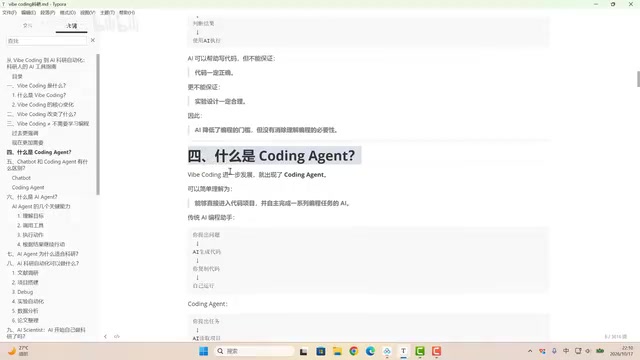
In the past, when we used chatbots like ChatGPT and DeepSeekAd, the essence was a "question-answer" mode: AI offered suggestions, and humans were responsible for execution. The emergence of coding Agents such as Codex and Claude Code has changed this relationship—they can take over the computer, analyze data, write code, and directly complete experimental steps. According to the demonstration by creator Qian Yun, this type of Agent tool "can analyze data and write code to complete the current experiment," and its core difference from chatbots lies in shifting from "telling you how to do it" to "doing it for you."
This leap in capability means researchers can hand off repetitive labor—such as writing training scripts, preprocessing data, and generating comparison experiment charts—to Agents. But the creator also explicitly cautioned: this does not mean programming no longer needs to be learned. Researchers still need the ability to understand code logic and algorithm principles; otherwise, they cannot judge the reliability of the Agent's output.
Agent is a class of AI systems distinct from traditional chatbots, whose core feature is autonomous planning and tool invocation capabilities. Unlike chatbots that only output text, Agents can call external tools (such as code interpreters, terminals, and browsers), execute multi-step operations, and dynamically adjust strategies based on intermediate results. Coding Agents such as OpenAI Codex and Anthropic Claude Code belong to this category: they can directly read file systems, run command lines, and debug code, thereby transforming natural language instructions into executable sequences of operations. This "perception—planning—execution" loop is the technical root of the capability divergence between Agents and chatbots, and the prerequisite for their ability to take over repetitive research programming tasks.
The Essence of Webcoding: A Programming Paradigm of Human-AI Collaboration
Webcoding (vibe coding) is not an entirely new concept; its core is that researchers describe requirements in natural language, and AI generates the corresponding code. In traditional deep learning projects, researchers often spend a great deal of time on repetitive code writing, debugging, and script maintenance. The creator pointed out that current Agents can take over most of this work, including model code, training scripts, and even data preprocessing code.
But this raises a key question: where should researchers' focus of ability lie? The answer is shifting from "writing code" to "asking questions." The ability to pose valuable research questions, design reasonable experimental plans, and judge the credibility of AI output—these are the core capabilities that Agents cannot replace. The creator emphasized, "What we need to consider is whether the current research question is valuable, innovative, and valid—we have to make a decision."
Real Progress in Research Automation and Multi-Agent Division of Labor
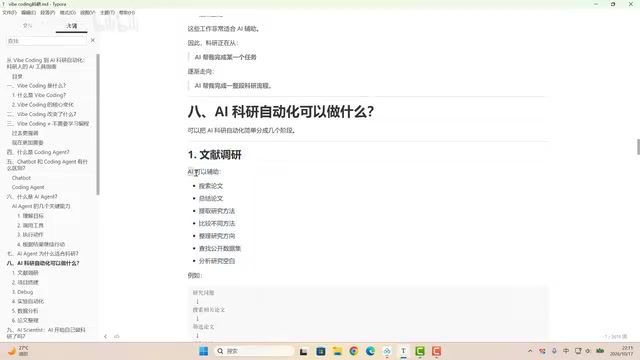
Research automation is not fantasy. The creator mentioned that cases of end-to-end AI Agents used for research automation have already been published, providing academic support for this direction. A further practice is multi-Agent collaboration: one Agent handles literature research and summarization, one proposes hypotheses, one seeks evidence, and one executes experiments, forming a clearly divided automated pipeline.
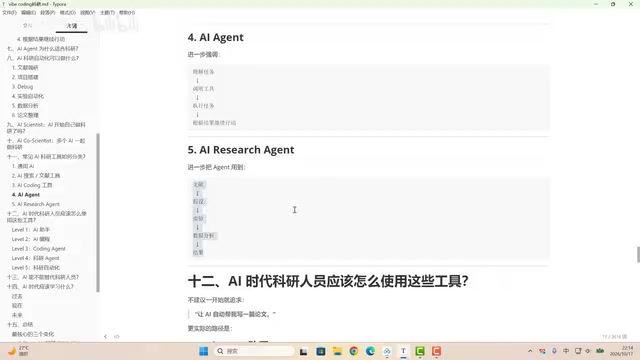
In terms of tool classification, the creator divided AI tools into literature search tools, general conversational tools, coding Agent tools (such as Codex and Claude Code), and research automation Agent tools. In addition, the Skill mechanism (encapsulating domain-specific skills and feeding them to Agents) enables Agents to produce more precise results in vertical domains. This layered approach helps researchers choose the right tools based on task type, rather than blindly pursuing "one Agent to solve all problems."
Multi-Agent Collaboration refers to multiple Agents with different role settings working together to complete complex tasks through message passing or shared context. Common architectures include: an Orchestrator responsible for decomposing tasks and assigning them, Workers each responsible for subtasks such as literature retrieval, hypothesis generation, and code execution, and finally a aggregator that integrates the results. This model simulates the division of labor in a research team; its advantage is that each Agent can load domain-specific prompts or Skills, thereby improving the precision of vertical tasks. But multi-Agent systems also face challenges such as context consistency, error propagation, and result traceability, and actual deployment usually requires human review and correction at key nodes.
Skill mechanism in the Agent context refers to encapsulating domain-specific operational workflows, knowledge templates, or tool invocations into reusable modules for Agents to load when needed. For example, a "paper reproduction Skill" might include environment configuration scripts, data loading specifications, and evaluation metric calculation templates. The role of a Skill is similar to installing "professional plugins" for a general Agent, enabling it to produce more precise results that better conform to domain conventions in vertical scenarios. Compared with simple prompts, Skills usually contain structured instructions and supporting tools, which can significantly reduce the hallucination rate and formatting errors of Agents in professional tasks.
Understanding Boundaries: AI Cannot Replace Research Decisions
Despite the power of Agents, the creator explicitly rejected the claim that "AI can replace researchers." What AI excels at is repetitive work—code writing, literature summarization, and simple data analysis; while the most critical parts of research—judging the value of research questions, the innovativeness of experimental design, and the credibility of results—still depend on human researchers.

This judgment is consistent with the current mainstream consensus in academia. Agent output needs to be scrutinized, not trusted. Researchers need the ability to "understand Agent output," which brings us right back to the fundamentals of programming comprehension and algorithmic literacy. The creator compiled a comprehensive Codex prompt library for deep learning scenarios, covering project setup, data analysis, model training, optimization and hyperparameter tuning, paper reproduction and writing, and more. Its value lies in improving the controllability and quality of Agent output through structured prompts.
Structured Prompting refers to organizing prompts in a step-by-step, role-based manner with clear input and output formats, rather than relying on single-sentence natural language instructions. In research scenarios, structured prompts usually include elements such as task objectives, available tools, constraints, output format examples, and review criteria. Their value lies in transforming vague requirements into specifications that Agents can execute stably, reducing output deviations. The "Codex prompt library" compiled by the creator is essentially a set of structured prompt templates oriented toward deep learning workflows, covering everything from project setup to paper writing, helping researchers manage Agent output quality in an engineering-driven way.
What Researchers Should Focus on Learning
In the Agent era, the focus of researchers' learning is shifting. The creator's advice can be summarized in three points: first, learn to use Agent tools to solve practical problems, including reasonable prompt design and tool orchestration; second, maintain a basic understanding of programming languages and algorithms to ensure the ability to review AI output; third, strengthen the core research qualities of posing good questions, designing good experiments, and judging the credibility of results. Literature research, code implementation, and data preprocessing can be boldly delegated to AI, but the cultivation of research judgment cannot be outsourced.
From chatbots to Agent assistants, the role of AI in research has shifted from "advisor" to "executor." The role of researchers has been upgraded from "executor" to "decision-maker and reviewer." Understanding this boundary is more important than chasing every new tool.
One-line Summary
Coding Agents are upgrading researchers from executors to decision-makers, but review and judgment remain core human responsibilities.
Paragraph Summary
Based on a sharing session by Bilibili creator Qian Yun, the article maps the evolution of AI tools in research: from chatbots to coding Agents capable of taking over a computer and executing tasks (such as Codex and Claude Code), and further to multi-Agent collaborative research automation pipelines. Webcoding (vibe coding) lowers the programming barrier, but researchers still need to understand code and algorithms to review AI output. The article emphasizes that AI excels at repetitive work, while judging the value of research questions, experimental innovation, and result credibility still depends on humans. Researchers' learning focus should shift toward using Agent tools, prompt design, and the core qualities of posing good questions and designing good experiments—transforming from executors into decision-makers and reviewers.
Related articles

Cursor AI Programming in Practice: Build a Student Management System from Scratch in 30 Minutes
A Bilibili creator demonstrates Cursor AI programming: generating a student management system in 30 minutes with natural language. Details on Agent mode, Claude selection, prompt techniques, and thresholds.

Top 20 AI Coding Tools Ranking: From Rock-Solid to Lackluster, a Scored Matrix
Bilibili creator releases top 20 AI coding tools ranking, tiered T0–T4 from rock-solid to lackluster, with Claude Code and Codex tied at T0. This article details the scoring dimensions (capability, reliability, robustness, durability, cost, domestic availability) and tool performances to help developers choose the right AI coding assistant.

Vibe Coding Systematic Tutorial: Master AI-Assisted Programming from Zero
A three-month Vibe Coding tutorial from a Bilibili creator covering Codex, ClaudeCode, and Cursor, from core logic to commercial project practice for beginners.