GVD Framework: A Local-First Approach to Document Repository Version Governance and Deduplication
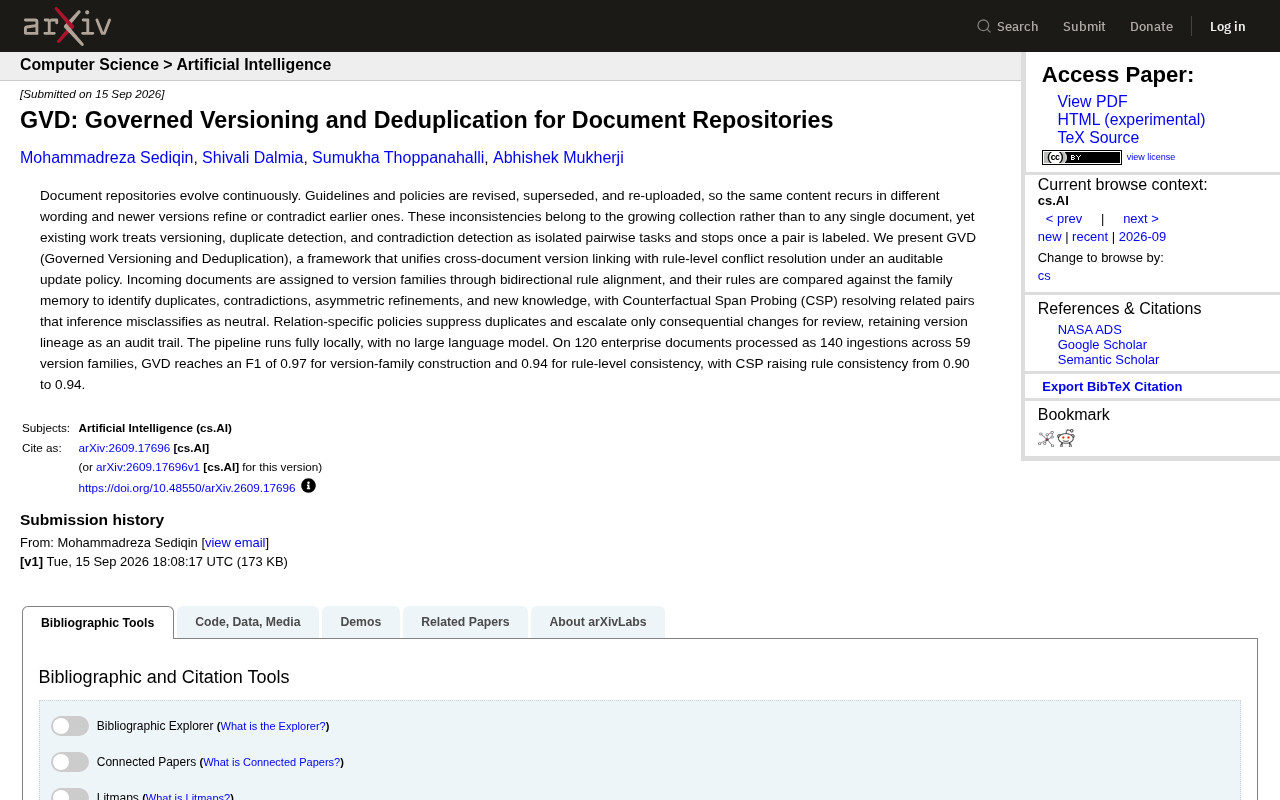
GVD unifies document versioning, deduplication, and conflict detection into an auditable, rule-level governance framework that runs fully locally.
Enterprise document repositories accumulate structural problems — version confusion, duplicate content, and conflicting rules — that existing tools handle as isolated pairwise tasks. GVD (Governed Versioning and Deduplication) proposes a unified framework that assigns documents to version families via bidirectional rule alignment, then classifies relationships at the rule level into duplicates, contradictions, asymmetric refinements, and new knowledge. Its key innovation, Counterfactual Span Probing (CSP), corrects rules misclassified as neutral, lifting rule consistency F1 from 0.90 to 0.94. The system escalates only substantive changes for human review while preserving full version lineage for compliance auditing — all running locally without any LLMs. Evaluated on 120 enterprise documents across 59 version families, it achieves a version family construction F1 of 0.97.
The Long-Standing Problem in Document Repository Evolution
Enterprise document repositories are never static. Guidelines, policies, and regulations are constantly revised, deprecated, and re-uploaded. The same content reappears in different wording, and new versions may refine or outright overturn rules from older ones. These inconsistencies don't belong to any single document — they are structural problems that accumulate as the entire document collection evolves over time.
Existing research tends to treat version management, duplicate detection, and conflict detection as three separate pairwise tasks: determining whether two documents are duplicates or contradictions, and calling it done once a pair is labeled. This approach misses the big picture of governing a document collection as a whole. Who is whose new version? Which changes are just rewording, and which are substantive conflicts requiring human intervention? These questions can't be answered through isolated pairwise comparisons.
A new paper on arXiv titled GVD: Governed Versioning and Deduplication for Document Repositories proposes a unified framework for tackling these challenges — and its approach is worth examining.
What GVD Does
GVD (Governed Versioning and Deduplication) aims to unify cross-document version association and rule-level conflict resolution under a single auditable update policy.
The processing pipeline works roughly as follows: incoming documents are assigned to their corresponding "version families" through bidirectional rule alignment, then the rules within each document are compared against that family's "memory" to identify four types of relationships — duplicates, contradictions, asymmetric refinements (where one rule supplements or refines another), and entirely new knowledge.
The key design choice here is the rule-level granularity. GVD doesn't stop at characterizing whole-document relationships — it drills into individual clauses within documents, determining the status of each rule relative to historical versions. This fine granularity allows the system to distinguish between "just rephrased duplicates" and "substantive conflicts that actually change a constraint."
Counterfactual Span Probing (CSP)
One of the paper's technical highlights is Counterfactual Span Probing (CSP). In natural language inference, many rule pairs that should be classified as "duplicate" or "contradictory" get incorrectly labeled as "neutral" by the model, causing genuinely important relationships to slip through. CSP is specifically designed to handle these misclassified neutral pairs and recover their true relationships.
The numbers speak for themselves: CSP lifts the F1 score for rule consistency classification from 0.90 to 0.94.
The design inspiration for Counterfactual Span Probing comes from research on "shortcut learning" in natural language inference (NLI). NLI models often rely on surface-level lexical overlap or syntactic similarity rather than truly understanding semantics when judging the relationship between two text segments. When two rules have similar wording but opposite meanings, or different wording but equivalent meaning, models tend to default to the most conservative "neutral" category — essentially saying "I can't detect clear entailment or contradiction."
CSP works by taking rule pairs classified as neutral and making minimal edits to key spans (text fragments) — for example, replacing numerical values, conditional terms, or negations with their opposites — then observing whether the model's output changes significantly. If a small semantic perturbation causes the model to flip from "neutral" to "contradiction" or "entailment," it indicates the original rule pair had a substantive relationship the model was missing. This "what if we said the opposite?" counterfactual test is precisely where the method gets its name.
Auditable Governance Policies
The biggest difference between GVD and traditional deduplication tools is that it bakes "governance" right into the framework's name.
The system employs relation-specific policies: content identified as duplicate is automatically suppressed, while only changes with substantive impact are "escalated" for human review. This means operators aren't buried under a flood of duplicate alerts — attention is concentrated on the conflicts and refinements that genuinely require judgment.
More importantly, the complete version lineage is preserved as an audit trail. For organizations operating under compliance constraints, this traceability — who changed which rule, when, and why — is often more valuable than detection accuracy alone.
Version lineage and audit trail have clear regulatory foundations in compliance-driven industries. Frameworks like ISO 9001, SOX (the Sarbanes-Oxley Act), and various financial regulatory regimes all require organizations to demonstrate "what policy version was in effect at a given point in time, and who authorized the change." Traditional document management systems (DMS) record when files were uploaded and by whom, but don't understand content-level changes — a clause quietly altered will only register as "file updated," with no indication that "the value cap in Section 3.2 changed from $1,000,000 to $800,000." GVD's rule-level change records make content-level compliance evidence possible, which is its most direct value for regulated industries.
Fully Local, No LLMs Required
At a time when large language models have become the default go-to, one of GVD's counterintuitive design choices is that the entire pipeline runs fully locally, without any large language models.
This tradeoff is quite pragmatic for enterprise document scenarios. Policy documents and compliance regulations often contain sensitive information that can't easily be uploaded to external LLM services. Running locally both eliminates data leakage risks and avoids API costs and latency. Achieving high accuracy under these constraints demonstrates that purpose-built, task-specific methods still have room to operate without relying on large models — at least in structured, well-defined domains like this one.
Achieving high-precision semantic understanding without large language models likely relies on a combination of smaller, specialized NLI models (such as BERT-based NLI classifiers) and rule-based pipelines. These models typically have around 100 million parameters and can be fully deployed on a local CPU or single GPU, with inference latency and hardware costs far lower than calling GPT-4-class model APIs.
This tradeoff does have its limitations: specialized NLI models' generalization depends heavily on training data coverage, and they may be unstable on highly specialized domain terminology (e.g., specific phrasing in medical regulations or financial contracts), where large models typically have stronger zero-shot understanding. GVD's local approach is therefore better suited to enterprise policy scenarios where document structure is relatively standardized, rather than general-purpose knowledge base governance across diverse domains.
Experimental Results
The paper evaluates on a set of enterprise documents: 120 corporate documents processed as 140 ingestions, distributed across 59 version families.
The results:
- Version family construction F1: 0.97
- Rule-level consistency F1: 0.94
- CSP improves rule consistency from 0.90 to 0.94
These figures indicate that GVD achieves a high level of performance on the specific task of enterprise document governance — both in version association and conflict identification. It's worth noting that an evaluation of 59 version families and 140 ingestions is a medium-scale benchmark; how the system performs on larger, more heterogeneous document repositories remains to be seen.
Why This Matters
GVD's significance isn't just in a few strong F1 scores — it's in how it reframes the problem.
It elevates versioning, deduplication, and conflict detection from "isolated pairwise judgments" to "collection-level continuous governance," backed by auditable policy mechanisms. For any organization maintaining large volumes of policy documents, technical specifications, or knowledge bases, the underlying approach — fine-grained rule comparison, escalating only meaningful changes, preserving a complete audit chain, local operation without LLM dependency — offers a concrete and actionable reference paradigm.
As enterprise knowledge bases continue to grow, "document governance" is gradually shifting from a back-office operations concern to a core issue affecting compliance and decision quality. Frameworks like GVD are a direct response to this trend.
Related articles

The Open Source Dilemma: A Non-Autoregressive Architecture Pioneer Overshadowed by Frontier Labs
An indie developer claims a frontier lab repackaged his year-old open-source non-autoregressive RL architecture as a breakthrough. We compare PPO sequence embeddings vs. RLCD parallel sampling and examine open source attribution gaps.
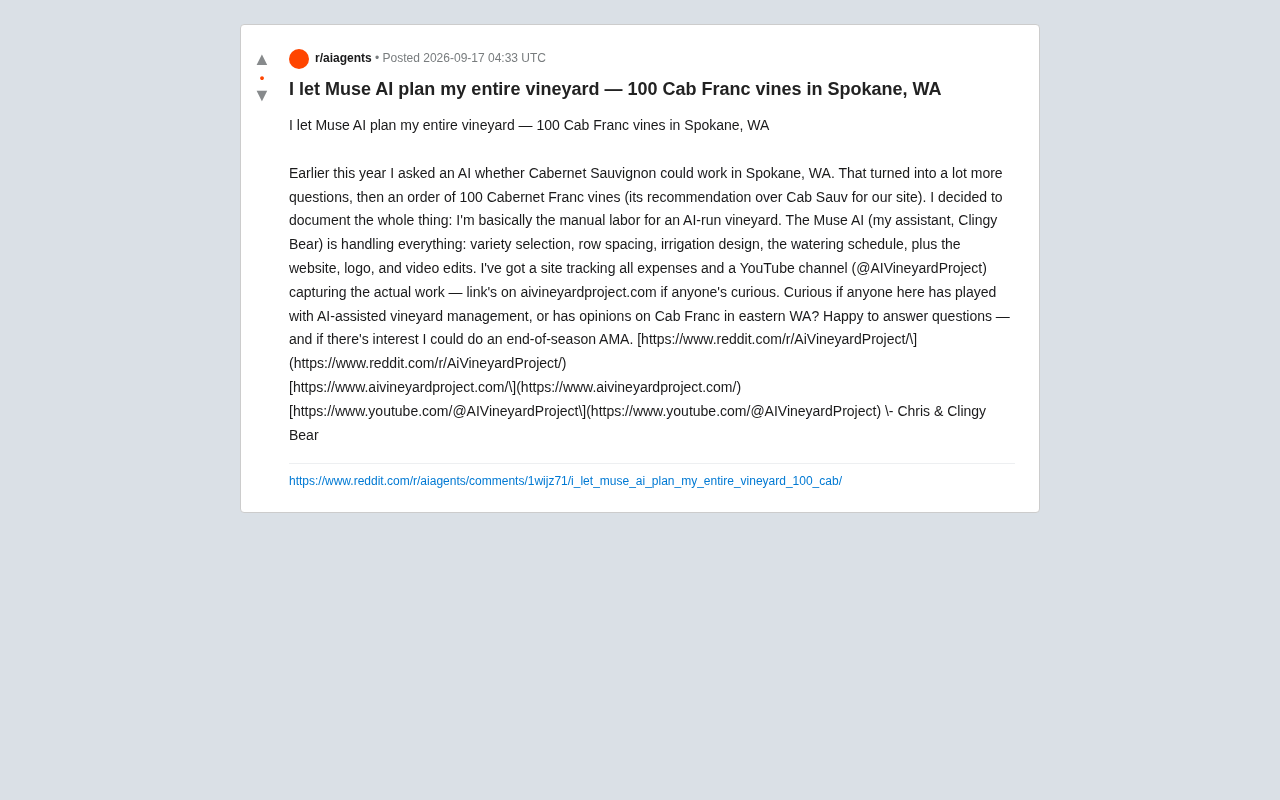
AI Plans an Entire Vineyard: A Real-World Experiment with 100 Grapevines
A Spokane hobbyist let Muse AI plan his entire vineyard — variety, spacing, irrigation, even the logo. He planted 100 Cabernet Franc vines and is documenting everything publicly.

Iceland's Treble Raises $18M to Bet on Voice Simulation Platform
Iceland-based voice simulation company Treble raises $18M. Its platform serves voice AI developers, AI wearables, and robotics firms. A deep dive into the technology and what the funding signals.