Hacker Times: Turning Hacker News into a Vintage Newspaper

A developer repackaged Hacker News in a New York Times layout, using UI reconstruction to change reading behavior.
Hacker Times is an experimental project that re-presents Hacker News posts in a New York Times-style newspaper layout, updating once per hour, and it sparked community discussion after release. The article notes that it does not change the data source or ranking logic, only re-imagining at the interface layer: columns, serif fonts, and heading levels make the layout itself carry editorial judgment, turning users' "scrolling" into "reading," while the hourly update constitutes a deliberate constraint on the instant information feed. The article also notes that currently public information mostly comes from the author's own account, with limited technical details and operational data. Its value lies in revealing that interface form itself is becoming an editorial stance, and in providing indie developers with a low-cost sample for validating ideas.
From Feed to Newspaper: A UI Experiment
Hacker News is a daily go-to information source for countless developers, but its bare-bones list interface hardly creates a sense of "reading" ritual. One developer made an interesting attempt: repackaging Hacker News in the layout of The New York Times, naming it Hacker Times. After being released as a Show HN post, the project quickly gained attention and sparked lively community discussion. The author's own words were simple—"I thought it would be fun to browse HN like reading a newspaper"—and the site updates once every hour.
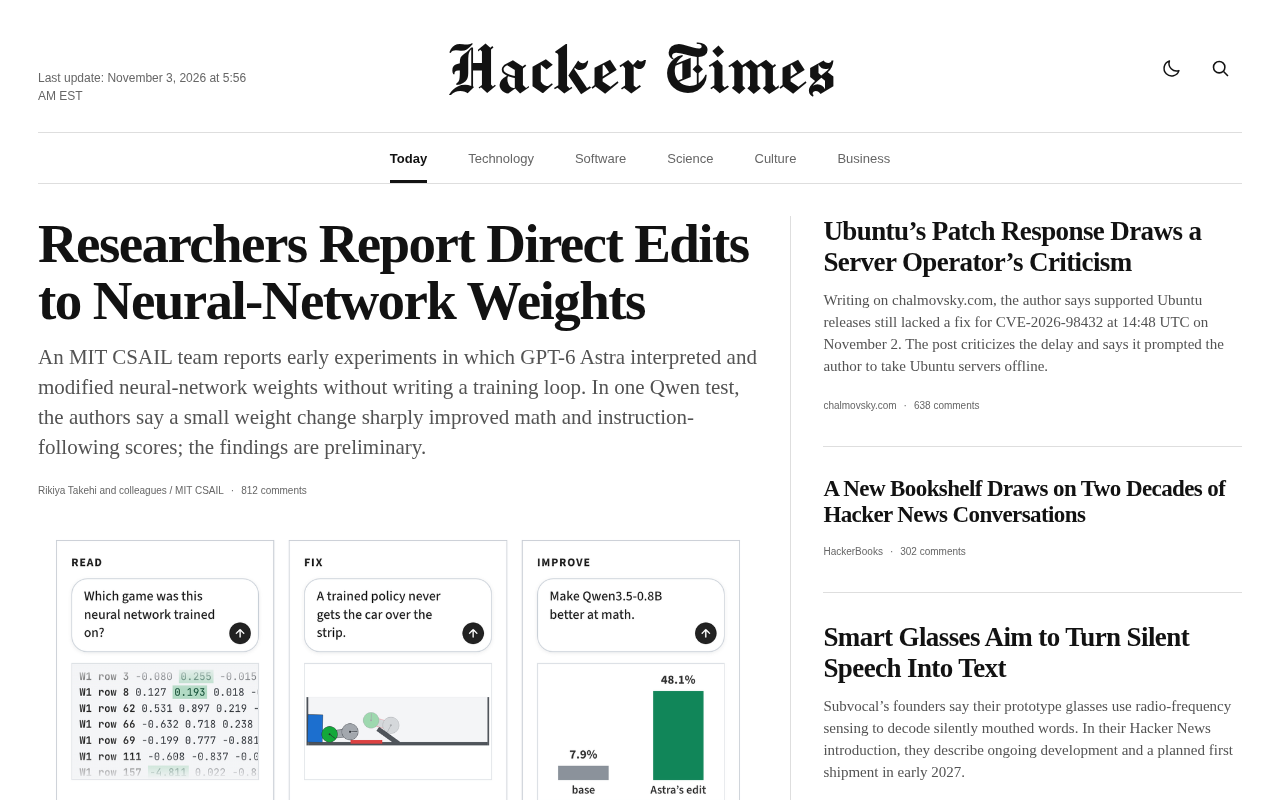
This project is essentially a re-imagining at the interface layer, not a functional rebuild. It places the same posts and the same ranking logic into a newspaper's visual framework: multi-column layout, serif fonts, and clearly differentiated heading levels. For users accustomed to infinite scrolling, this "one edition per day" rhythm actually constitutes a deliberate constraint.
Hacker News is a tech community and link aggregation site incubated by Y Combinator, launched in 2007. It uses a minimalist list interface and a ranking algorithm based on votes and time decay, and has long been regarded as an important entry point for developers to get tech news. Show HN is a regular section on Hacker News where authors publish their own work and seek feedback from the community. Post titles usually start with "Show HN:" and it is an important channel for indie developers to gain early exposure.
"Reskinning" in the context of web development refers to changing only a site's visual style (CSS/theme) without touching backend data or business logic; in contrast, "refactoring" changes data structures or interaction flows. Hacker Times belongs to the former category.
Why "Newspaperization" Makes People Want to Read
The core of a newspaper layout is not nostalgia but the reorganization of information density. Feeds stack content chronologically, with newer content higher up, but readers' attention is also fragmented into smaller pieces; newspapers use layout language to distinguish primary from secondary—headlines take large titles, secondary news is indented into smaller columns, and readers can tell at a glance what to read first.
Putting HN into this framework turns "scrolling" into "reading." The once-per-hour update setting also implies: you don't have to stare at it all the time; come back an hour later and this edition is a complete edition. This sense of rhythm seems somewhat counterintuitive in an environment flooded with instant information, but it also explains why it resonates.
Information density refers to the amount of effective information carried per unit area. Feeds stack content through infinite scrolling and equally weighted cards, resulting in low per-screen information density, and readers need to continuously swipe to filter; newspaper layouts, within a limited page area, encode importance through font size, column width, whitespace, and positional differences, resulting in higher per-screen information density, allowing readers to quickly locate key points by scanning the layout.
Related to this is the concept of page language: layout elements themselves convey editorial judgment—for example, headline position implies priority, and changes in the number of columns imply content categorization. This is exactly the mechanism source behind Hacker Times' ability to create a "reading" rather than "scrolling" experience.
Community Reaction and Similar Attempts
Judging from the release data, the project generated considerable discussion heat, with comments focusing on two areas: one is the fun of the visuals and typography themselves, and the other is extended discussion of the HN reading experience. Projects that "reskin established sites" are not uncommon in developer communities, but Hacker Times seized on the culturally resonant metaphor of a newspaper, going further than mere dark themes or card layouts.
It should be stated objectively that currently public information about this project mainly comes from the author's own account and the release post, and there are no further technical implementation details or long-term operational data for cross-verification. Its value lies more in the inspiration of its design thinking than in engineering complexity.
Cross-verification refers to checking the same fact using mutually independent information sources to reduce single-source bias. For Show HN-type projects, common cross-verification materials include open-source code repositories, traffic data, the author's subsequent update records, or third-party reports; when only the author's own account and the release post are available, the project's actual usage scale and stability are difficult to judge, and readers' expectations should be adjusted accordingly.
A Lesson for Content Products
Hacker Times reminds us of one thing: the same content, presented differently, changes reading behavior. Feeds pursue dwell time and click-through rate; newspapers pursue editorial judgment and reading completion. As AI aggregation tools increasingly redistribute content to users, the interface form itself is becoming an editorial stance—the layout you choose tells users how they should treat this information.
For indie developers, this is also a low-cost sample of validating an idea: without changing the data source, only changing the way users encounter the data is enough to constitute a product worth discussing.
One-line Summary
A developer repackaged Hacker News in The New York Times layout, using UI reconstruction to change reading behavior.
Paragraph Summary
Hacker Times is an experimental project that re-presents Hacker News posts in a New York Times-style newspaper layout, updating once per hour, and it sparked community discussion after release. The article points out that it does not change the data source or ranking logic, only re-imagining at the interface layer: columns, serif fonts, and heading levels make the layout itself carry editorial judgment, turning users' "scrolling" into "reading," while the hourly update constitutes a deliberate constraint on the instant information feed. The article also notes that currently public information mostly comes from the author's own account, with limited technical details and operational data. Its value lies in revealing that interface form itself is becoming an editorial stance, and in providing indie developers with a low-cost sample for validating ideas.
Related articles

Bypassing DeepSeek Detection: Sneaky Reverse-Proxy Tricks to Avoid Bans and Their Risks
A Bilibili creator shares a DeepSeek reverse-proxy scheme to avoid bans: evading XML tags, using a single English word as trigger, and registering with overseas emails. This article breaks down the technical approach, Harness integration results, and the real risks of this "unlimited tokens" game in terms of rule confrontation, account stability, and compliance.

4 Must-Have Plugins for Saving Tokens in DSH — Stop Installing Blindly
A detailed guide to 4 must-have DSH token-saving plugins: DSH Shops shortens tool output, Billion Context compresses early context, Vision Router converts images to text, and Thinking Levels auto-adjusts thinking depth — plus backup and verification tips before installing.
Retested 51 Times: DeepSeek Harness Token-Saving Plugins — Use Them Right and Save Half, Use Them Wrong and Pay More
51 test runs of three DeepSeek Harness token-saving plugins: Ops saves half only in PTC mode, Flash Presets saves ~20% via rules, Billion Context saves context space but not money. Includes selection guide and pitfalls.