4 Must-Have Plugins for Saving Tokens in DSH — Stop Installing Blindly

Token costs come mainly from how much the model reads, thinks, and re-reads; four plugins each save money via read less, think less, and re-read less.
The article argues that token consumption isn't determined by how much the user says, but by how much the model reads, generates, and re-reads. The second read of the same content costs only one-fiftieth of the first, model-generated content carries a higher unit price, and long conversations get pricier because every round re-reads the whole history. From this come three money-saving paths — read less, think less, re-read less — mapped to four plugins: DSH Shops reduces per-round reads with more compact tool output, Billion Context folds early context into summaries to control length, DSH Vision Router converts images to text first to avoid re-reading them each round, and DSH Thinking Levels auto-adjusts thinking depth by task difficulty. The article also advises backing up before installing, first tallying your spending structure, and comparing costs before and after to verify results.
Why Your Token Bill Keeps Climbing Even When You Barely Say Anything
Many people assume token consumption depends on how much they say, but according to Bilibili creator Ziyue's analysis, the real money-burners are often the places you're not paying attention to. For the same passage, DSH's second read costs only one-fiftieth of the first read, and the words the model "thinks up" on its own are billed separately at a higher rate. In other words, what determines cost isn't how much you input — it's how much the model reads, how much it thinks, and how much it re-reads.
This also explains why long conversations get more expensive the further they go: every time you send a message, the model re-reads all the preceding content from scratch. Content that's been read counts as a cache hit at a lower price; content that hasn't is billed at full price; and the model's own generated content has an even higher unit price.

From this we can distill three paths to saving tokens: read less, think less, re-read less. The four plugins below each map to one of these directions.
Context Window and Repeated Billing
Large language models are inherently stateless: each time it generates a reply, the model must re-read "the entire history of the current conversation" (system prompt, user messages, model replies, tool return results, etc.) as input. The maximum length this can hold is called the context window, typically measured in tokens. So in a long conversation, the input volume at round N is roughly the cumulative total of all content from the previous N-1 rounds — costs stack up quickly with each turn rather than being billed only by the length of your current message.
Cache Hits and Unit Price Differences
Mainstream APIs offer prompt caching: if the prefix of the current request is identical to the previous one, that portion can be billed at the lower "cache hit" price; new or changed portions are billed at full price. This explains the claim that "the second read costs only one-fiftieth of the first." Caches typically have an expiration window (ranging from minutes to hours); if too much time passes, they expire and content must be re-read at full price.
Asymmetric Pricing of Input vs. Output Tokens
The words the model "thinks up" are output tokens, whose unit price is typically significantly higher than input tokens (commonly 3–5x). The article's "read less, think less, re-read less" correspond respectively to reducing input that misses the cache, reducing output generation, and reducing repeated reads — these three are the main components of your bill.
1. DSH Shops: Making Tool Call Output More Compact
DSH Shops' approach is to replace the official suite of tools for reading, searching, and executing commands with more compact, shorter-output versions. The shorter the content a tool returns, the fewer words the model needs to read.
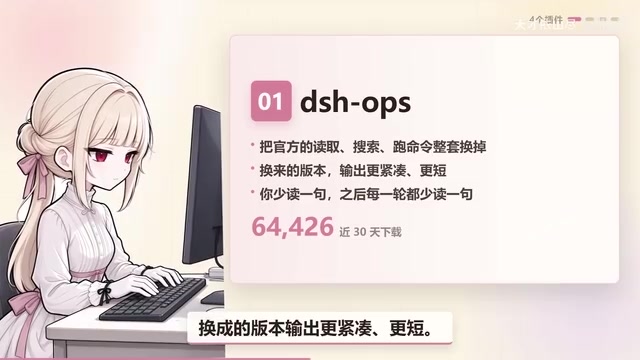
The value of this plugin lies in its "multiplier effect": what it reduces isn't a one-time amount, but the amount that must be re-read in every round of conversation. As the creator puts it bluntly — read one line less now, and every subsequent round reads one line less. For long sessions that frequently call search or commands, this cumulative savings is quite substantial.
2. Billion Context: Folding Early Context into Summaries
Billion Context is the most-downloaded plugin and falls into the "context-filling" category of tools. Its logic: as more and more content gets read over the course of a conversation, once it accumulates to a certain amount, the earliest segment is folded into a summary, thereby controlling context length.
This maps to the "re-read less" path. The longer the context, the higher the repeated-read cost per round, and summary compression can shrink the volume of early content. It's suited to long-term use and scenarios with wide-ranging topics.
3. DSH Vision Router: Converting Images to Text First
Once an image enters the conversation, it stays in the context and gets re-read every subsequent round. DSH Vision Router offers a "K-free" path: translate the image into text before sending it in, so the image becomes a few lines of text — far smaller in volume.
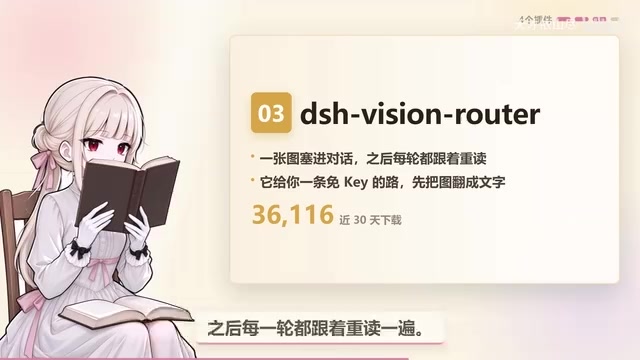
According to the creator, with this approach, starting from the second read, the price is only one-fiftieth of the original. For users who frequently paste screenshots or view charts in conversations, this plugin's savings will be very noticeable.
4. DSH Thinking Levels: An Automatic Transmission for "How Long to Think"
Complex tasks deserve more thinking time, simple tasks should think faster — everyone understands the principle, but many people don't have that switch at hand. DSH Thinking Levels provides exactly this automatic transmission: it observes what you've been doing recently, dials things down when there's a lot of simple work, and dials back up when it hits tasks that require real thinking.

This maps to the "think less" path — controlling the volume of model-generated content, which in turn controls the portion billed at a higher unit price.
Installation Notes: Don't Install Blindly
The creator highlighted a few points in the video that are worth reviewing before you start:
- Back up before installing. Some plugins conflict with each other, and version mismatches can also cause errors.
- Not every plugin is for you. First ask your DSH to tally up where you're actually spending more, then choose plugins accordingly.
- Check the numbers before and after installing. Record your per-round cost before installation, then check again after — only when the numbers move have you truly saved.
All four plugins can be found by searching their names in the plugin marketplace, or you can just ask DSH directly.
A Few Observations
The popularity of these token-saving plugins reveals a trend: as the intensity of AI coding and everyday AI application usage rises, cost optimization is shifting down from "model selection" to the "context management" level. The three paths — read less, think less, re-read less — are all essentially fine-grained control over context and generation volume. For heavy users, installing the right plugins may yield more direct savings than switching to a cheaper model.
But the plugin ecosystem also introduces new complexity: conflicts, versions, compatibility — all maintenance costs you have to bear yourself. Measure first, install second, verify last — this workflow matters more than blindly following the crowd.
Related articles

9 AI Subscription Plans Compared: The Real Cost Per 100M Tokens Revealed
Bilibili creator tests 9 AI subscription plans from Volcano, Alibaba, Tencent, Baidu, Zhipu, Xiaomi, MiniMax and more, converting them all to real cost per 100M tokens, breaking down fixed-quota vs. three-tier coefficient billing and how caching, time-of-day discounts, and window limits affect actual quota.

Vibe Coding for Beginners: Expressing Intent Instead of Handwriting Code
What is Vibe Coding? A 137-episode Bilibili course defines it: the core is expressing intent, not writing code. This article analyzes Vibe Coding's productivity logic, target audience, and entry expectations to help beginners decide if it's worth learning.

LangChain Beginner's Guide: An Agent Development Roadmap from LangGraph to Deep Agents
Clarify the encapsulation relationship among LangChain, LangGraph, and Deep Agents, and master the learning path and selection logic for agent development frameworks—suitable for beginners in large model development.