Hackers Target Supermarket Freezers Across Europe, Causing Abnormal Temperature Fluctuations

Supermarket freezer temperature control systems across multiple European countries suspected of being hacked, exposing retail IoT security weaknesses.
Several major supermarket chains in Belgium, Sweden, Luxembourg, and Estonia recently experienced suspected cyber attacks causing abnormal temperature fluctuations in freezers and refrigerators. Sweden's Ica Kvantum supermarket publicly confirmed the incident, while others have not disclosed details. Modern cold chains widely use IoT temperature control systems, and remote monitoring expands the attack surface. Attackers may exploit vulnerabilities to tamper with setpoints, creating physical operational chaos rather than demanding ransom. Such incidents cause economic losses and food spoilage while threatening food safety. The article notes this is not the first attack on European supermarket freezers and highlights the urgent need to address the gap between retail IoT dependence and insufficient security investment.
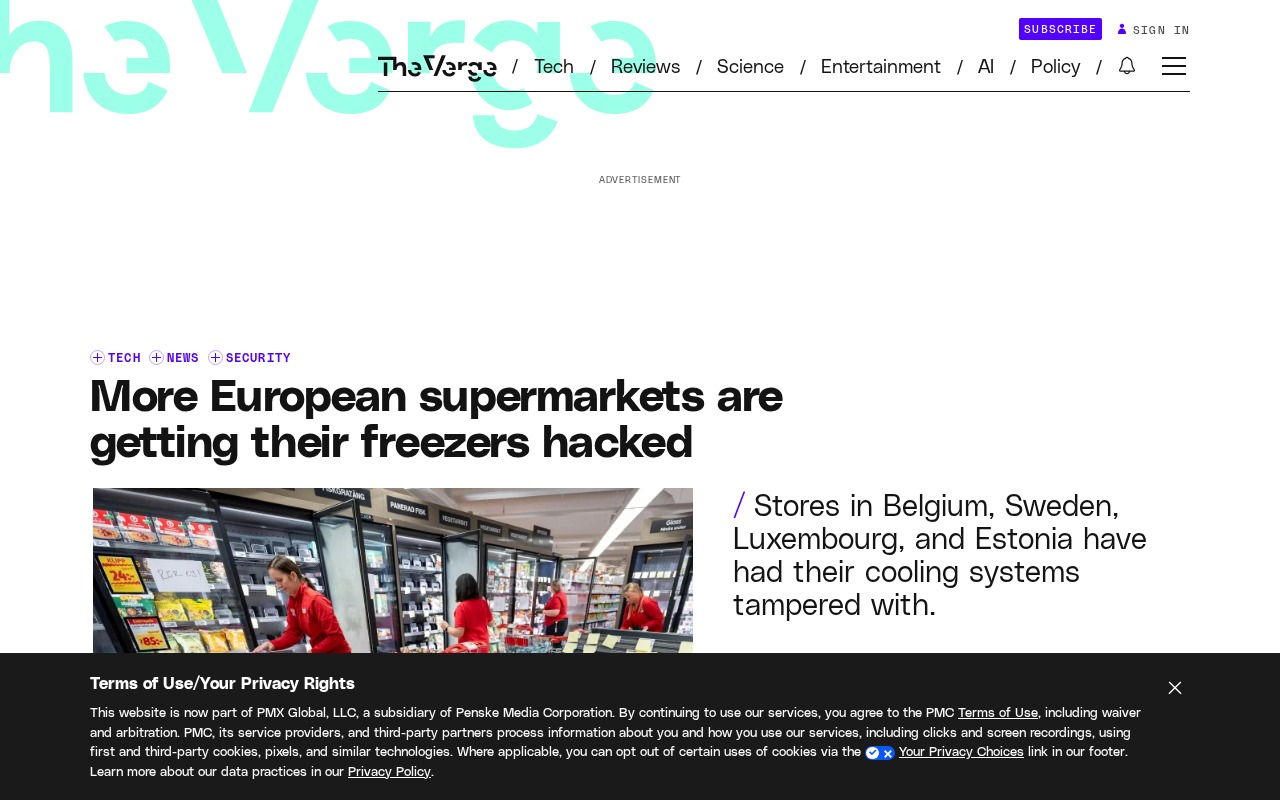
Incident Overview: Freezer Temperature Anomalies Affect Multiple Countries
According to local reports shared by Bloomberg and Reuters, several major supermarket chains in Belgium, Sweden, Luxembourg, and Estonia have recently experienced a new wave of suspected cyber attacks that caused sudden temperature changes in their refrigerators and freezers. An Ica Kvantum supermarket in Sweden posted a statement on its Facebook page confirming the temperature anomalies. This marks yet another security threat to cold chain systems facing the European retail industry, following similar previous incidents.
The specific source and method of the attack remain unclear, but the simultaneous temperature fluctuations in supermarket freezers across multiple countries strongly suggest an organized cyber intrusion. Affected stores have had to urgently check food storage safety, with some products potentially facing spoilage risks due to temperature loss of control.
How Does the Attack Affect Cold Chain Systems?
Modern supermarket freezers and refrigeration equipment are typically connected to Internet of Things (IoT) management systems, which ensure food quality through remote monitoring and temperature adjustment. While this connected design improves operational efficiency, it also expands the attack surface. Hackers may exploit vulnerabilities to breach temperature control systems and maliciously alter setpoints, causing equipment to deviate from safe temperature ranges.
In this incident, the attackers do not appear to have directly demanded ransom or destroyed data, but rather targeted the physical environment to create chaos. This approach differs from traditional ransomware attacks, focusing more on disrupting physical operations—possibly aimed at causing panic or testing system vulnerabilities. For supermarkets, cold chain disruption not only causes economic losses but may also trigger food safety issues.
A typical IoT architecture in retail cold chains includes: temperature sensors deployed in freezers and cold storage rooms, edge gateways, and centralized monitoring platforms in the cloud or on-premises. Sensors report temperature data to gateways via Zigbee, LoRa, Wi-Fi, or cellular networks, and gateways communicate with control centers over the internet. Operations staff can remotely issue commands such as temperature setpoints and defrost cycles. Common weak points in this chain include: unmodified factory default passwords, firmware that is rarely updated, control protocols lacking authentication and encryption (such as Modbus or MQTT without TLS enabled), and management interfaces of monitoring platforms exposed to the public internet. Once attackers gain access to these entry points, they can forge sensor readings or directly rewrite temperature control setpoints, causing refrigeration equipment to deviate from safe ranges without detection. Because cold chain equipment typically lacks redundant local alarms, tampering may only be discovered during manual inspections hours later—which is precisely why such attacks are difficult to contain quickly.
Multiple Countries Affected, Response Measures Underway
According to available reports, supermarkets in Belgium, Sweden, Luxembourg, and Estonia have all reported similar problems. The Swedish Ica Kvantum supermarket's social media statement is one of the few public confirmations of the incident. Other supermarket chains have not disclosed details, but local regulatory authorities may have already launched investigations.
Supermarkets are urgently investigating system vulnerabilities and strengthening cybersecurity protections for temperature control equipment. Some stores may temporarily adopt manual monitoring methods to ensure stable refrigeration environments. Industry experts point out that the retail sector's growing dependence on IoT devices is often accompanied by insufficient security investment, and such attacks may prompt more companies to reassess their cybersecurity strategies.
From a regulatory perspective, supermarket cold chains fall at the intersection of food safety and critical infrastructure. At the EU level, the Network and Information Security Directive (NIS2) has included parts of food retail within the scope of critical entities, requiring companies to implement risk management measures and report major incidents promptly; the General Data Protection Regulation (GDPR) triggers notification obligations when an incident involves personal data breaches. National food safety agencies typically mandate that refrigerated and frozen foods be kept within specific temperature ranges (e.g., frozen food generally not exceeding -18°C). Once temperature loss of control exceeds a specified duration, the affected batches must be assessed or even destroyed. Therefore, the consequences of such attacks go beyond equipment failure—they may trigger food recalls, regulatory penalties, and consumer trust crises. Companies must simultaneously coordinate with both cybersecurity and food safety regulators during incident response.
Retail IoT Security Alarm Sounds Again
This is not the first time European supermarkets have faced attacks targeting freezers. Similar cases have been reported previously, indicating that cyber threats to retail cold chain systems are continuously growing. As smart devices become more prevalent in retail scenarios—from temperature control systems to inventory management—every connected node can become an attack entry point.
For supermarkets, ensuring food safety is a primary responsibility, and cyber attacks directly threaten this bottom line. Companies need to incorporate IoT security into their overall risk management frameworks, conduct regular vulnerability scans and penetration tests, and provide security awareness training for employees. Collaboration with equipment suppliers to ensure timely firmware updates is also key to reducing risk.
This incident of supermarket freezer attacks across multiple countries once again reminds us: in the wave of digitalization, the boundary between the physical world and cyberspace is increasingly blurred, and security protection must keep pace with the times.
Attacks on industrial and IoT control systems are not new. The Stuxnet worm exposed in 2010 demonstrated that malicious code can cross network boundaries to directly manipulate physical devices; the 2015 Ukraine power grid attack caused widespread blackouts, highlighting the destructive potential against critical infrastructure; and the 2016 Mirai botnet exploited default weak passwords on IoT devices to build a large-scale attack platform. These cases collectively illustrate that once physical devices are connected to networks, information security issues can directly translate into physical-world consequences. Although retail cold chains are not critical infrastructure in the traditional sense, their large device counts, distributed deployment, and widespread outsourced maintenance mean their security baselines are often lower than those of industrial control systems, making them easier targets for low-cost, high-disruption attacks. Understanding this evolutionary trajectory helps companies break away from the cognitive inertia of "a freezer is just a refrigeration device" and view temperature control systems as networked assets requiring continuous protection.
One-line Summary
Supermarket freezer temperature control systems across multiple European countries are suspected of being hacked, exposing retail IoT security weaknesses.
Paragraph Summary
Several major supermarket chains in Belgium, Sweden, Luxembourg, and Estonia have recently experienced suspected cyber attacks, with abnormal temperature fluctuations in freezers and refrigerators. Sweden's Ica Kvantum supermarket publicly confirmed the incident, while other companies have not disclosed details. Modern supermarket cold chains are widely connected to IoT temperature control systems; remote monitoring improves efficiency but also expands the attack surface. Attackers may exploit vulnerabilities to tamper with setpoints, creating physical operational chaos rather than directly demanding ransom. Such incidents not only cause economic losses and food spoilage but also touch the bottom line of food safety. The article notes that this is not the first time European supermarkets have faced attacks targeting freezers, and the contradiction between the retail industry's dependence on IoT devices and insufficient security investment urgently needs to be resolved. Companies must incorporate IoT security into risk management frameworks and strengthen vulnerability protection.
Related articles

Deleted Reddit Post Sparks Debate Over AI Content Moderation
A Reddit post removed with only a 'Removed by Reddit' notice highlights AI content moderation's transparency gaps, misjudgment risks, and appeal challenges for platforms and creators.

DSH + Ollama Local LLM Deployment in Practice: Free Chat with Da Fei Yu
Bilibili creator tests DSH + Ollama local LLM deployment end to end: Ollama install, Xunlei-accelerated downloads, ModelScope GGUF model import, DSH custom API address setup, and a comparison of Qwen 3.5 4B, 8B, Gemma, and other models on 8GB VRAM, with advice on choosing local deployment vs. API calls.

Tested: A $899 Mac Mini vs. a $200/Month AI Subscription
Real-world test of whether an M4 Mac mini can replace a $200 AI subscription: 16GB can't fit large models, and both speed and quality fall short—but privacy, no caps, and near-zero running costs make it an ideal host for an always-on agent. Includes buying advice per configuration and money-saving strategies.