Hand-bending After 3D Printing: Oberdoerfer and Krebs' Bend Chair

The Bend chair combines 3D printing with hand bending, exploring new possibilities for hybrid manufacturing and digital artisans.
The Bend chair by Oberdoerfer and Krebs is 3D-printed and then manually heat-bent into organic curves. This hybrid process breaks the stereotype of rigid, uniform 3D-printed products, giving each piece handmade character. Technically, it relies on the plastic deformation of thermoplastics (PLA, PETG) above their glass transition temperature and requires optimized print paths and infill to handle interlayer anisotropy and stress concentration. Industrially, it shows hybrid manufacturing's potential for small-batch custom furniture—reducing mold costs and fostering "digital artisan" roles combining digital modeling and manual skills. Hacker News discussion is limited, but design media interest is high.
In today's increasingly digital manufacturing landscape, designers are exploring how to combine the precision of 3D printing with the uniqueness of manual craftsmanship. The Bend chair by Oberdoerfer and Krebs is a prime example of this trend: it is first formed in a 3D printer and then hand-bent to create a unique shape.
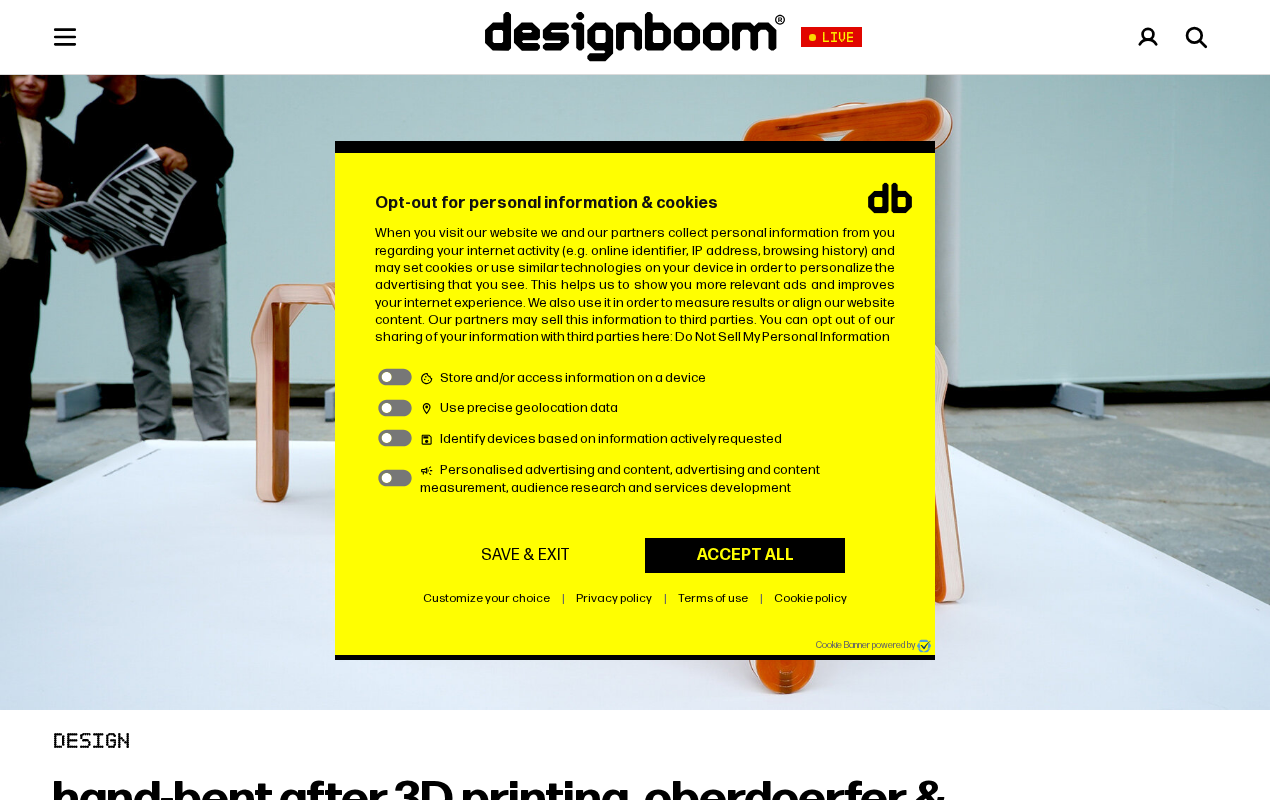
Design Philosophy: When 3D Printing Meets Hand Bending
The core innovation of the Bend chair lies in its hybrid manufacturing process. Traditional 3D printing typically produces rigid, non-deformable structures, but Oberdoerfer and Krebs chose to manually heat-bend specific parts after printing. This approach not only gives the chair organic curves but also leaves subtle handmade marks on each piece, breaking the stereotype of 3D-printed products being "cookie-cutter."
According to discussions on Hacker News, this "bend-after-print" process requires precise control of material temperature and bending angle, otherwise structural failure can occur. Through repeated experiments, the designers found suitable printing parameters and bending timing, allowing the chair to achieve the desired shape while maintaining strength.
Technical Details: Balancing Material and Process
Although the original article does not disclose specific materials, such processes typically use thermoplastic polymers (such as PLA or PETG), which have some ductility when heated. The manufacturing process of the Bend chair may involve: 3D printing flat components, then locally heating them to soften, applying force through molds or by hand to bend them, and finally cooling to set the shape.
The challenge of this process is that 3D-printed parts usually exhibit interlayer anisotropy, and bending can easily cause stress concentration between layers. Designers need to optimize printing paths and infill patterns to ensure that the bent areas do not crack. From the brief Hacker News report, Oberdoerfer and Krebs have successfully solved these problems, but the specific technical solutions have not been disclosed.
Thermoplastic Polymers and Glass Transition Temperature
PLA (polylactic acid) and PETG (polyethylene terephthalate glycol-modified) are the two most commonly used thermoplastic materials in desktop 3D printing. The key to their ability to be "bent after printing" lies in their thermoplastic nature: when heated above the glass transition temperature (Tg), molecular chain segments gain mobility, and the material transitions from a glassy state to a rubbery state. At this point, applying external force can cause plastic deformation, and the shape is fixed upon cooling. PLA has a Tg of about 60°C, while PETG is about 80°C, meaning the temperature window for bending is relatively low and can be achieved with a heat gun or hot water bath. However, temperature control must be precise: too low and the material cracks during bending; too high and the entire part softens, losing printing precision.
Interlayer Anisotropy and Stress Concentration
Parts made by fused deposition modeling (FDM) typically have only 50%-80% strength in the Z-axis direction (between layers) compared to the XY plane, because interlayer bonding relies on molecular chain diffusion and entanglement rather than continuous bulk material. When bending force is perpendicular to the printing layer plane, the interlayer interface becomes the weakest link, and stress concentration can easily initiate delamination and cracking. Mitigation strategies include: adjusting the printing orientation so that layer lines in the bending area are parallel to the neutral axis, increasing infill density and wall thickness, using higher extrusion temperatures to promote interlayer fusion, and uniformly preheating the area before bending to reduce material brittleness. These are exactly the engineering logic behind the Bend chair's "optimized printing paths and infill patterns."
Industry Significance: New Possibilities for Hybrid Manufacturing
The Bend chair demonstrates the potential of hybrid manufacturing: combining the flexibility of additive manufacturing with traditional manual forming can create products that are both complex and warm. For the furniture industry, this model allows small-batch customization while reducing mold costs.
Furthermore, this process has sparked discussions about the role of the "digital artisan." Designers are no longer just modelers in front of a screen; they also need to understand how materials behave in the physical world and even participate in post-processing. This may give rise to new professional roles that require both digital design and manual skills.
Definition and Spectrum of Hybrid Manufacturing
Hybrid manufacturing broadly refers to integrating two or more different manufacturing paradigms into the same production process. The most common combination is additive manufacturing (3D printing) and subtractive manufacturing (CNC milling) used alternately in the same machine or process chain to produce complex parts with fine mating surfaces. The Bend chair represents another path: the combination of additive manufacturing and manual forming—printing provides geometric freedom and customization capabilities, while manual bending introduces the shaping flexibility of traditional craft and the uniqueness of "each piece being different." This model is conceptually closer to "digital craft" than industrial-scale additive-subtractive hybrid. Its economic significance lies in eliminating the cost of mold-making for each curve shape, making small-batch, multi-form furniture production economically viable.
Community Response and Future Outlook
On Hacker News, the post received 5 points with no comments, indicating that the community is attentive to such design experiments but has not yet formed a heated discussion. However, similar projects often gain more exposure on design media such as Designboom and Dezeen. As 3D printing materials science advances, post-printing processes are expected to become more controllable and widespread.
Oberdoerfer and Krebs' Bend chair is a case worth watching. It reminds us that 3D printing is not the end, but the beginning. Through subsequent manual intervention, digitally manufactured products can have richer expressions.
One-line Summary
The Bend chair combines 3D printing with hand bending, exploring new possibilities for hybrid manufacturing and digital artisans.
Paragraph Summary
The Bend chair by Oberdoerfer and Krebs is first formed in a 3D printer and then manually heat-bent to create organic curves. This hybrid process breaks the stereotype of rigid, cookie-cutter 3D-printed products, giving each piece handmade marks. Technically, it relies on the plastic deformation ability of thermoplastic materials (such as PLA and PETG) above their glass transition temperature, while optimizing printing paths and infill patterns to address interlayer anisotropy and stress concentration. At the industry level, the case demonstrates the potential of hybrid manufacturing for small-batch custom furniture—reducing mold costs and giving rise to "digital artisan" roles that combine digital modeling and manual skills. Discussion on Hacker News is limited, but design media attention is relatively high.
Related articles

WorkBuddy Full Tutorial: Build an AI Office Automation Agent from Scratch
A complete WorkBuddy tutorial: installation, three working modes, multimodal picture book video practice, expert team agent building, and workflow configuration for low-cost AI office automation.

WorkBuddy Agent Complete Guide: From Beginner to Automation in 7 Days
Based on Bilibili's 256-episode WorkBuddy masterclass, this systematically breaks down Tencent's AI office workbench core capabilities: Agent principles, Skill encapsulation, cross-platform connectors, scheduled automation, knowledge bases, and zero-code development, with learning path recommendations.

8 AI Accounts, 7 Failed: An Honest Review of Using AI to Get Work Done
Only 1 of 8 AI-run Bilibili accounts succeeded. We break down the real difference between "performing AI" and "using AI to get work done."