Handing Everything to AI—Will People Really Degenerate?

Handing tasks to AI won't make you degenerate—if you have judgment, you and the system grow stronger together.
The article addresses the common anxiety that using AI makes people increasingly incapable, arguing that handing off tasks and personal growth are not contradictory. The core point: confident delivery depends on your ability to judge result quality, which comes from your own accumulation, not AI. The more you hand off, the more you're forced to turn vague intuition into explicit rules deposited into the system; a more reliable system lets you deliver bigger things—a positive cycle. The author's floor-and-ceiling model turns abstract fear into two actionable questions and advises non-technical people to start where they can tell good from bad in their own field.
Title
Handing Everything to AI—Will People Really Degenerate?
Meta Description
Will handing work to AI make people degenerate? A content creator with a design background proposes a model where "original abilities determine the floor, taste and judgment determine the ceiling," showing that productivity and growth are not a choice between two options, but the same process of humans and systems getting stronger together.
Article Content
Will handing work to AI make you increasingly "incapable"? This is one of the most widespread anxieties today, as if productivity and personal growth were a zero-sum choice. A content creator who transitioned from designer shared his answer on Bilibili: these two things not only don't conflict—they even point to the same process—you and the system get stronger together.
The Root of Anxiety: Equating "Handing Off Tasks" with "Giving Up Ability"
The logic behind worrying about degeneration is intuitive: when tools take over execution, muscle memory and proficiency naturally decline. But this creator's experience offers a different perspective. At first he only dared to let AI help make a page, and the reason he dared to hand it off was very concrete—he could tell whether the page looked good or not. This discernment came from the accumulation he brought in as a designer, not from AI.
In other words, whether you can confidently hand off a task depends on whether you have the ability to judge the quality of the result. Someone without judgment who hands off a task is gambling; someone with judgment who hands off a task is amplifying their own standards. Anxiety often comes from the latter not yet being established, yet rushing to give away the former.
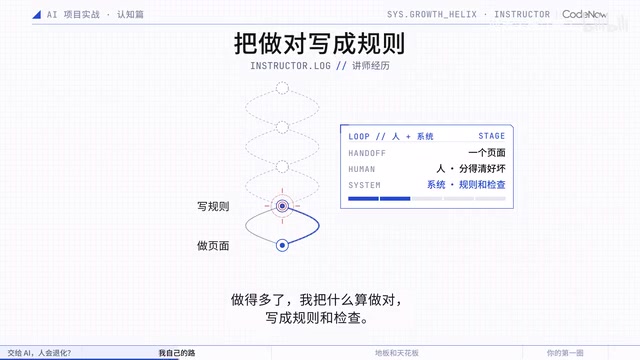
"The ability to judge the quality of a result" is often called metacognition in cognitive science—the awareness and evaluation of one's own cognitive processes. It differs from specific execution skills; it is an intuitive grasp of "what counts as good, and where something is off." Metacognition usually comes from accumulated feedback through long-term practice, so it is hard to acquire through reading or short-term learning. This also explains why the article emphasizes that judgment must come from one's own accumulation: metacognition is the precondition for you to hand AI your standards to amplify, not something AI can generate for you. People lacking metacognition struggle to recognize high-quality output even when they receive it, and delivery becomes a blind gamble.
The More You Hand Off, the Clearer You Can Articulate What Counts as Right
The creator mentions a counterintuitive discovery: the more work he handed off, the clearer he could articulate "what counts as right." The reason is that delivery forces you to translate vague intuition into explicit standards. As he did more, he wrote what counts as right into rules and checklists, depositing them into the system. The system thus became more reliable, so he dared to hand it bigger things, forming a positive cycle.
The key action in this cycle is "writing it down." What gets written down enters the system to check things on your behalf; what can't be written down stays with you—and precisely the latter grows stronger with use. Because the system takes over mechanical, rule-able labor, you have the bandwidth to hone those judgments that are hard to put into words.
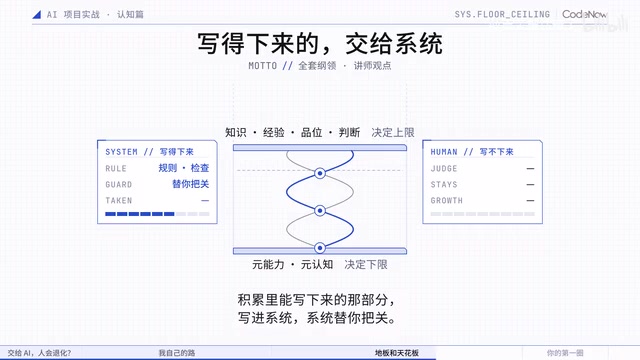
The process in the article of "writing vague intuition into rules and checklists" is called externalizing tacit knowledge in the field of knowledge management. Michael Polanyi's "tacit knowledge" refers to the part where "we know more than we can tell," such as a sommelier's discrimination of flavors or a veteran's sensitivity to code smells. Externalization means translating this kind of intuition into transferable, executable rules. For a company or an individual, the value of this process lies in: rules that enter the system can be reused and audited, while the tacit judgment that stays with people becomes sharper through repeated use. AI's role here is to take on explicit rules, thereby freeing up space for people to continue refining tacit judgment.
Original Abilities and Original Cognition: The Floor and Ceiling Model
The creator summarizes the entire methodology with a set of concepts: original abilities and original cognition determine the floor; knowledge, experience, taste, and judgment determine the ceiling.
The floor is that you can get hands-on and know where you lack confidence. Entering an unfamiliar field, with this foundation you won't go too far off. The ceiling is how well and how deeply you can do things; its height is pushed up bit by bit through accumulation. The practical value of this model is that it breaks the abstract fear of "will I be replaced by AI" into two actionable questions: Is my floor stable enough? Is my ceiling growing?
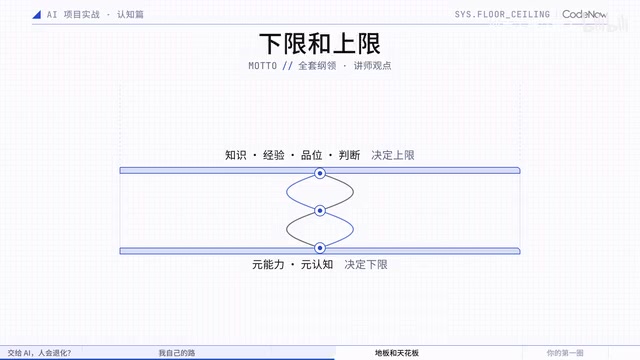
The "floor and ceiling" distinction can be understood in contrast with the concept of circle of competence. The circle of competence emphasizes that people should be clear about what they know and don't know, and make decisions only within the boundary. The "floor" in the article is roughly the lower edge of the circle of competence—you can at least get hands-on and identify where you lack confidence; the "ceiling" is the space for upward expansion of the circle of competence. The difference is that the circle of competence leans toward defense (not crossing boundaries), while the floor-ceiling model leans toward offense (continuously pushing up the ceiling). In AI collaboration scenarios, the floor determines which tasks you dare to hand off, and the ceiling determines what bigger things you can still catch after handing them off.
The First Circle Doesn't Have to Start with Code
For people without a technical background, the most practical advice is: you don't need to start with writing code. What you can tell good from bad in your own line of work is the accumulation you can bring in. A designer's judgment of layout, an operations person's intuition for copy, a salesperson's sensitivity to customer emotions—these are all "original abilities" that can be directly delivered to AI and used to verify results.
The path is summarized as a gradual line: from there, first hand off one thing and write down one rule clearly, and in the next circle you dare to hand off something bigger. This approach has been extended in the creator's own projects—he mentions CodeNow, HCI, Top, and five sets of courses, one of which specifically covers how to launch the projects you've built and how to articulate their value clearly, with eleven livestreams where everyone brings their own project, moving from being able to use AI to being able to run it long-term on their own.

Productivity and Growth Are the Same Thing
The most thought-provoking part of this view is its rejection of the "either-or" framework. If what you hand off is all the rule-able parts, then degeneration only happens in the links that shouldn't have been borne by people long-term in the first place; what people retain and strengthen are abilities like judgment, taste, and standard-setting that cannot be fully externalized. The system takes over what can be written down, and you free up your hands to hone what can't be written down—productivity improvement and cognitive growth thus become two sides of the same coin.
It should be noted that this model is built on the premise that "you truly have deliverable judgment." For beginners who haven't yet established judgment in any field, directly handing off tasks on a large scale does carry the risk of spinning in place. But even so, the path is the same: first establish judgment in areas you understand, then gradually expand the scope of delivery, letting the system and you push the ceiling up together.
One-line Summary
Handing tasks to AI won't make people degenerate, provided you have judgment—the system and you get stronger together.
Paragraph Summary
The article responds to the widespread anxiety of "will using AI make people increasingly incapable," arguing that handing off tasks and personal growth are not contradictory. The core argument is: whether you can confidently deliver depends on whether you have the ability to judge the quality of results, and this judgment comes from your own accumulation rather than AI. The more tasks you hand off, the more it forces you to write vague intuition into explicit rules deposited into the system; the system becomes more reliable, and you dare to deliver bigger things, forming a positive cycle. The author uses the floor-and-ceiling model of "original abilities and original cognition determine the floor; knowledge, experience, taste, and judgment determine the ceiling" to break abstract fear into two actionable questions, and suggests that people without technical backgrounds start from where they can tell good from bad in their own industry.
Related articles

Amphibious Transforming Drone: Beyond 100x Power Savings, What Are the Real Needs?
Is the amphibious transforming drone just a gimmick? Starting from the 100x power difference of the M4 Morphobot, explore real application scenarios and thesis topic ideas, analyzing boundary conditions where pure drones and pure ground robots both fail.

Warhound Raises $200 Million: Genetically Engineered "War Dogs" Paired with Anduril Gear
Warhound raises $200M, backed by Ben Lamm and Palmer Luckey, to genetically engineer dogs for military and law enforcement use and equip them with Anduril gear. This article analyzes its technology direction, funding logic, and ethical controversy.

Claude API Comes to Google Cloud: IAM Integration and SDK Access Guide
Anthropic hosts the full Claude API on Google Cloud with IAM-controlled permissions and unified billing. This guide covers the Vertex AI and Anthropic-hosted entry points, IAM role configuration, and SDK access.