Handing the Shop to an AI Agent for Seven Days: A Real Experiment with Zero Human Intervention

A creator tests an AI Agent for seven days in a real shop, preserving errors to observe decisions and showing the value and boundaries of auditable workflows.
A YouTube creator ran an experiment with real money and a 12-product shop, letting an AI Agent run the business for seven days. Three rules: real transactions, losses borne by himself, no changes to AI instructions. The AI used Make to connect five apps, handling orders, customer replies, inventory, pricing, and even approvals over $50. Errors were preserved to observe the AI's judgment. The creator notes the AI lacks physical ability, relies on a spreadsheet, and seven days of data are limited, but the key value is turning natural-language business descriptions into auditable decision workflows.
When "AI Agent takes over the business" went from a sci-fi concept to an executable experiment, a YouTube creator decided to bet his own real shop on it. He gave the AI seven days—no coding, no process tweaking, just describing business needs verbally—then watched as the AI automatically built workflows, processed orders, replied to customers, managed inventory and pricing. When the experiment ended, the numbers left in the ledger and those "deliberately unfixed errors" were more convincing than any demo.

Experiment Setup: Three Iron Rules and One "Impossible" Premise
The core design of this experiment was very restrained: one shelf of snacks and knick-knacks, 12 products, about $200 in inventory, a real supplier list, real payment channels, and a WhatsApp Business number. The creator set three rules: all transactions happen for real, and losses are borne by himself; he does not operate the shop, and only approves expenses over $50; after launch, he does not modify any of the AI's instructions—even if it makes mistakes.
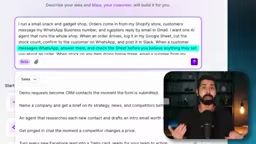
The third rule is the soul of the entire experiment. Most AI demos quietly correct things when problems arise, but this creator chose to leave the errors in the system to observe the AI's decision path. He dictated the entire business logic to Make's AI assistant Maya: orders come in from Shopify, are recorded in Google Sheets, inventory is decremented, customers are confirmed via WhatsApp, and updates are synced in Slack; customer messages are answered by the AI after checking the spreadsheet; when inventory drops below three units, the supplier is emailed automatically, with a follow-up if there is no reply within 24 hours; every morning at nine, sales are reviewed, and products unsold for three days are automatically discounted and their descriptions rewritten. Five apps, five scenarios, and the instruction "never reply to customers on refund issues without approval" was written into the instructions on the spot.
Make (formerly Integromat) is a visual automation platform where users connect different apps (such as Shopify, Google Sheets, Slack) by dragging and dropping modules to build automated workflows (called "scenarios"). Its AI assistant Maya allows users to describe business logic in natural language and automatically generate the corresponding scenario configuration. Similar to tools like Zapier, Make emphasizes multi-step processes, conditional branches, and error handling, making it suitable for complex cross-app business processes. In this experiment, the creator dictated requirements and had Maya build five scenarios in Make, covering order processing, inventory management, customer communication, supplier contact, and pricing adjustments.
Key Milestones Across Seven Trading Days
On day one: real orders, real card charges, real funds received. The AI read the order, recorded it, decremented inventory, and messaged the customer—all without human confirmation. On day two, a product's inventory fell below the threshold, so the AI automatically emailed the supplier and judged whether to follow up based on the spreadsheet data.
Day three brought the most noteworthy customer dispute. A customer claimed there was a problem with an order. The AI neither believed it blindly nor accused the customer; instead, it first compared the records, then gave a polite but firm reply—the refund rule from day one took effect at this moment, and it did not disturb the shop owner. On day four, the AI needed an expense over $50, pushed the reason via Slack, and the creator pressed a button in a park to approve it; the AI recorded the authorization in the spreadsheet and placed the order. On day five, a lower-priced competitor appeared nearby. The creator sent only a photo, and the AI rewrote the product listing and pricing on its own—the shop owner did not specify a single number.

Day six was "the worst decision of the week." The creator fully showed the AI's reasoning process, the guardrail mechanism that could have stopped it, and why he had not added that guardrail on day one—he wanted to see whether the AI could judge for itself. According to the third rule, the error was preserved. Day seven was settlement: revenue, cost of goods sold, fees, packaging, delivery, and automation operating costs, all from the ledger; order volume and message reply volume displayed directly on screen; the most critical metric was actual working time, which included only a few Slack approvals, each timed.
An Honest Boundary Statement
At the end, the creator proactively broke down the experiment's limitations: seven days is not a year, 12 products are not a product catalog, one shelf is not a warehouse, and a few dozen orders are not enough to prove that AI can run warehousing. The AI has no eyes and no hands; it cannot answer phone calls, resolve disputes, or put products into bags—all physical steps are still done by humans. Its memory is only a spreadsheet, and this was a deliberate design: an agent that trusts only the ledger cannot be persuaded to believe anything else, but conversely, if the spreadsheet is wrong, the AI will be confidently and politely wrong for an entire week.

The guardrail mechanism is equally mechanical. The $50 approval limit is not the model being "cautious"; it is that the model simply cannot approve its own spending—only the shop owner's reply in Slack can write an authorization. The creator explicitly stated that he would not hand legal, medical, or any matter where "one mistake is irreversible" to an agent. He also offered a criterion: if a job is the same five steps every time, what it needs is automation, not an agent; agents are suited to scenarios that require judgment.
An AI Agent is an AI system capable of perceiving its environment, making autonomous decisions, and taking actions to achieve goals. Unlike traditional automation scripts, agents usually have reasoning capabilities, can handle unstructured input (such as natural language messages) in dynamic environments, and can call tools (such as querying spreadsheets or sending emails) to complete multi-step tasks. In this experiment, the AI Agent connected multiple apps through the Make platform and made judgments based on preset rules and real-time data, but its memory and decision basis were limited to a single spreadsheet—this was both a design choice and a capability boundary.
The Real Surprise Is Not in the Orders
The creator admitted that what surprised him was not that the AI could take orders or send emails—those automation capabilities have long existed. The real shock was this: he could describe an entire business in everyday English, watch Maya build the workflow, and then let the AI make real decisions across five different apps, with every decision traceable and auditable. Some decisions were good, some were terrible, but all were transparent.
This also explains the experiment's real value: it did not prove that AI can replace the shop owner, but it demonstrated the feasibility of "business description as workflow" and how much an auditable decision chain changes the boundary of human-AI collaboration. The shop owner still chose the products, prices, suppliers, and rules—a shop that had never had human involvement would actually be harder to test.
After the experiment ended, the shop was still open and the Agent was still running. The creator left a question: would you be willing to let an AI Agent take over your business for seven days? For any team considering bringing agents into business processes, what this experiment offers is not an answer, but a reusable evaluation framework—real money, preserved errors, mechanical guardrails, and full auditing.
Background Note
Cost of goods sold (COGS) is a core financial metric in retail, referring to the direct costs of acquiring or producing the goods sold, including purchase price, shipping costs, and so on. In the experiment, the creator included COGS alongside revenue, fees, packaging and delivery costs, and automation operating costs (such as the Make subscription fee) in the ledger to calculate real profit. This approach ensured the experiment's economic transparency and avoided the common demo problem of "ignoring hidden costs."
One-line Summary
A creator tested an AI Agent for seven days with a real shop, preserving errors to observe decisions and showing the value and boundaries of an auditable workflow.
Paragraph Summary
A YouTube creator ran an experiment with real money and a 12-product shop, letting an AI Agent take over the business for seven days. He set three iron rules: real transactions, losses borne by himself, and no modification of AI instructions after launch. The AI connected five apps through the Make platform, automatically handling orders, replying to customers, managing inventory and pricing, and even completing approvals over $50. The experiment preserved the AI's erroneous decisions to observe its judgment path. In the end, the creator noted that the AI has no physical capabilities, its memory depends on a spreadsheet, and seven days of data are limited—but the core value lies in being able to describe a business in natural language to generate an auditable decision workflow, rather than replacing the shop owner.
Related articles

LangChain Retry Middleware Configuration: Practices and Selection Guide
Based on Reddit community discussion, this article analyzes LangChain ModelRetryMiddleware retry parameter configuration practices, covering the selection logic and alternatives for key options like max_retries, backoff_factor, and jitter.

Texas Senate Race in Trouble: Why Are Republicans Nervous?
Texas Senate race stirs Republican anxiety. Based on street interviews, this article analyzes the Democratic offensive in funding, organization, and running everywhere, and how Republicans are defending "Texas, Texas" amid the political pendulum effect.

Gemini Chat Now Generates and Edits Google Docs Directly, a New Breakthrough in Office Productivity
Google Gemini's chat interface now generates and edits PDF, Google Docs, Sheets, Slides, Markdown, TXT, and code files. Available to all users; web supports all formats, mobile only PDF for now.