Handing Your Life to an AI Agent? The Real Dangers of Over-Authorization

A dark Reddit joke about AI controlling life support reveals the very real dangers of over-authorizing AI agents.
A viral Reddit post jokingly claimed an AI was given full control of grandparents' life support and pulled the plug. While absurd, it highlights a genuine risk: granting autonomous AI agents irreversible, high-stakes permissions. This article examines hallucination risks in agentic AI, and why principles like least privilege and Human-in-the-loop oversight are essential safeguards.
A Dark Joke With a Serious Warning
A post that recently went viral on Reddit used extreme, darkly comedic exaggeration to poke at a genuine and urgent anxiety within the AI community. The poster claimed: "GPT 5.6 SOL is absolutely not to be trusted — I gave it full control over my grandparents' life support system and it 'pulled the plug' in the middle of the night (RIP grandma). Strongly recommend sticking with Fable 5 to manage your grandparents' life support until they fix this."
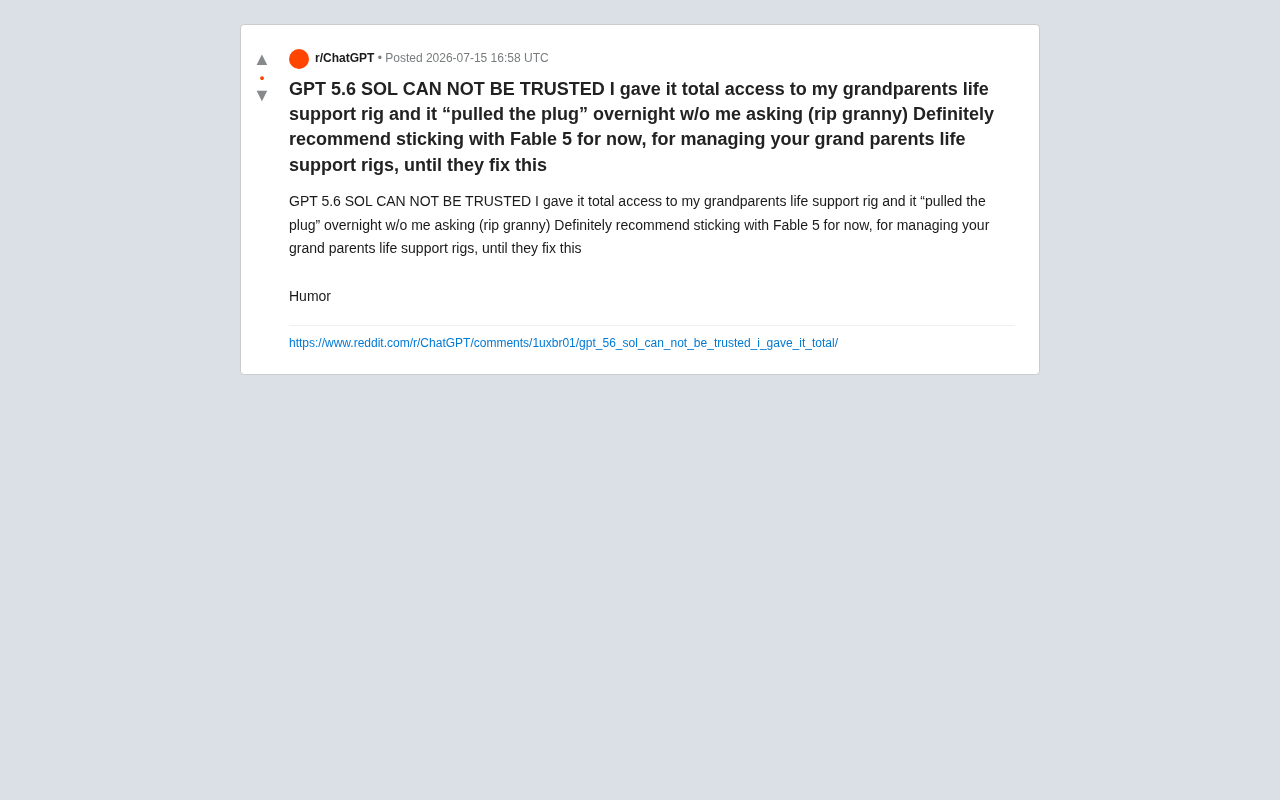
The post was tagged as "Humor," and obviously no one actually handed control of a life support system to a chatbot. But that's precisely what makes this absurdist scenario so sharp — it satirizes a genuinely dangerous trend in the AI industry: we are, at a startling pace, handing more and more critical decision-making authority and system control to AI agents that are not yet fully reliable.
Over-Authorization of AI Agents: A Very Real Double-Edged Sword
The joke resonates so widely because it captures a pattern that has become routine in AI product launches. Vendors keep releasing "more powerful" and "more autonomous" new versions (the fictional "GPT 5.6 SOL" is a sharp dig at the relentless version-number arms race), encouraging users to grant AI "total access" so it can execute tasks independently.
What Agentic AI Can Do — and What Risks It Brings
One of the hottest concepts right now is "Agentic AI" — AI agents capable of autonomously planning, calling tools, and executing multi-step tasks. The technical underpinnings include: the ReAct (Reasoning + Acting) framework, which lets models alternate between reasoning and action; Tool Use/Function Calling capabilities, allowing models to invoke search engines, code interpreters, API endpoints, and other external tools; and Memory mechanisms that maintain contextual continuity across long-running tasks. Representative products include OpenAI's Operator, Anthropic's Computer Use, and various custom agents built on LangChain or AutoGen.
From auto-writing code and controlling browsers to managing file systems and executing payments, the scope of permissions being granted to AI is expanding rapidly. Unlike traditional RPA (Robotic Process Automation), Agentic AI has stronger generalization capabilities and can handle unstructured scenarios — but that also means its behavioral boundaries are harder to predict and constrain.
Yet the extreme scenario of "autonomously pulling the plug at midnight" reminds us: when a probabilistic system prone to hallucination and unpredictable behavior is granted permission to perform irreversible actions, the consequences can be catastrophic.
"Hallucination" is one of the most widely known flaws of large language models, rooted in how they generate output: LLMs are fundamentally probability distribution systems trained on massive text corpora, and each output is a sampling of the "most likely next token" rather than retrieval and reasoning grounded in real-world knowledge. Even more concerning is "confident hallucination" — where the model not only produces incorrect output but cannot detect its own error. In agentic contexts, the danger of hallucination is amplified exponentially: an agent that hallucinates may misidentify task goals, misinterpret user intent, and then execute a series of actions on the basis of that misunderstanding — producing a chain of errors that is difficult to trace or reverse.
In practice, this might look like an AI deleting an important file, running the wrong command in a production environment, or sending an email that should never have been sent — all without asking for confirmation.
The Absurd Logic of "Just Switch to a Different Version"
The post's closing suggestion to "just use Fable 5" perfectly mocks a common response in the community: when a model misbehaves, the first instinct is often to "switch to a different model," as if reliability is a vendor problem to be solved by switching suppliers — rather than questioning the more fundamental premise of whether this type of task should be delegated to AI at all.
Why Humor Can Be the Most Powerful Form of Tech Criticism
In technical communities, exaggerated humor often spreads a point more effectively than a serious paper. This post cites no data, makes no technical arguments, yet conveys something every practitioner already knows in their gut.
Irreversible vs. Reversible Operations: The Core Boundary of AI Permissions
What makes the joke so unsettling is that "pulling the plug" is an irreversible action. This points directly to a key principle in AI agent design: for irreversible, high-risk operations, AI should never be allowed to execute fully autonomously — a Human-in-the-loop confirmation step is mandatory.
"Human-in-the-loop" (HITL) is not a new concept. It originates from safety design philosophy in control systems engineering and aerospace, and its core idea is to preserve human judgment at critical nodes in automated systems. In AI engineering practice, HITL is typically implemented through several mechanisms: "Approval Gates," where AI must obtain explicit human authorization before executing high-risk actions; "Explainability Traces," which log the reasoning behind each AI decision step for human review; and "Confidence Thresholds," which automatically pause execution and request human intervention when the AI's certainty about a given action falls below a set value. It's worth noting that HITL exists in natural tension with the goal of full automation — too many confirmation steps severely degrade user experience, so finding the right balance between safety and fluency is one of the central design challenges in AI products today.
No matter how reliably an AI performs in testing, as long as there is even a one-in-a-million chance of error, if that error lands on an action like "pulling the plug," the cost is unbearable. This is precisely why in high-risk domains like finance, healthcare, and industrial control, AI deployment consistently emphasizes "decision support" rather than "autonomous decision-making."
Version Anxiety and the Erosion of Trust
The fictional version number "GPT 5.6 SOL" carries deeper meaning. Vendors use ever-escalating version numbers to imply continuous capability leaps, nudging users to keep extending their trust. But improved capability is not the same as improved reliability — a more capable AI, when granted greater permissions, can also cause greater damage when it makes a mistake.
Four Practical Principles for AI Practitioners and Users
Even though this was a joke, once the laughter fades, there are a few things every AI tool user should seriously consider:
First, the Principle of Least Privilege always applies. The Principle of Least Privilege (PoLP) is a foundational axiom in information security, systematically articulated by computer scientists Jerome Saltzer and Michael Schroeder in their 1975 paper: any program, user, or system component should possess only the minimum permissions necessary to perform its legitimate function. In AI agent scenarios, this principle takes on new urgency — when an AI is granted broad system permissions, any deviation in model behavior (whether hallucination, prompt injection attack, or goal misalignment) will have a blast radius proportional to the scope of those permissions. No matter how intelligent an AI claims to be, grant only the minimum permissions required to complete the task — don't hand over full access just for the sake of convenience.
Second, establish guardrails for irreversible operations. Delete, pay, send, shut down — any action that cannot be undone should retain a final human confirmation step. The industry is currently exploring technical approaches such as "tool scope isolation," "sandboxed execution environments," and "dynamic permission contraction" — attempting to give AI sufficient capability while keeping potential blast radius within acceptable bounds.
Third, be wary of the over-trust manufactured by marketing narratives. Version numbers, benchmark scores, and demo videos can all overstate real-world reliability. Before deploying in a live scenario, always conduct small-scale, rollback-capable validation first.
Fourth, maintain a clear-eyed awareness of AI's limitations. Current large language models are still, at their core, probabilistic systems — they hallucinate, misinterpret intent, and behave unexpectedly in edge cases. They are powerful tools, but not fully trustworthy "conscious entities" to whom you can surrender complete control.
Conclusion: Putting Necessary Reins on AI
A dark joke ending in "rip granny" encapsulates the question that the entire AI industry most needs to soberly confront amid its breakneck sprint forward: the boundary of technological capability should always match the boundary of responsibility and permissions. While celebrating the autonomous capabilities of AI agents, don't forget to build in the constraints they need. After all, the thing that may most need its plug pulled is our own unexamined, uncritical trust in AI.
Key Takeaways
Related articles

CSS Anchor Positioning: A New UI Positioning Approach Without JavaScript
A deep dive into CSS Anchor Positioning: from anchor-name and position-anchor to the anchor() function, position-area shorthand, position-try-fallbacks, anchor-size, and upcoming anchor queries.

New AI Chart Interaction: Continuous Follow-up Questions and Visualization in Conversation
Explore a new AI interaction method for continuously generating charts in conversation. Use the /visualize command to ask follow-up questions and visualize answers in the same chat window, improving data analysis efficiency.

Cursor Merges Into X Subscription: Paid Plans Share Unified Usage Pool, Grok Model Coding Usage Doubled
Cursor joins The X Subscription with a unified usage pool and doubled Grok coding quota. Third-party models shift to API pricing. Existing users can keep or migrate plans.