Hands-On N8N Low-Code Agents: From Building Nodes to Enterprise Applications

N8N is a general-purpose low-code automation platform supporting 500+ nodes; this article explains its features, deployment, and AI integration path.
The article clarifies that N8N is not a pure AI workflow tool but a node-driven general-purpose low-code automation platform with over 500 nodes, capable of handling non-AI tasks such as data cleaning, video publishing, and content scraping. Its node ecosystem mainly covers overseas applications, while domestic platforms lack native support and require self-encapsulation via HTTP request nodes. In terms of deployment, it recommends Docker Compose private deployment. The AI integration section summarizes three key elements: AI Agent nodes, Chain nodes, and tool nodes. Finally, it offers selection advice: assess the match between business scenarios and node coverage.
N8N is often misunderstood as a pure AI workflow tool, but it is essentially a general-purpose low-code automation platform. In a sharing session by Mashi Group on Bilibili, N8N was positioned as a platform capable of handling routine tasks such as data cleaning, video publishing, and content scraping, while also offering deep AI integration. This article will cover N8N's core features, deployment methods, and the path to building AI agents, helping developers understand how to bring this tool into real-world business scenarios.
What N8N Really Is: More Than Just AI Workflows
N8N is first and foremost a workflow automation platform, with its core being node-driven process orchestration. Each node handles a specific function, such as scraping data from web pages, publishing content to video platforms, or fetching news. This design is similar to the node concept in tools like Coze and Dify, but N8N's node library is far larger.
According to the speaker, N8N supports at least 500 nodes, with some counts even exceeding 1,000. This number far surpasses self-built or some comparable platforms, forming the foundation of N8N's strong integration capabilities. Users can combine different nodes to build highly complex business processes, including branching, loops, error handling, and data transformation logic.
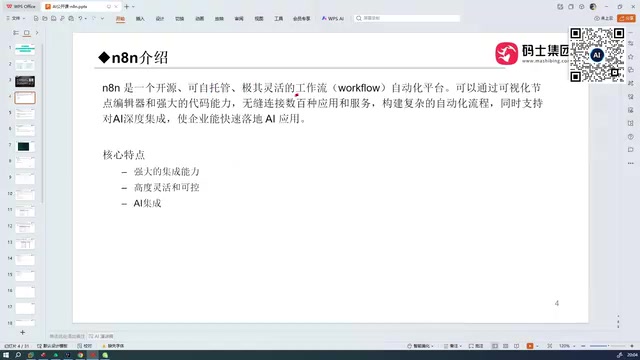
The speaker particularly emphasized not to equate N8N workflows with AI workflows from the start. It can absolutely be used for tasks unrelated to AI, such as data cleaning or video comment analysis. This generality gives N8N broader applicability within enterprises, rather than being limited to AI application development.
Advantages of the Node Ecosystem and Localization Gaps
N8N's node richness is its core selling point, but this advantage faces challenges in the domestic market. The speaker pointed out that as a foreign platform, N8N's nodes mainly cover overseas application ecosystems, such as YouTube, Telegram, Instagram, Google Sheets, and Airtable online spreadsheet services. After configuring an account, users can directly publish videos, send messages, or write data to online spreadsheets through nodes.
However, commonly used domestic platforms such as Weibo, WeChat, Feishu Spreadsheets, and Dameng Database lack native node support in N8N. This means that when domestic enterprises use N8N, the range of available nodes is significantly narrowed, and many localized scenarios require self-encapsulation via HTTP request nodes, increasing implementation costs. The speaker admitted that this is one of the important reasons why N8N has low adoption among domestic companies.
This shortcoming does not negate N8N's technical value, but it reminds developers to assess the match between business scenarios and node coverage when making selections. For tasks involving overseas business or general data processing, N8N's node ecosystem advantage is obvious; for scenarios heavily dependent on the domestic application ecosystem, careful evaluation is needed.
HTTP request nodes are the most versatile and commonly used "fallback" node type in N8N. They allow users to directly send GET, POST, PUT, DELETE, and other requests to any URL, customize request headers, query parameters, authentication methods, and request bodies, and parse returned JSON or XML. For domestic platforms without native nodes in N8N (such as Feishu, WeCom, Weibo), developers typically need to consult the platform's open API documentation and manually complete authentication (such as obtaining an access_token), construct requests, and process responses using HTTP request nodes. This means additional development and maintenance costs, but it also allows N8N in theory to connect to any service that provides an API.
Three Deployment Methods: Why Docker Is Recommended
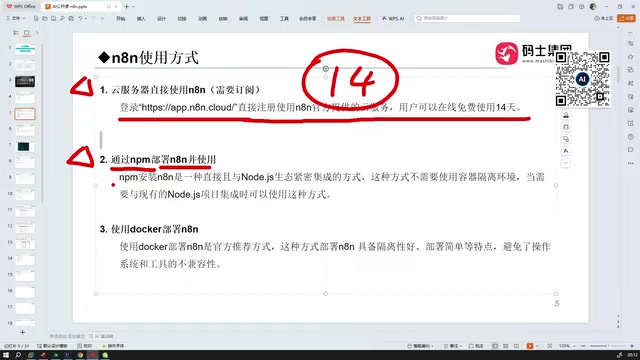
There are three main ways to use N8N: online cloud service, native NPM deployment, and Docker deployment. The speaker gave clear preferences among these three methods.
The online cloud service is the quickest way to get started; users can simply log in to the N8N official website to use it. However, the free version has a 14-day trial period, after which features are limited, such as the inability to manage multiple spaces and the lack of a workflow execution history dashboard and other enterprise-grade features. For personal experience or lightweight needs, the online version is sufficient; but for enterprise applications, paid or private deployment is more appropriate.
Native NPM deployment requires users to install the Node.js environment themselves and download the N8N source code. The configuration process involves dependency package management and may cause compatibility issues with the existing system environment, leading to installation failure. The speaker explicitly stated that this method is not recommended.
Docker deployment is regarded by the speaker as the optimal solution. Docker offers good isolation, simple commands, and strong cross-system compatibility—it can run as long as Docker is available in the environment. The speaker recommends a Docker version no lower than 24.0.0 and suggests using Docker Compose with a YAML file to manage configuration items, avoiding the need to manually specify a large number of startup parameters.
For enterprise users, private deployment is a more reliable choice. The speaker mentioned that even within enterprises, private deployment of N8N is not a problem; it both ensures data security and provides full platform capabilities.
Docker Compose is the container orchestration tool officially provided by Docker. Through a YAML file (usually named docker-compose.yml), it centrally declares configurations such as services, images, port mappings, environment variables, data volumes, and networks. Compared with manually entering a long string of docker run parameters on the command line, Compose files are versionable, reusable, and easy to share among teams; a single docker compose up -d command can bring up the entire service stack. For N8N, Compose also makes it easy to mount persistent data volumes (avoiding loss of workflows after container restarts) and configure environment variables such as database connections and encryption keys, making it a common practice for single-machine private deployment.
Building AI Agents: Three Key Aspects of Combining N8N with AI
The combination of N8N and AI is the core of this sharing. The speaker summarized the key points into three parts: AI Agent nodes, Chain nodes, and tool nodes.
AI Agent nodes are used to build agents, enabling workflows to have autonomous decision-making and task execution capabilities. Chain nodes are divided into three categories, each handling different task logic and integrating with AI to complete complex processes. Tool nodes are the bridge through which agents call external capabilities, determining which specific actions the agent can perform.
These three parts form the foundation for building RAG (Retrieval-Augmented Generation) systems and AI applications with N8N. The speaker mentioned that future case demonstrations would show how to use these nodes to build actual AI systems, but since the sharing was mainly an overview, specific case details were not elaborated.
From a technical perspective, N8N's AI integration path is similar to that of mainstream low-code AI platforms. Its advantage lies in the flexibility of its underlying workflow engine and the breadth of its node ecosystem. Developers can complete data processing, AI inference, and business action orchestration on the same platform, reducing switching costs between systems.
RAG (Retrieval-Augmented Generation) is a technical architecture that combines external knowledge base retrieval with large language model generation. Its basic process is: first split documents and vectorize them into a vector database; when a user asks a question, the system first retrieves several text snippets most relevant to the question, then feeds these snippets as context into the large model, which generates an answer based on these factual materials. Compared with letting the model answer directly from parametric memory, RAG can significantly reduce hallucinations, support private knowledge, and make it easy to update knowledge without retraining the model. Building a RAG system in N8N typically requires vector database nodes (such as Pinecone, Qdrant), embedding model nodes, document loading and splitting nodes, and AI Agent nodes to orchestrate the sequence of retrieval and generation calls.
Selection Advice and Implementation Considerations
N8N is suitable for enterprises that need highly customized workflows and whose business scenarios intersect with overseas application ecosystems. For domestic enterprises, if their core business relies on local platforms, they need to evaluate the development cost of self-encapsulating nodes. In terms of deployment, Docker Compose is the recommended solution that balances ease of use and controllability, while private deployment is more suitable for enterprise environments with data security requirements.
The speaker's content focused more on conceptual clarification and directional guidance, with less detail on specific AI agent building cases. Readers who wish to go deeper into hands-on practice will need to combine official documentation with actual projects for practice. N8N's value lies in integrating general automation and AI capabilities within one platform, but whether it can be effective depends on the match between node coverage and business needs.
One-line Summary
N8N is a general-purpose low-code automation platform supporting 500+ nodes; this article explains its features, deployment, and AI integration path.
Paragraph Summary
The article clarifies that N8N is not a pure AI workflow tool but a node-driven general-purpose low-code automation platform with over 500 nodes, capable of handling non-AI tasks such as data cleaning, video publishing, and content scraping. Its node ecosystem mainly covers overseas applications such as YouTube, Telegram, and Google Sheets, while domestic platforms like Weibo, WeChat, and Feishu lack native support and require self-encapsulation via HTTP request nodes—an important reason for its low adoption in China. In terms of deployment, the article compares online cloud service, native NPM installation, and Docker, and clearly recommends Docker Compose private deployment. The AI integration section summarizes three key elements: AI Agent nodes, Chain nodes, and tool nodes, which form the foundation of RAG and AI applications. Finally, it offers selection advice: assess the match between business scenarios and node coverage.
Related articles

Chain of Thought Isn't Just for AI: How Humans Can Use CoT to Improve Thinking Quality
Chain of Thought isn't just a prompt trick for large models. Starting from a Hacker News discussion, this article analyzes why CoT works for human thinking too, breaks down actionable ways to transfer it, and highlights the key differences between human CoT and machine CoT.
Cloudflare Teams Up with OpenAI: Closi…
Cloudflare Teams Up with OpenAI: Closing the Loop from Vulnerability Discovery to Defense with AI
Cloudflare uses OpenAI Daybreak to investigate security vulnerabilities and generate reviewable remediation plans, while developers use Codex to boost coding efficiency and quality.

Orca Multi-Agent Orchestration in Practice: A Guide to Parallel Collaboration with Claude and Codex
Orca is Stable AI's free open-source agent workbench supporting 34 agents like Claude Code and Codex in parallel. Learn its Git worktree isolation, multi-model orchestration, and mobile management.