Hands-On Testing Nano Banana Lite: Remarkably Accurate Detail Reproduction from Complex Prompts
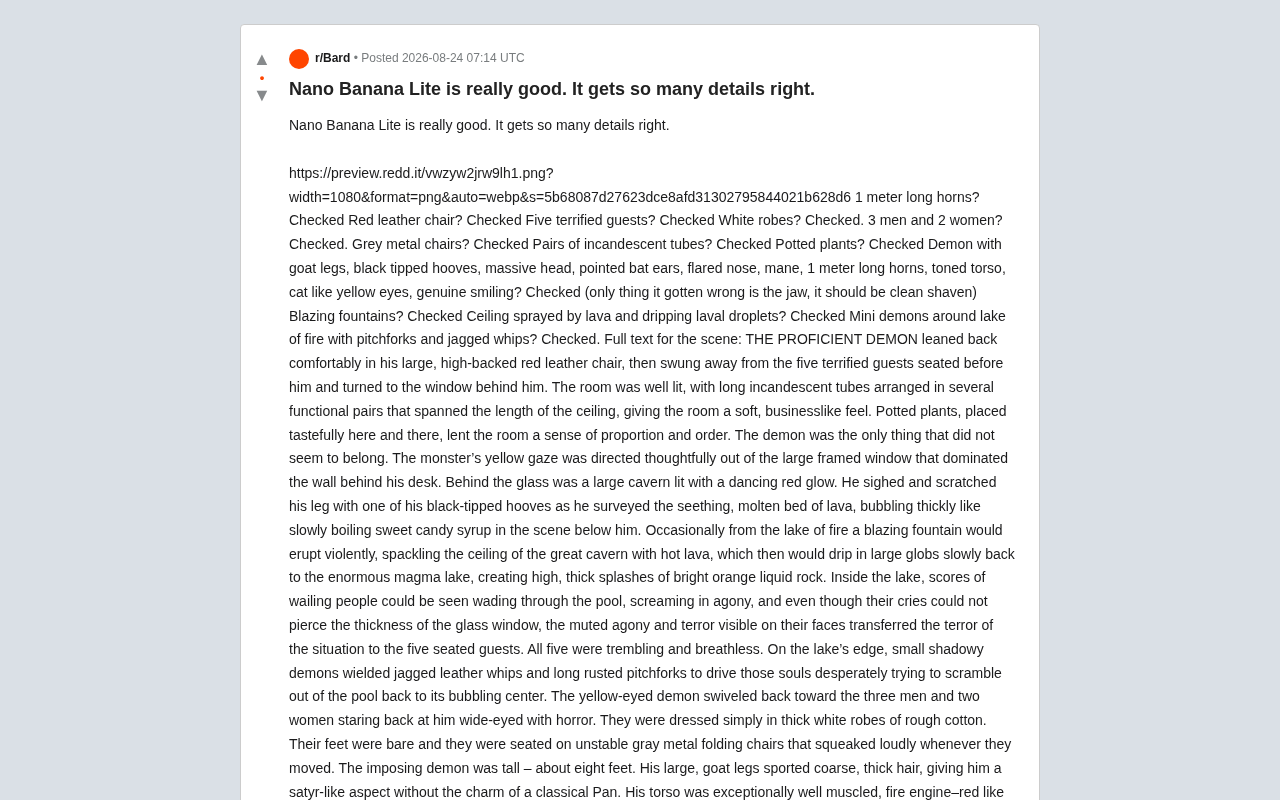
Nano Banana Lite accurately reproduces nearly all details from a highly complex multi-constraint prompt.
A Reddit user put Google's Nano Banana Lite model through an extreme stress test using a complex literary scene prompt with dozens of simultaneous constraints. The model accurately reproduced precise character counts, gender composition, intricate character features, and dynamic environmental details, with only a minor attribute leakage issue on a clean-shaven chin. The results demonstrate that lightweight models can achieve near-flagship quality in semantic understanding and image generation.
An Extreme Test with a Complex Prompt
In the world of AI image generation, a model's ability to handle intricate scene details has always been the core metric for measuring its true capability. Recently, a Reddit user shared their hands-on experience testing Google's Nano Banana Lite model, and their conclusion was striking: "Nano Banana Lite is really impressive — it gets so many details right."
This wasn't a simple "draw a cat" kind of prompt. Instead, it was an extremely complex, constraint-heavy literary scene description — a depiction of a "business-savvy demon" in hell receiving five terrified visitors. These high-density, multi-element prompts often serve as the ultimate litmus test for exposing an AI model's weaknesses.
Item-by-Item Verification: Nearly Perfect Accuracy
Based on the user's detailed checklist, Nano Banana Lite's performance on this demanding scene was nothing short of textbook-level. Here are the core elements verified as accurately reproduced:
Scene and Props
- 1-meter-long horns: Accurate
- Red leather chairs: Accurate
- Five frightened visitors: Accurate
- White robes: Accurate
- Gender composition of 3 males and 2 females: Accurate
- Gray metal folding chairs: Accurate
- Paired incandescent light tubes: Accurate
- Potted plants: Accurate
You might not realize it, but accurately reproducing gender composition (3 males and 2 females) and exact quantities (five visitors) is precisely where many mainstream image generation models frequently stumble. Precise quantity generation remains one of the most persistent challenges facing current Diffusion Models. The root cause lies in the fundamental nature of the diffusion process — it progressively denoises images from Gaussian noise, relying on cross-attention mechanisms at each denoising step to reference text conditions. However, text encoders like CLIP or T5 tend to encode numerical concepts as a vague "sense of quantity" rather than precise counting instructions. For example, "five apples" and "four apples" may be very close together in the embedding space, causing the model to fail at strictly adhering to quantity constraints during spatial layout. In recent years, researchers have attempted to mitigate this through Layout Guidance, LLM-based prompt decomposition, and regionalized attention control, but precise quantity control in open-ended scenes remains an active area of research. The fact that Nano Banana Lite hits the mark on this particular challenge speaks volumes about its progress in numerical semantic understanding.
Complex Feature Reproduction of the Demon Subject
The prompt described the demon in extraordinary detail: goat legs, black hooves, a massive skull, pointed bat ears, flared nostrils, a mane, 1-meter-long horns, a muscular torso, feline yellow eyes, and a "genuine smile."
According to the tester's feedback, apart from the chin area (which was supposed to be clean-shaven but the model added a beard), all other features were accurately captured. This means the model not only understood individual feature descriptors but was able to coherently integrate over a dozen traits into a single, unified character design — a rigorous test of the model's "multi-concept binding" capability.
Dynamic Environment Details
The most impressive aspect was the reproduction of dynamic environmental elements:
- Erupting fire fountains: Accurate
- Ceiling splattered with magma, with dripping magma droplets: Accurate
- Minor demons around the fire lake wielding pitchforks and serrated whips: Accurate
These descriptions involve physical dynamics (splattering, dripping) and spatial relationships (lake edges, ceiling above), requiring the model to possess a deep understanding of scene spatial logic rather than simply stacking visual elements together.
Why This Test Is Compelling for AI Image Generation Evaluation
The value of this test lies in its "stress test" nature. The original prompt came from a complete literary scene description containing dozens of constraints that needed to be satisfied simultaneously. This type of test effectively examines three core model capabilities:
Concept Binding
When a prompt contains multiple "attribute + object" combinations like "black hooves," "yellow cat eyes," and "red bat ears," weaker models tend to suffer from "attribute misalignment" — for example, incorrectly applying black to the eyes instead of the hooves.
Concept Binding is a long-standing technical challenge in AI image generation. During the diffusion model's generation process, the text encoder maps different semantic units in the prompt to distinct regions in latent space, while Cross-Attention mechanisms are responsible for associating this semantic information with corresponding spatial positions in the image. When multiple "attribute + object" combinations appear in a prompt, attention maps can overlap or misalign, causing attributes to be assigned to the wrong objects — this is known as "attribute misalignment" or "attribute leakage." Earlier versions of Stable Diffusion and DALL·E 2 performed poorly in this regard, while subsequent models like SDXL, DALL·E 3, and Midjourney v5 significantly improved concept binding accuracy by introducing more powerful text encoders (such as T5-XXL), improving cross-attention mechanisms, and adopting more refined image-text alignment training strategies.
Nano Banana Lite's stable performance in this area indicates that its text-to-image semantic alignment is quite well-tuned.
Quantity and Spatial Understanding
Precise quantity constraints like "five visitors," "3 males and 2 females," and "paired light tubes," along with spatial relationships like "chairs in front," "windows behind," and "fire lake below," test the model's scene construction logic. Being able to satisfy all these constraints simultaneously suggests that the Lite version hasn't sacrificed core semantic understanding capabilities in the name of being "lightweight."
Coherence in Complex Scenes
The hell scene features both an indoor office atmosphere (leather chairs, potted plants, incandescent lights creating a "business vibe") and a magma-filled hellscape visible through windows. These two vastly different visual tones need to coexist harmoniously within a single image. The model successfully handled this "uncanny everyday feeling," which is the very essence of the black humor the original text aimed to convey.
The Practical Significance of the Lite Version
Typically, a model's "Lite" or "lightweight" version implies compromises between parameter size, inference speed, and quality. Users generally expect Lite versions to fall short on detail processing. However, this hands-on test demonstrates that Nano Banana Lite maintains a high standard of detail reproduction even in extremely complex scenes.
This reflects a broader trend: as model architectures and training methods advance, even lightweight versions can achieve impressive semantic understanding and generation quality while maintaining computational efficiency. Model compression in deep learning has several well-established technical approaches. The most common include: Knowledge Distillation, where a small model (student) learns from the output distribution of a large model (teacher) to retain most capabilities with fewer parameters; Pruning, which reduces model size by removing weight connections that contribute minimally to outputs; Quantization, which compresses model weights from 32-bit floating point to 8-bit or even 4-bit integer representations to dramatically reduce VRAM usage and inference latency; and Neural Architecture Search (NAS), which automatically finds the optimal network structure for a given computational budget. In the image generation domain, Stable Diffusion's Turbo and LCM (Latent Consistency Model) variants are prime examples of using consistency distillation to compress the sampling process from dozens of steps down to just 1-4 steps. The continued advancement of these techniques means that the quality gap in lightweight versions keeps shrinking while their practical value keeps growing.
For everyday users and developers, this means achieving near-flagship generation quality at significantly lower computational costs.
The One "Fumble": Attribute Leakage
To be fair, the test wasn't 100% perfect. The only deviation occurred with the demon's chin — the original text explicitly specified a "clean-shaven jaw" contrasting with the wild mane, but the model added a beard.
This small mistake is actually quite representative: the "mane" and "clean-shaven jaw" in the original text form a deliberate contrast. The model likely allowed the overall impression of "having hair" to "bleed" the mane's hairy characteristics into the chin area.
From a technical perspective, the deeper mechanism behind attribute leakage is closely related to the spatial resolution limitations of cross-attention maps in diffusion models. In U-Net or DiT (Diffusion Transformer) architectures, cross-attention layers operate on feature maps at different resolutions: low-resolution layers capture global semantics and composition, while high-resolution layers handle local details. When two semantically related but attribute-opposing concepts (like "wild mane" and "clean jaw") appear in physically adjacent regions, the low-resolution attention layers may fail to precisely distinguish their boundaries, causing one concept's attributes to "seep" into the other's territory. This phenomenon is particularly pronounced in spatially dense areas such as facial features and finger counts. Current improvement directions include increasing the spatial resolution of attention maps, introducing segmentation masks as additional conditions, and increasing the annotation density of such contrastive descriptions in training data.
This type of subtle attribute leakage represents exactly the kind of issue that current image generation models still need to optimize.
Conclusion: Nano Banana Lite's Detail Reproduction Prowess
Nano Banana Lite's performance in this high-difficulty hands-on test showcases significant advances in current AI image generation technology when handling complex, multi-constraint prompts. From precise character counts and gender composition, to the coordinated integration of over a dozen character traits, to the reproduction of dynamic environmental details, the model delivered a near-perfect scorecard.
While minor deviations like the "chin beard" persist, the overall performance is more than sufficient to prove that lightweight doesn't necessarily mean compromised capability. For content creators, designers, and AI enthusiasts, models like these are making the ideal of "words become images" increasingly within reach.
Key Takeaways
Related articles
Claude Fable and Mythos 5.1 Deep Dive: A Layered Safety Strategy from One Underlying Model
Deep dive into Anthropic's Claude Fable 5.1 and Mythos 5.1: how one model uses layered safety to serve both the public and researchers, with 1M token context, agent capabilities, and 75% cache savings.
Fable 5.1 and Mythos 5.1 Launch Together: Topping Eight Benchmarks with 45% Cost Reduction
Fable 5.1 and Mythos 5.1 launch together, topping all eight benchmarks. Protein design success rate hits 3-5x industry average. Cached read prices cut 75%, reducing Agent task costs by up to 45%.

Tovel AI Deep Dive: The AI Action Assistant That Goes from Meeting Recordings to Automatic Execution
Tovel AI goes beyond meeting transcription—it automatically converts conversations into CRM entries, follow-up emails, and task scheduling. A deep dive into its native integrations, human-in-the-loop design, and wearable hardware strategy.