Hands-On Testing of the Top 10 LLMs in 2026: The #1 Model on the Leaderboard Might Not Be the Right One for You

Top-ranked LLM has 748s first-token latency — real benchmarks reveal 265x gap and two undocumented API pitfalls.
A hands-on benchmark of the Artificial Analysis top 10 LLMs reveals that the #1 model (Claude Opus 5.5 at max) takes 748 seconds to return its first token — 265x longer than the #10 model, despite only a 13-point score gap. Two undocumented pitfalls were uncovered: one model charges ~4,200 tokens of fixed overhead on a single-word input, and another treats max_tokens as a shared budget between reasoning and output, silently returning empty responses. Dropping the reasoning level one tier can cut costs by 70% and latency by 94% with only a 4-point score loss.
A model leaderboard can tell you which model is the "most capable" — but it can't answer the question you actually care about: "Which model is right for my task?" These are two entirely different questions, and the gap between their answers is often far larger than engineers expect.
A developer collected all data from the Artificial Analysis Intelligence Index v4.3.2 on October 12, 2026, and benchmarked every model on the list via API in a single day. The conclusion is blunt: the #1 model, in the exact configuration that earned it that ranking, takes 748 seconds to return its first token — a full twelve minutes.
A 13-Point Score Gap, A 265x Latency Gap
Among the top ten models ranked by intelligence index (eleven in total due to ties), scores range from 58 down to 45 — a gap of just 13 points. But Time to First Token (TTFT) ranges from 748.61 seconds all the way down to 2.82 seconds — a difference of 265x.
| # | Model (Config) | Index | Cost/Task (USD) | TTFT |
|---|---|---|---|---|
| 1 | Claude Opus 5.5 (max) | 58 | 5.98 | 748.61 s |
| 2 | Claude Sonnet 5.5 (max) | 56 | 5.46 | 484.09 s |
| 3 | GPT-6 Astra (max) | 53 | 3.26 | 383.62 s |
| 6 | GPT-6.1 Sol (max) | 52 | 0.72 | 330.58 s |
| 8 | MiMo-V2.6-Pro | 46 | 0.13 | 3.51 s |
| 10 | Qwen3.8 Max | 45 | 5.41 | 2.82 s |
| 10 | GLM-5.3 (max) | 45 | 2.01 | 3.36 s |
Three observations that matter more than raw rankings: the latency gap dwarfs the score gap — when a human is waiting at a screen, the last column matters more than the score; score and cost don't scale linearly — Opus 5.5 scores 6 points higher than GPT-6.1 Sol but costs roughly 8.3x more; and models tied on score can differ wildly in engineering characteristics — three models tied for third place range from $1.99 to $7.63 per task.
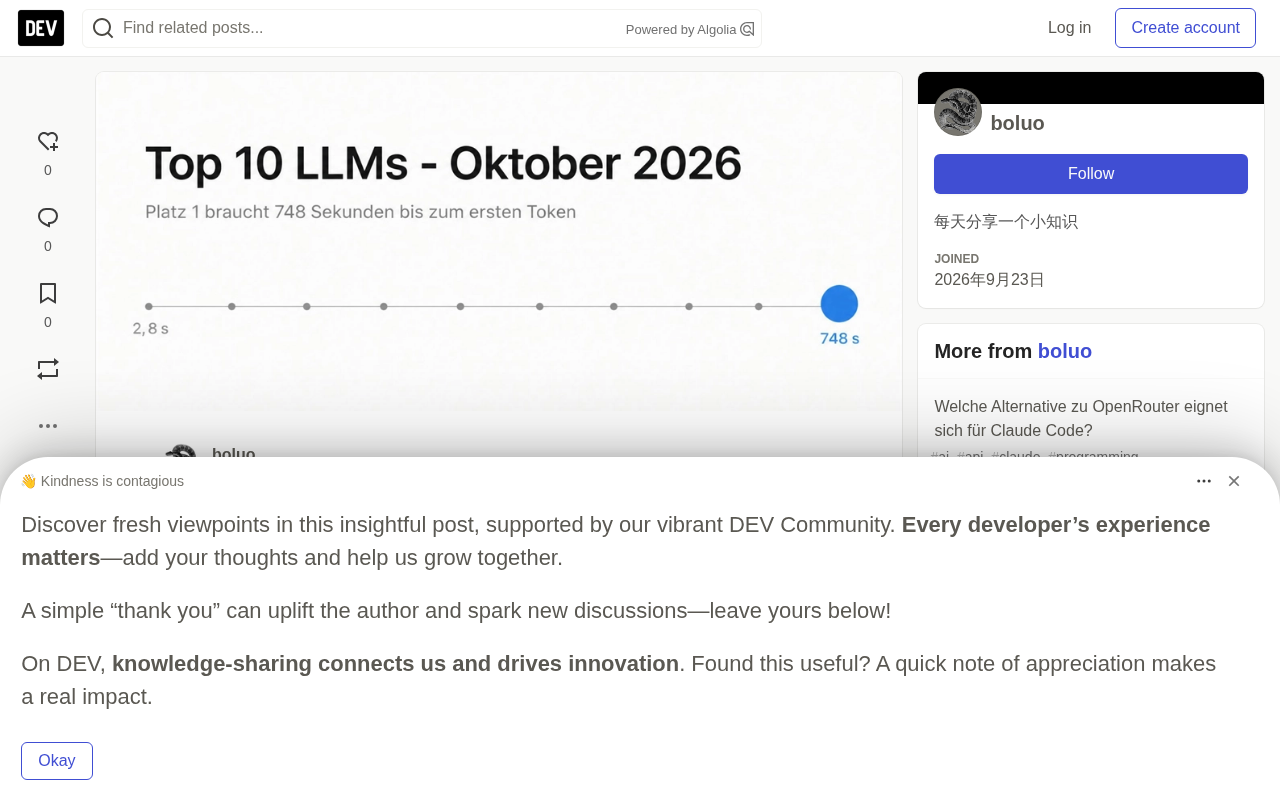
Time to First Token (TTFT) is the time between a client sending a request and the server returning the first token — also called "first-byte latency." It's distinct from total generation time, which covers the full output process. TTFT only measures the moment a user perceives the model as "starting to respond." In interactive scenarios with a human waiting in real time, TTFT directly determines whether the interface looks "frozen." In batch processing, it affects queue throughput. For reasoning models, TTFT tends to be far higher than for standard models, because the model must first complete an invisible internal chain-of-thought before outputting the first visible token — this is exactly why TTFT is so extreme under the max configuration in the table above.
Extracting Three Key Fields from the API Response
The testing methodology was deliberately minimal: a single API call per model through an OpenAI-compatible endpoint, no evaluation frameworks or libraries. What mattered was knowing which fields to extract from the response.
Three fields worth recording:
prompt_tokens: Compare against actual input length — a large discrepancy signals fixed overhead;reasoning_tokens: How much of your budget went toward an inference process you'll never see;completion_tokens: If it exactly equals yourmax_tokens, the output was truncated — and the returned text may be empty.
The author emphasizes that both "hidden pitfalls" described below were discovered entirely through these three fields. Every model tested returned HTTP 200, with response times between 1.80 and 7.80 seconds — everything looked fine on the surface.
There's also a practical trap: model IDs copied directly from the leaderboard often don't work. Of the 11 models tested, 3 couldn't be found in the API catalog at all. Grok is a prime example — the leaderboard lists Grok 4.7 (xhigh), but only Grok 4.6 is actually available. These are different versions, and the 46-point score and $3.74/task cost from the leaderboard don't apply to 4.6. The right approach is to reverse the process: first confirm which model IDs you can actually call, then look up their numbers on the leaderboard.
Two Hidden Pitfalls That Never Make It Into the Docs
Pitfall #1: A Single "hi" Gets Billed as 4,223 Input Tokens
The author sent a request to gpt-6.1-sol with only hi as the content. The returned prompt_tokens was 4,223. Meanwhile, an 18-token request sent to claude-sonnet-5-5 at the same time came back with prompt_tokens of 18. Two retests confirmed stable values between 4,223 and 4,227.
This means there's a fixed input overhead of approximately 4,200 tokens. For long documents, this is negligible. But if you're running 200,000 short requests per day, this overhead becomes the dominant line item on your bill. Verification takes ten seconds: send your shortest typical request and compare usage.prompt_tokens against your expected input length.
Pitfall #2: max_tokens Is Not a Cap on the Answer — It's the Total Budget
The author set max_tokens=64 for glm-5.3. The result: completion_tokens hit exactly 64, with 60 of those going to reasoning and only 4 left for the actual answer — making the response effectively empty. Switching to max_tokens=512 yielded 34 tokens of output with 32 reasoning tokens, and the answer came back normally. The same request sent to claude-sonnet-5-5 returned reasoning_tokens of 0.
The problem is that this model enables reasoning by default, and reasoning tokens count against max_tokens. If you set this value based on your expected answer length, you'll receive an empty response with no error of any kind. The verification method is to print usage.completion_tokens_details.reasoning_tokens.
OpenAI-compatible endpoints are third-party or self-hosted services that conform to the OpenAI Chat Completions API specification. Since OpenAI's API format has become the de facto industry standard, many model providers (including GLM, MiMo, and others covered in this article) expose the same /v1/chat/completions path and request/response structure, allowing the same client code to switch between vendors by simply changing base_url. The usage field — including prompt_tokens, completion_tokens, and sub-fields like reasoning_tokens — is a core return value in this spec used for billing and debugging. It's worth noting that "compatible" doesn't mean "identical in behavior" — individual providers may implement token counting rules and max_tokens semantics differently. The two hidden pitfalls in this article are classic examples of exactly that kind of divergence.
Reasoning Level Matters More Than Model Rank
Leaderboards always show the configuration that scores highest — but in practice, the reasoning level often matters more than which model you choose.
| Model | Level | Index | Cost/Task | TTFT |
|---|---|---|---|---|
| Claude Opus 5.5 | max | 58 | 5.98 | 748.61 s |
| Claude Opus 5.5 | high | 54 | 1.82 | 44.34 s |
| Claude Opus 5.5 | medium | 51 | 1.34 | 21.61 s |
| GPT-6.1 Sol | max | 52 | 0.72 | 330.58 s |
| GPT-6.1 Sol | medium | 48 | 0.21 | 7.55 s |
Dropping Opus 5.5 from max to high: 4 fewer points, ~70% lower cost, 94% shorter wait time. Dropping GPT-6.1 Sol from max to medium: 4 fewer points, ~71% lower cost, 98% shorter wait time.
In the vast majority of production scenarios, trading 4 points for 94% less latency is a bargain. The real lesson here: treat the reasoning level as a parameter to test, not a default to accept. Reasoning is a switch meant for hard tasks, not a constant-on setting — pitfall #2 is a direct consequence of reasoning being applied to a task that never needed it.
"Reasoning budget" (also called thinking level) is a parameter offered by some LLM APIs to control how much compute the model invests in internal reasoning before producing a final answer. Anthropic and OpenAI products, for example, typically offer low / medium / high / max tiers. Higher tiers consume more tokens in the hidden chain-of-thought, generally improving reasoning quality but dramatically increasing latency and cost. The mechanism is essentially a dial that trades time and money for accuracy. For tasks with simple structure and clear answers — like ticket classification or format conversion — high or even medium output quality is virtually indistinguishable from max. For tasks requiring multi-step derivation like mathematical proofs or complex architectural decisions, the extra reasoning at max genuinely earns its keep. Reasoning level should therefore be treated as a hyperparameter requiring per-task ablation experiments, not a fixed default.
Which Model to Use for Which Task
The most interesting entry in the author's task-to-model reference table is the last row: Claude Haiku 5.5 (235 tok/s, $0.21/task) doesn't make the top ten at all — yet it's the optimal choice for ticket classification and high-throughput scenarios.
A few representative recommendations:
- Architecture reviews, critical refactors (offline): Go with Opus 5.5, but test
highfirst — if it passes, skipmaxentirely; - Everyday coding, interactive tasks, human-in-the-loop: Sonnet 5.5 at
mediumhas a TTFT of just 0.87 seconds — but measure P95 latency, not the mean; - Small budget, high capability (offline): GPT-6.1 Sol is the only model scoring above 50 for under $1/task — but check
prompt_tokensfirst; - Massive-scale classification, self-hosted: MiMo-V2.6-Pro at $0.13/task with open weights;
- Balanced with Tool-Call support: GLM-5.3 has no glaring weaknesses across the three metrics — just make sure to set
max_tokensgenerously.
This is the core point of the entire article: on the right task, a model scoring 43 can beat one scoring 58.
The Limits of This Data
The author is transparent about the data's constraints: the index, costs, speed, and latency figures all come from public leaderboards rather than independent measurement — the author only tested reachability and token counts directly. The collection date was October 12, 2026, which is not the same as each model's individual test date. The index skews toward English and plain text, making it less useful for image, audio, or multilingual tasks. Three of the 11 models couldn't be found in the API catalog and aren't recommended.
At the end of the day, a leaderboard is a capability-sorted reference, not a selection decision. What actually determines success is the numbers you get when you run your own task in your own environment. Have you ever logged reasoning_tokens? Many hidden failure modes never appear in the documentation — they only circulate among people who've already been burned by them.
Related articles

Meta vs. Publishers: The AI Data Battle Over Terms of Service Changes and the Future of the Internet
Meta changed its business account terms to allow AI training on linked website data, sparking backlash from publishers and creators. Industry groups demanded negotiations, forcing Meta to remove 'training' wording and delay the effective date. The dispute reveals the deeper battle over data authorization and the future of the internet in the AI era.

When Outside Xbox Meets Blood on the Clocktower: A Legion Match in Minecraft
Outside Xbox guests Ellen and Mike play Minecraft Blood on the Clocktower in a Legion game. How can three good players fight an evil majority amid information noise? This article breaks down Legion mechanics, information-role mind games, and the endgame reversal.

Kimi K3.1 Hands-On Test: Open-Source Model Nears Opus, Video Generation Steals the Show
Kimi K3.1 completed motion graphics, 3D rendering, mini-games, and video generation in a live test. Analysis of its 2.8T MoE architecture, gap vs Opus/GPT, and hidden video generation.