Hands-On: The New OLED iPad Mini Has a Stunning Display
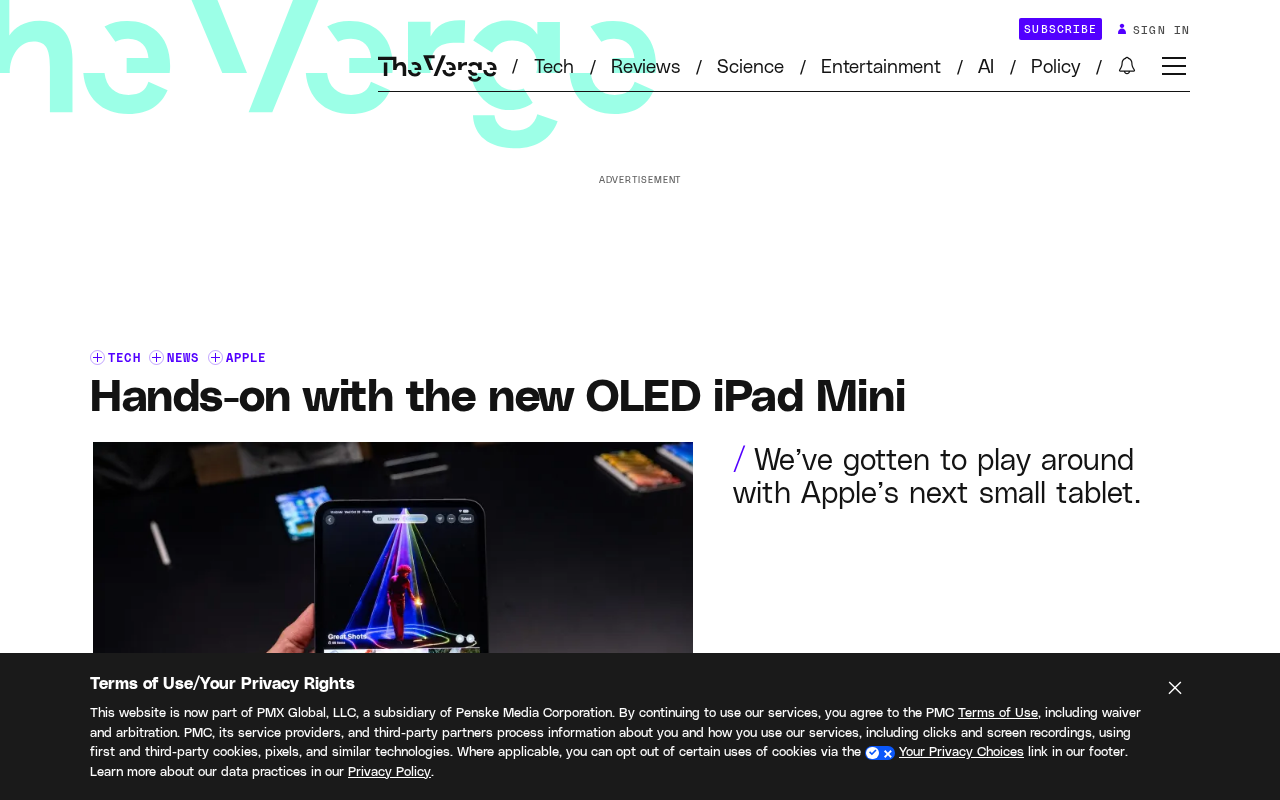
The new iPad Mini gets an OLED screen and optional nano-texture glass, upgrading the experience without changing its positioning.
Apple released the new iPad Mini this week, with the biggest change being a larger OLED screen. After a brief hands-on at the "Pro and tell" event, foreign media found that OLED brings noticeably improved contrast and black-level performance, with an "exceptional" viewing experience; the optional nano-texture matte glass effectively reduces glare and is suitable for outdoor use. However, the product form and positioning are unchanged—it is still a portable, lightweight iPad rather than a productivity tool. Since this was only a brief experience, performance and battery life have not yet been tested, but the core selling points are already very clear: a better screen and more flexible display options.
Apple released the new iPad Mini this week, and the biggest change is a larger OLED screen. We got our hands on the device at Apple's "Pro and tell" event for a brief hands-on experience.
Display: The Visual Upgrade Brought by OLED
The OLED screen on the new iPad Mini is the most standout highlight of this hands-on. Compared with LCD, OLED has a natural advantage in contrast and black-level performance, and the actual viewing experience is "exceptional." The original article used the word "exceptional" to describe this screen, indicating that Apple has put effort into tuning it. For users who like watching videos and reading on the Mini, this screen upgrade is highly noticeable.
OLED (organic light-emitting diode) works differently from LCD: LCD relies on a backlight layer to emit light, while liquid crystal molecules only control whether light passes through; each pixel in OLED can emit light independently, so when displaying black, the pixels can be completely turned off, achieving theoretically infinite contrast, while also offering lower power consumption, faster response times, and wider viewing angles. The trade-off is higher cost and the risk of burn-in when static high-brightness content is displayed for long periods. Apple has previously adopted OLED on iPhone and iPad Pro, but introducing it to a small-sized iPad for the first time means its OLED supply chain can now cover smaller panel sizes.
Nano-texture Glass: A Good Choice for Anti-Glare
In addition to OLED, the new iPad Mini also offers optional nano-texture matte glass. The original author's evaluation of this configuration was "awesome." Nano-texture glass has previously appeared mainly on iPad Pro, and can effectively reduce reflections, making it more comfortable to use outdoors or in strong light. For users who frequently need mobile productivity or outdoor reading, this optional feature is worth considering.
Nano-texture glass is a surface treatment process first introduced by Apple on the Pro Display XDR and later extended to iPad Pro. By etching nanoscale irregular textures into the glass surface, it scatters incoming light rather than reflecting it like a mirror, thereby maintaining image readability under strong light while avoiding the image quality degradation caused by traditional matte films. Its drawbacks are that it requires a special polishing cloth for cleaning and that the optional price is relatively high.
Positioning: It Is Still an iPad
The original article mentioned "It's an iPad for sure," meaning that the new Mini does not break out of the iPad framework in form or experience. It has not become a productivity tool, nor does it deliberately blur the line with iPhone. Apple's positioning of the Mini remains a portable, lightweight tablet suitable for one-handed holding and carrying. The addition of OLED and nano-texture strengthens the experience within the original positioning rather than redefining the product.
In Apple's product line, iPad Mini has long played the role of a "small-sized all-around tablet," with a screen size usually around 8 inches, between iPhone and standard iPad. Its user base includes e-book readers, mobile workers, and users in scenarios requiring one-handed operation. Unlike iPad Pro, which emphasizes productivity, and iPad Air, which emphasizes balance, the Mini's core value lies in portability, so the marginal benefit of improved screen quality to its user experience is particularly obvious.
Hands-On Summary
Because this was a brief hands-on at an event, we have not yet conducted full performance testing or battery life evaluation. But from first impressions, the core selling points of the new iPad Mini are very clear: a better screen and more flexible display options. If you have been waiting for a small-sized iPad with excellent screen quality, this generation is worth watching.
(This article is based on foreign media hands-on content; specific performance should be subject to actual testing.)
Related articles

DeepSeek V5 Code Leak? It's Actually a Compatibility Test
AI Evening Report: DeepSeek Harness code shows V5 model names, deemed a compatibility test; Artificial Analysis V5 leaderboard released with DeepSeek tied for first among open-source models; Codex reset complete with news teased for tomorrow; coding agent security risks and OpenAI TPU procurement rumors analyzed.

The AI Coding Terminal Built for DeepSeek: A Deep Dive into the 38K-Star Open Source Project
A deep dive into the open source AI coding terminal built for DeepSeek: 38K stars, 20 parallel agents, three security modes, and OS-level sandbox isolation for fully automated file reading, code editing, and command execution from a single-sentence requirement.

Wuzhen Conference Signals: Open Source Becomes China's Key Card for Changing Lanes and Overtaking in AI
The Wuzhen Internet Conference put open source and openness at center stage, with domestic open-source models from Huawei, Kimi, MiniMax, and DeepSeek showcased together. This article analyzes why open source has become China's key card for changing lanes and overtaking in AI, as well as the ecosystem standards battle, security governance, and commercialization challenges behind open source.