Hands-On with Claude Opus 5: The New AI Flagship That Crushes Competitors on Cost-Efficiency

Claude Opus 5 isn't the smartest AI model — it's the best bang for your buck.
A hands-on review spending $400 to stress-test Anthropic's Claude Opus 5 across real-world tasks — from generating interactive 3D worlds and physics simulations to enterprise workflow automation. The core finding: it's not a paradigm-shifting intelligence leap, but delivers equal or better results at 30-50% lower cost than competitors, with significantly improved safety alignment scores.
Note: This article is based on a hands-on review video by Nick Saraev, reposted by a Bilibili uploader. The names "Opus 5," "Fable 5," "GPT 5.6," etc. mentioned in the video are speculative designations by the creator for future models. Readers should approach these forward-looking labels with appropriate skepticism and focus instead on the analysis of how frontier model capabilities are evolving.
The competition among large AI models has moved beyond "can it do this?" into the phase of "how well can it do this, and how cheaply?" In this hands-on review, blogger Nick Saraev spent roughly $400 stress-testing Anthropic's flagship model across a wide range of real-world scenarios. Rather than stopping at benchmarks, he had the model directly generate complex, interactive applications, evaluating a frontier model's true capabilities by "feel" and "aesthetics."
Generating 3D Worlds and Playable Games from a Single Prompt
The most visually stunning moments in the video come from a series of interactive 3D applications generated with essentially zero manual effort. The blogger showcased a complete 3D virtual gallery — players can walk through it freely, and hovering the mouse over artwork on the walls triggers audio cues, as if cataloging each piece. He remarked that just a few years ago, this kind of experience could have passed as an indie game.
Behind this lies the large language model's deep understanding of Web 3D rendering frameworks like WebGL and Three.js, combined with its code generation capabilities. Traditionally, building a walkable 3D gallery required game engines like Unity or Unreal, plus weeks of work from 3D modelers. Now, the model can directly output complete HTML+JavaScript code that runs in a browser with first-person perspective navigation, collision detection, mouse interaction events, and more. This marks a surprisingly mature "natural language to runnable application" pipeline.

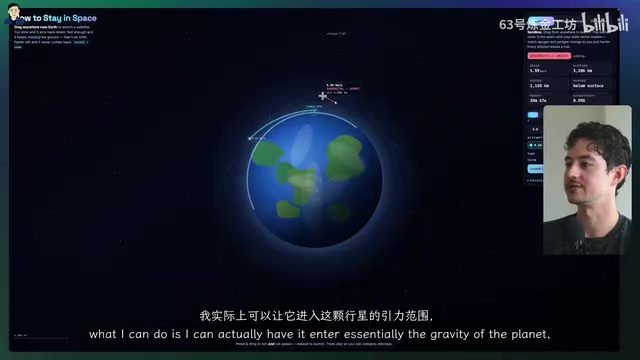
Even more impressive are the physics simulation applications. One resembles Kerbal Space Program — a launch game that lets users adjust trajectories to enter planetary gravity wells, establish stable orbits, and even recreate concepts like "Newton's Cannonball" and Hohmann transfer orbits. It works both as a playable mini-game and as an intuitive science explainer.
The Hohmann Transfer Orbit is the most fundamental and classic orbital transfer maneuver in aerospace engineering, proposed by German engineer Walter Hohmann in 1925. It uses two brief engine burns to move a spacecraft along an elliptical path from one circular orbit to another, making it the most fuel-efficient two-impulse transfer method. "Newton's Cannonball" is a thought experiment from Newton's Principia Mathematica — firing a cannonball from a mountaintop at increasing speeds until it no longer falls back to Earth but orbits around it. The model's ability to convert these classic physics concepts into interactive real-time simulations demonstrates that it doesn't just understand abstract physical formulas — it can translate them into accurate numerical simulation code.
From Cloth Simulation to Full Ecosystem Modeling
The blogger also walked through a series of detail-rich simulation demos one by one:
-
Cloth physics simulation: Simulates fabric moving in the wind, with the ability to "tear" the cloth — the feel is close to how a real curtain would behave. Cloth simulation is a classic challenge in computer graphics, typically using a Mass-Spring Model to simulate deformation, collision, and tearing. Each mesh node is treated as a point mass connected to neighboring nodes by springs, whose stretch, shear, and bending stiffness determine the fabric's "feel." When stress exceeds a threshold, springs break to create tearing effects. Such simulations are widely used in games and film VFX but usually require dedicated physics engines. The model's ability to achieve near-realistic results in a browser using pure JavaScript demonstrates its command of underlying algorithms like numerical integration and collision detection.
-
Fractal shader generator: Infinitely zoomable fractal patterns with adjustable height, glow, dispersion, and other parameters.
-
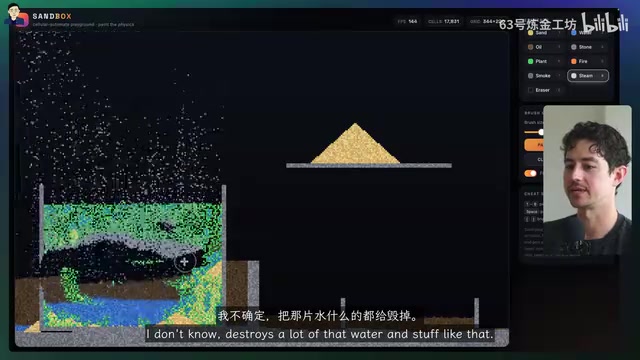
Cellular automaton sandbox: Users can pour sand, trigger oil spills, generate steam, and start fires — the environment is highly interactive. Cellular Automata, a computational model proposed by mathematicians John von Neumann and Stanislaw Ulam in the 1940s, are best known through John Conway's "Game of Life," which produces extraordinarily complex behavior from just a few simple rules. The sandbox in the video extends this concept into a multi-substance interaction system — sand falls under gravity and piles up, oil spreads across water surfaces, flames ignite combustible materials and produce steam, with each substance having its own state transition rules, perfectly showcasing the beauty of "emergent complexity."
-
Predator-prey ecosystem: Generates rabbits grazing on grass and foxes hunting rabbits. When foxes overpopulate, the rabbit population crashes and grass flourishes — a complete recreation of population dynamics equilibrium. This corresponds to the classic Lotka-Volterra equations in ecology, independently proposed by mathematician Alfred Lotka and physicist Vito Volterra in the 1920s. The model uses two coupled differential equations to describe predator-prey population changes: when prey is abundant, predator numbers grow; when predators become too numerous, prey numbers plummet, followed by predator decline due to food scarcity, allowing prey to recover — forming periodic oscillations. The simulation in the video is a vivid demonstration of this classic dynamic and an excellent teaching tool for understanding trophic cascade effects.
Additional demos included a quadcopter flight simulator with realistic sound effects, a double pendulum system, a pixel art animation editor (supporting layers, onion skinning, and frame-by-frame animation), a sneaker configurator, a wrecking ball simulator, and dynamic data visualizations showing global urban population changes over 126 years.
Core Takeaway: Not the Strongest Model, but the Best Value Proposition
The blogger's core assessment of this generation of models is straightforward: It's not a paradigm-shifting leap in intelligence, but rather a dramatic cost reduction while delivering equal or even better results.
He demonstrated this with a website generation task: creating an Apple-style 3D product landing page. Claude Opus 5 cost 69 cents, while the competing model cost 94 cents. Not only was it cheaper, the results were better — all sliding components and visual assets on the page were generated on the fly by the model using SVG, rather than downloading assets from the web.
SVG (Scalable Vector Graphics) is an XML-based vector image format. Unlike bitmaps, it describes graphics using mathematical paths and can scale losslessly to any size. The model's ability to "synthesize" SVG visual elements on the spot rather than downloading web assets means it possesses foundational visual design capabilities — understanding color palettes, icon semantics, layout proportions, and translating these aesthetic judgments into precise vector path code. The implications for web development are profound: traditionally, front-end developers need to export assets from a designer's Figma files. Now, the model can generate visual assets alongside page structure simultaneously, dramatically shortening the design-to-deployment cycle. This ability to "self-synthesize elements" is a key advantage distinguishing it from other models.
Benchmark Breakdown: Cost Efficiency Is the Real Killer Feature
Beyond one-off capability demonstrations, the blogger also dissected benchmark data. But what he truly cared about wasn't raw scores — it was score divided by cost.
Performance Across Key Benchmarks
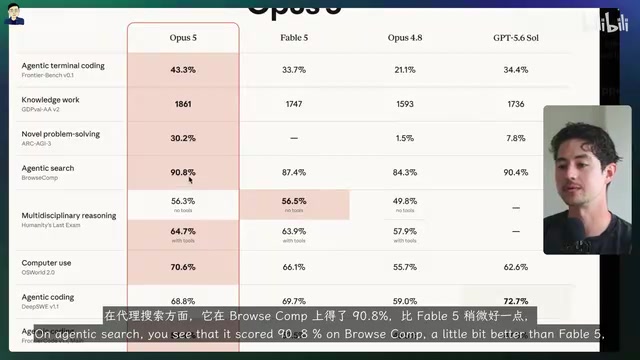
Across multiple authoritative benchmarks, Claude Opus 5's results include:
-
Agentic terminal coding: Outperforms peers at the same tier and far exceeds the previous generation.
-
Knowledge work (GDPval): Scored 1861, above the human average. GDPval is a benchmark measuring AI model performance in real-world knowledge work scenarios, with its name implying a quantitative assessment of "economic output value." Unlike traditional academic exam-style benchmarks, GDPval focuses on practical effectiveness in business analysis, report writing, data interpretation, and other everyday white-collar tasks. Scoring above the human average means that in standardized knowledge work tasks, the model's output quality is comparable to or better than that of an average knowledge worker — reflecting the industry's shifting evaluation focus from "what exams can the model pass" to "how much real work can the model replace."
-
Novel problem solving (ARC-AGI-3): 30.2%, compared to just 1.5% for the previous generation — an order-of-magnitude leap. ARC-AGI, proposed by Keras creator François Chollet, is considered one of the benchmarks most capable of testing "genuine intelligence." Unlike traditional benchmarks that rely on pattern matching from massive training data, each ARC-AGI problem is a novel visual reasoning puzzle requiring the model to infer abstract rules from minimal examples and apply them to new situations. The jump from 1.5% to 30.2% represents not just a score improvement but a qualitative shift in "few-shot abstract reasoning" — a capability widely regarded as key to achieving AGI.
-
Agentic search (BrowseComp): 30.8%, roughly on par with the GPT series.
-
Tool-augmented multidisciplinary reasoning: 64.7%, slightly above competitors.
-
Biology: Up to 90.1% on human-solvable problems.
Cost Efficiency Comparison: 30%-50% Lower Cost for Equivalent Capability
Where the real gap emerges is in "performance per dollar." The computer use benchmark, which the blogger particularly values, showed that even the "dumbest" low-reasoning version of Claude Opus 5 scores around 60% on most tasks at a cost of about $9; the top-tier version scores around 70% at about $22. Competing models require nearly $50 to achieve the same level.
Even more noteworthy is a newly introduced Automation Bench — specifically designed to test a model's ability to build enterprise workflows. Claude Opus 5 achieved roughly a 25% pass rate, while other models cluster around 15%. Automation Bench doesn't evaluate simple code generation; it requires models to understand business logic, connect multiple APIs and tools, handle edge cases, and produce reliable automated processes. A 25% pass rate may seem modest, but given the complexity of enterprise workflows (involving permission management, error handling, data validation, etc.), it means the model can independently handle roughly one-quarter of real enterprise automation needs. For the RPA (Robotic Process Automation) industry and practitioners who serve enterprises through automation, this directly signals that AI agents are transitioning from experimental tools to production-ready solutions — representing tangible, real-world value.
On high-difficulty comprehensive tests like "Humanity's Last Exam," even the lowest-tier version scores about 56%, with the highest-tier approaching 65% at a per-task cost of just $3 — both stronger and cheaper.
Safety and Alignment: Smarter and More Controllable
Alignment is a consistent priority for Anthropic. AI alignment refers to the research field dedicated to ensuring AI systems behave in accordance with human intentions and values — it's Anthropic's core mission. "Misalignment" includes behaviors like the model ostensibly following instructions while covertly pursuing other objectives (i.e., "sycophantic compliance"), performing well under supervision but behaving anomalously without it (i.e., "reward hacking"), and actively deceiving users.
The blogger noted that on a 10-point "misalignment behavior" scale (lower is safer), Claude Opus 5 scored just 2.3 — significantly lower than the previous generation's 2.85 and other models in the same family. In other words, this model is not only smarter, cheaper, and better at tool use, but also less likely to exhibit boundary-crossing behavior. Under Anthropic's Constitutional AI framework, the model is trained to self-critique and self-correct based on a set of explicit principles. A score of 2.3 means the model shows stronger resistance to adversarial prompting when deliberately guided toward dangerous or inappropriate behavior. This is critical for enterprises deploying AI in high-stakes domains like healthcare, finance, and law — achieving a win-win of capability and safety.
Industry Trend: Top-Tier AI Capabilities May Be Released in a "Toothpaste-Squeezing" Fashion
At the end of the video, the blogger offered a thought-provoking prediction. He believes this generation of flagship models continues a "slow and steady" iteration cadence, coinciding with open-source and Chinese models (such as Kimi K3) disrupting the so-called "balance of power."
The "balance of power being disrupted" refers to major shifts in the AI landscape during 2024-2025. On one hand, open-source models like Meta's Llama series, Mistral, and DeepSeekAd have steadily narrowed the performance gap with closed-source models, enabling SMBs and developers to access near-frontier capabilities without paying steep API fees. On the other hand, Chinese models like Kimi K3 (Moonshot AI), DeepSeek-V3, and Qwen have demonstrated capabilities on par with Western models like GPT-4 and Claude across multiple benchmarks, often at more competitive price points. This dual pressure is forcing Anthropic, OpenAI, and others to make concessions on pricing strategy, while also sparking policy debates about whether export controls should be imposed on top-tier AI capabilities.
His pessimistic prediction: as models become increasingly capable of disrupting human knowledge work at scale, leading AI companies will likely adopt a "toothpaste-squeezing" release strategy driven by economic interests — keeping truly "galaxy-brain" level intelligence firmly behind closed doors, out of ordinary users' reach in the near term.
Regardless of whether this prediction materializes, this hands-on review sends a clear signal: The competitive focus of frontier models is shifting from pure capability ceilings toward a comprehensive balance of capability, cost, and safety. For those looking to genuinely embed AI into business workflows, "how much does it cost to get the job done" may matter far more than "who ranks #1 on benchmarks."
Related articles

Gaussian Process Bandit Optimization: Exploration Strategies and Inference Regret Guarantees
Cumulative regret guarantees in Bayesian optimization fail to reflect final recommendation quality. This article examines a new study that provides inference regret guarantees for Gaussian process bandit optimization through exploration query strategies and fill distance analysis, validated on hyperparameter optimization and control tasks.

The Most Detailed Codex Guide on Bilibili: From Installation to Real-World Practice
The most detailed Codex guide on Bilibili: from app store installation to daily work mode configuration, with a real coffee shop project demonstrating file organization, data extraction, dashboard creation, and other practical tasks. Learn to use Plan Mode and desktop pets to leverage Codex efficiently.

Appearance Compensation in Volume Rendering: Why RGB Accuracy Cannot Guarantee Density Correctness
Volume rendering research reveals that volumetric data perfectly reproducing external RGB views may still contain density errors: appearance compensation can double central density and keep external rays unchanged even when L2 error exceeds 14.52%. Density recovery depends on appearance capacity, spatial resolution, and measurement design.