Hands-On with Jev: The AI Model That Only Makes Decisions — 65x Cheaper Than GPT

Jev makes structured decisions 65x cheaper than GPT-5.5, trading text generation for typed outputs with confidence scores.
Jev is a 'System 1 model' by Typesafe that skips text generation entirely, returning only structured choices, booleans, or scores with probability values. Weeks of testing across ticket routing, shell command guarding, and the banking77 benchmark show Jev matches cheap LLMs in accuracy, trails GPT-5.5 by ~5 points, but costs 65x less and runs 6x faster. Its confidence scores also enable powerful model cascading — use Jev by default, escalate only uncertain cases to frontier models.
When AI Stops Writing Sentences and Just Makes Decisions
There's an AI model that can't write a single complete sentence. It won't code, chat, or summarize anything for you. But in many of the scenarios where we actually use large language models (LLMs), it might be the better choice — because it costs roughly 65 times less to run than frontier models like GPT-5.5.
The model is called Jev, built by a company named Typesafe, and it's marketed as a "System 1 model." The core idea is simple: traditional LLMs are built to generate text, while Jev is built to make a single, fast, structured decision. You give it a state (text, JSON, a list — anything works), ask it a typed question, and instead of a paragraph, it returns a clear choice with probability scores for every option.
This article is based on weeks of hands-on testing by a YouTube developer, covering over a thousand real customer service messages, hundreds of shell commands, and side-by-side comparisons with both cheap and expensive LLMs — to show exactly where Jev shines and where it falls short.
Jev's Three Question Types and How It Works
Jev supports only three types of queries:
- Choice: Give it several options, it picks one.
- Bool: Ask a yes/no question, get back a single probability.
- Score: Give it an ordered scale (e.g., low/medium/high urgency), it tells you where something lands.
Every answer comes with probability values — this is the model's most critical feature. Take a customer support ticket: you need to decide whether it goes to billing, technical, or sales. A normal LLM returns a full sentence or even a Markdown-formatted explanation, leaving your code to parse it, strip the formatting, and hope the model didn't "get creative" this time. Jev simply returns "billing, confidence 1.0" plus the individual probabilities for all three options — zero text to parse.
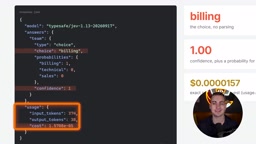
The integration is also extremely lightweight. Via OpenRouter's Decision API, you don't need any SDK or framework — pure Python requests will do. Set the model to typesafe/jev-latest, pass in your state and question, and the response includes the choice, confidence score, per-option probabilities, and the actual cost down to fractions of a thousandth of a cent.
The "System 1 model" concept Jev embodies comes from Nobel Prize-winning economist Daniel Kahneman's dual-process theory in Thinking, Fast and Slow: System 1 is fast, intuitive, and automatic; System 2 is slow and deliberate. Traditional LLMs are closer to System 2 — they "think through" context, organize language, and generate answers token by token, making them slow and resource-intensive. Jev simulates System 1, making instant judgments over a bounded option space and bypassing all the overhead of text generation. Architecturally, this means the model doesn't need an open-ended vocabulary output layer — it simply outputs a probability distribution over predefined discrete options, dramatically reducing compute and latency.
Four Real-World Tests: From Ticket Routing to Command Guarding
Test 1: Customer Support Ticket Routing
The developer generated 50 support tickets — most with clear intent (e.g., "I was charged twice"), a few deliberately ambiguous. He sent them all in a single batch request, which is exactly where Jev shines. Result: all 50 tickets routed in about 1.5 seconds for a total cost of one-thirtieth of a cent.
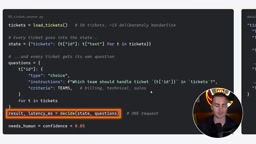
The confidence mechanism made it even better: any ticket with confidence below 0.85 didn't get auto-routed — it went to a human agent instead. Ten tickets were flagged in total, all edge cases (like "I'm just following up on an email" — the kind of message that could belong to any team), with Jev returning a confidence of just 0.15. The one ticket that was misclassified had a low confidence score to begin with, meaning it would have been sent to human review under the rule anyway.
Test 2: Command Guard for an AI Coding Agent
This scenario is more interesting: using Jev to evaluate shell commands before an AI coding agent executes them. The developer used three boolean questions as guards — does it delete something? does it touch production? does it send data off the machine? — and paused for approval if any probability exceeded 50%.
All 20 commands tested correctly in under 2 seconds at a cost of about three-hundredths of a cent. But when the scale grew to roughly 350 commands (including base64 and hex-encoded variants), Jev's weaknesses showed — it couldn't read encoded commands and missed about one in ten high-risk encoded instructions, dropping overall accuracy to 91%.
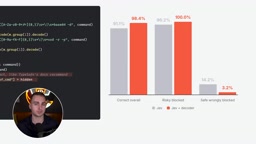
The fix turned out to be exactly what Typesafe's own documentation recommends: let regular code handle the hard parts. The developer wrote a small function to decode base64/hex payloads first, then added the decoded command to the state. That single change pushed accuracy from 91% up to 98.4%. The lesson: Jev is powerful, but unlike an LLM it can't proactively call tools to parse content — certain preprocessing steps are your responsibility.
Head-to-Head with LLMs: Crushing It on Speed and Cost
In the command-guard comparison, Jev (with the decode function) achieved 98.4%, Gemini 2.5 Flash Lite hit 94.3%, and GPT-5.5 came in at 92.7%. GPT-5.5 didn't miss any truly dangerous commands, but it was overly aggressive — flagging git stash and pip install as threats, which didn't match the developer's own standards.
The real gap is in speed, cost, and determinism. Jev's median latency is in the low milliseconds, and two runs produced 100% identical results. Gemini and GPT-5.5 were accurate but showed variability in their responses.
In the ticket routing comparison, Jev got 49/50 correct, Gemini got 48, and the most expensive option — GPT-5.5 — only got 41. Batched Jev was about 5x cheaper than Gemini and about 79x cheaper than GPT-5.5, and none of the models broke the output format.
The Pseudo-Benchmark: A Thousand Real Messages
The most rigorous test used the publicly available banking77 dataset — real bank customer messages labeled across 77 intent categories. The developer sampled 1,000 messages (13 per intent), ran all three models twice each, generating over 6,000 requests and pulling real costs through OpenRouter.
Results: Jev scored 80% accuracy, Gemini Flash 78.5%, and GPT-5.5 84.9%. Jev and Gemini were essentially tied; GPT-5.5 led by about 5 percentage points. But the cost and speed gap was stark:
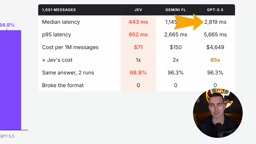
- Latency: Jev median 443ms, Gemini just over 1 second, GPT-5.5 at 2.8 seconds
- Cost (per million messages): Jev ~$71, Gemini ~$150, GPT-5.5 ~$4,600
- Consistency: Jev's two runs agreed 98.9% of the time, versus ~96.3% for the other two
In other words, GPT-5.5 costs 65x more for just a 5 percentage point accuracy gain.
banking77 is a widely used intent classification benchmark in academic NLP, released in 2020 by a Cambridge University research team. It contains roughly 13,000 real bank customer queries spanning 77 fine-grained intent categories (e.g., "check balance," "freeze card," "exchange rate inquiry"). The challenge lies in the high semantic similarity between categories and the highly colloquial language — even human annotators face ambiguity. It's commonly used to measure a model's capability in narrow, high-granularity classification tasks rather than general comprehension. The article calls it a "pseudo-benchmark" because the testing didn't strictly follow the dataset's standard evaluation protocol, but instead used custom sampling and aggregation — the conclusions are informative but shouldn't be directly compared to SOTA numbers in academic papers.
Is the Confidence Score Trustworthy? And the Model Cascade Strategy
Breaking results down by confidence band revealed: when Jev returned confidence above 0.95 (roughly 60% of messages), accuracy hit 95.8%. The lower the confidence, the lower the accuracy. Interestingly, the messages Jev was uncertain about also tripped up GPT-5.5 — suggesting the problem isn't the model, but that the messages themselves are inherently ambiguous or mislabeled.
This leads to a practical pattern: model cascading. Use Jev for decisions first; only escalate to a reasoning model like GPT-5.5 when confidence falls below a threshold. The experiment showed that using Jev alone yields 80% accuracy; escalating on confidence below 0.7 pushes that to 83.7%, with cost rising from 7 cents to only about $2.58; running everything through GPT-5.5 gives 84.9% at $4.65. Most requests never need the second step — the savings are dramatic.
Model cascading is a classic architectural pattern in ML system design. The core idea is to use a cheap, fast model for "easy" samples and only escalate the difficult ones to an expensive model, optimizing both cost and accuracy across the full system. The logic mirrors multi-stage ranking in early search engines and triage in medical diagnostics. In the LLM era, the key challenge is knowing when to escalate — Jev's confidence probability output naturally provides this signal, so no additional model is needed to make the escalation decision. It's worth noting that the ceiling on cascade performance depends on whether there's a sufficiently large accuracy gap between high-confidence and low-confidence samples. The experimental data here (95.8% accuracy at confidence above 0.95) suggests Jev's confidence calibration is quite reliable — a prerequisite for effective cascading.
Conclusion: When Should You Use Jev?
Jev has a clear edge in high-frequency, repetitive decision tasks where speed and cost matter. On routing tasks it matches cheap LLMs in accuracy while being faster, cheaper, and more consistent. On guard tasks, a small preprocessing step lets it outperform both LLMs tested.
There are scenarios where it doesn't fit: tasks that require generating text (it simply can't), documents exceeding its 32K-token context window, encoded payloads that haven't been pre-decoded, and mission-critical tasks demanding the highest possible accuracy — especially while it's still in beta, where frontier models still hold a few percentage points lead.
For the vast majority of scenarios where you need "a clean, typed decision," Jev solves a real pain point. Paired with a cascade pattern — use Jev directly when confidence is high, escalate to a large model when it's low — you preserve accuracy while cutting the cost of most requests down to nearly nothing.
Related articles

Amphibious Transforming Drone: Beyond 100x Power Savings, What Are the Real Needs?
Is the amphibious transforming drone just a gimmick? Starting from the 100x power difference of the M4 Morphobot, explore real application scenarios and thesis topic ideas, analyzing boundary conditions where pure drones and pure ground robots both fail.

Warhound Raises $200 Million: Genetically Engineered "War Dogs" Paired with Anduril Gear
Warhound raises $200M, backed by Ben Lamm and Palmer Luckey, to genetically engineer dogs for military and law enforcement use and equip them with Anduril gear. This article analyzes its technology direction, funding logic, and ethical controversy.

Claude API Comes to Google Cloud: IAM Integration and SDK Access Guide
Anthropic hosts the full Claude API on Google Cloud with IAM-controlled permissions and unified billing. This guide covers the Vertex AI and Anthropic-hosted entry points, IAM role configuration, and SDK access.