Hansel: A Self-Hosted Encrypted Email Service as a Privacy-First Alternative to Gmail

Hansel offers self-hosted encrypted email with user-owned servers and keys as a privacy-first Gmail alternative.
Hansel by Seedling is a self-hosted encrypted email service that gives users complete control over their servers and encryption keys, ensuring privacy through architecture rather than promises. Beyond email, it integrates encrypted messaging, calendar, notes, and enterprise tools as a privacy-first Google Workspace alternative, targeting teams in legal, healthcare, and financial sectors who prioritize data sovereignty.
When Your Email No Longer Belongs to You
In today's cloud-dominated world, we've grown accustomed to entrusting our email to giants like Gmail and Outlook. Behind the convenience lies a frequently overlooked question: who does your email truly belong to? Service providers can not only read your email content but can also freeze or even ban your account at any time, causing you to permanently lose years of communication history.
Here it's important to understand a key technical distinction: most mainstream email providers use encryption at rest—meaning emails are encrypted during transmission and storage, but the provider holds the decryption keys and can read the original email content whenever needed (whether for ad targeting, content moderation, or responding to government requests). This is fundamentally different from end-to-end encryption (E2EE), which ensures only the sender and recipient can decrypt the content, making it unreadable even to the service provider. Historically, Google sparked widespread controversy for automatically scanning Gmail content to serve targeted ads. Although Google announced it would stop this practice in 2017, the technical capability was never removed. Microsoft, Yahoo, and other platforms have also experienced incidents where algorithmic misjudgments led to mass account bans, leaving victims with no recourse—years of emails, documents, and photos vanishing overnight.
Recently launched on Product Hunt, Hansel by Seedling was born precisely to address this pain point. Its positioning is straightforward and powerful—"Your email, your server, your keys, so you'll never be locked out." As a Gmail/Outlook alternative designed for teams that value privacy and data ownership, Hansel garnered 78 votes after launch, reaching #12 on the daily leaderboard.
Hansel's Core Philosophy: Architecture-Level Privacy Protection
Self-Owned Servers and Keys, Complete Data Sovereignty for Users
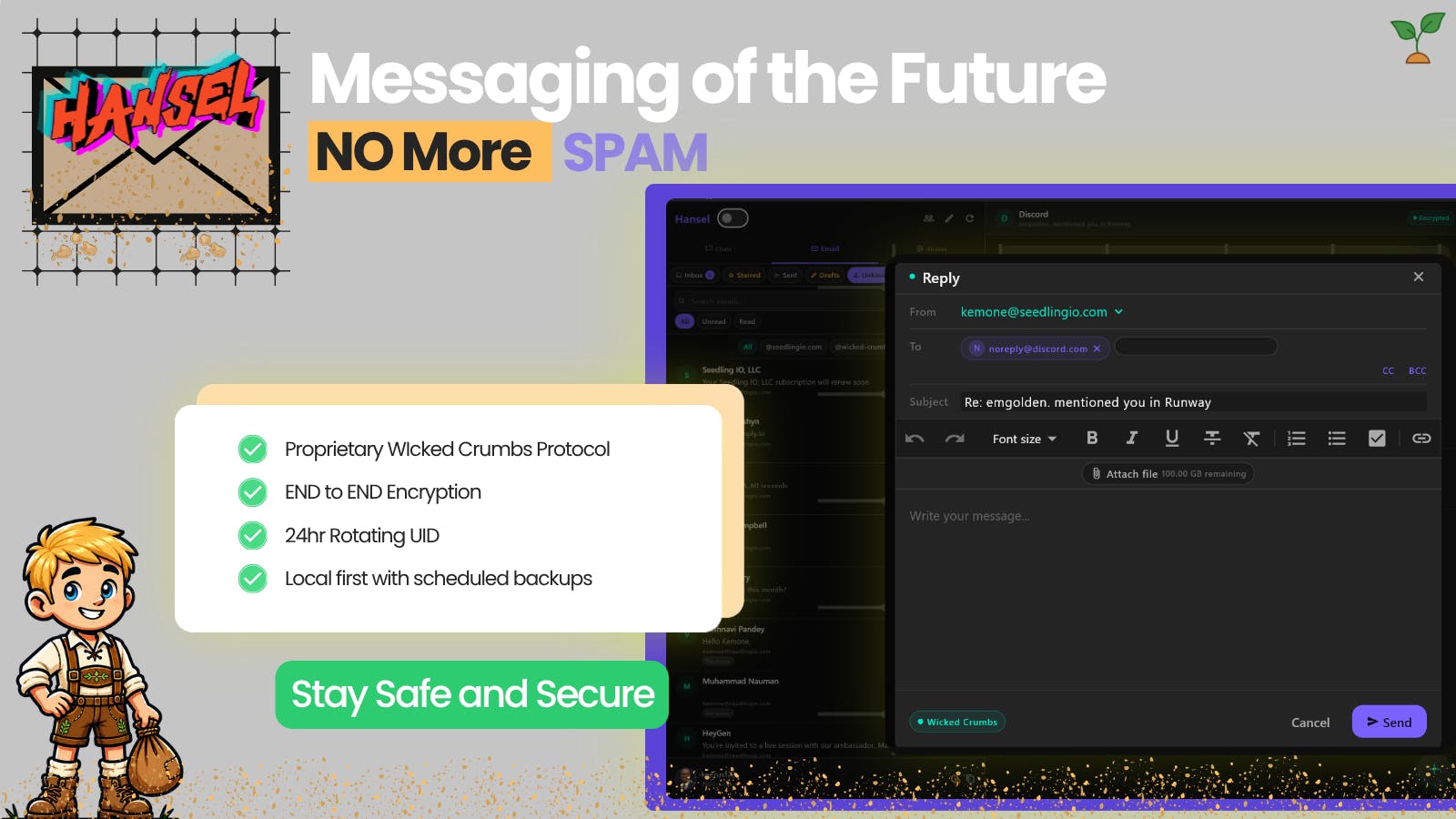
Hansel's most critical differentiator is that it hands control entirely back to the user. Email runs on your own server, messages are encrypted on your device, and the platform itself cannot read any content. This self-hosted encrypted email design means even the service provider cannot peek at your communications—privacy isn't guaranteed by promises but enforced by technical architecture.
From a technical perspective, the core of this model is the application of asymmetric encryption in email scenarios. Each user possesses a key pair: a public key used to encrypt emails sent to that user, and a private key stored only on the user's own device for decrypting received emails. This isn't an entirely new concept—back in 1991, Phil Zimmermann released PGP (Pretty Good Privacy), providing end-to-end encryption for email, which later evolved into the open-source GPG (GNU Privacy Guard) standard. However, PGP/GPG has an extremely high barrier to entry, requiring users to manually manage keyrings, understand the Web of Trust, and grasp other complex concepts, which has kept it from going mainstream for over three decades. What Hansel attempts to do is package this architecture-level encryption capability into a product form that ordinary teams can use, lowering the entry barrier for self-hosted encrypted email.
More importantly, there's the data sovereignty dimension: since both servers and keys are in the user's hands, no company can lock you out. For teams and enterprises that have experienced their accounts being arbitrarily banned or data being frozen by platforms, this is an extremely compelling promise. Against the backdrop of increasingly strict regulations like the EU's General Data Protection Regulation (GDPR) and various national data localization laws, the self-hosted model naturally satisfies data storage location compliance requirements—which server the data resides on and which jurisdiction it falls under is entirely the user's decision.
Solving Spam at the Architecture Level
Spam has long been email's chronic ailment. Statistics show that over 45% of all emails sent globally each day are spam. Hansel proposes a novel approach: solving spam at the architecture level. The logic is simple—without your key, messages simply cannot be delivered. In other words, only communications verified through key exchange can enter your inbox, blocking spam at the source rather than relying on after-the-fact filtering algorithms.
To understand the breakthrough nature of this approach, we need to compare it with the traditional anti-spam technology stack. Current mainstream email systems rely on multiple layers of defense: SPF (Sender Policy Framework) verifies whether the sending server is authorized to send on behalf of a domain; DKIM (DomainKeys Identified Mail) uses digital signatures to verify emails haven't been tampered with during transit; DMARC (Domain-based Message Authentication, Reporting & Conformance) integrates the previous two and defines handling policies. At the content level, systems rely on Bayesian filters, machine learning models, and other algorithms for semantic analysis and spam probability scoring. However, these technologies are essentially "post-delivery filtering"—spam has already reached the server and is merely sorted into the spam folder. Hansel's key verification mechanism fundamentally changes the game: emails without the correct key cannot even complete the protocol-level handshake, and the step of "reaching the server" never occurs.
This "whitelist-style" encrypted communication mechanism may involve trade-offs in openness—for example, new contacts sending their first email may require an additional key exchange step, reducing the convenience of traditional email's "just know the address and write" model—but for professional teams pursuing maximum security and a clean inbox, it's a design choice worth considering.
More Than Email: A Privacy-First Complete Collaboration Suite
Hansel isn't merely an encrypted email client—it's a complete team collaboration toolkit. Beyond core email functionality, it offers:
- End-to-end encrypted messaging: Secure instant communication
- Custom domain email: Send and receive emails using your own domain, reinforcing brand identity and control
- Calendar: Team schedule management
- Notes: Information recording and knowledge management
- Enterprise management tools: Backend administration capabilities for organizations
This feature combination means Hansel aims to become a privacy-first Google Workspace alternative, covering the main scenarios of daily team communication and collaboration without requiring users to switch between multiple tools.
In the privacy-first collaboration tools niche, Hansel isn't fighting alone. ProtonMail (now rebranded as Proton) is currently the most well-known encrypted email service, headquartered in Switzerland under strict Swiss privacy laws, having expanded into a complete ecosystem including Proton Drive, Proton Calendar, and Proton VPN. Tutanota (now rebranded as Tuta) comes from Germany and similarly offers end-to-end encrypted email and calendar, attracting privacy enthusiasts with extremely low pricing. The once-popular Skiff was acquired by Notion in 2024 and gradually shut down, leaving a gap in this market. However, most of these products remain "hosted" services—user data is encrypted but still stored on the provider's servers. Hansel's self-hosted positioning pushes control even further toward the user side, which is both its core differentiator and the fundamental reason it faces a higher usage barrier.
Who Is Hansel For?
From a product positioning perspective, Hansel's target users are very clear: teams that value privacy and data ownership. Specifically:
- Legal, healthcare, and financial industries: Where compliance and confidentiality requirements are extremely high and communication security is a hard requirement. For example, the U.S. Health Insurance Portability and Accountability Act (HIPAA) imposes strict encryption and access control requirements on healthcare institutions' electronic communications; the EU's General Data Protection Regulation (GDPR) grants individuals rights to access, correct, and delete their data; financial industry regulations like MiFID II require communication records to be auditable and traceable. Self-hosted solutions allow these institutions to fully control data flow and simplify compliance audit processes.
- Startups and technical organizations: Those skeptical of big tech data policies who want autonomous control over their data
- Security-sensitive enterprises: Those needing auditable, verifiable privacy assurance solutions
Interestingly, Hansel's category tags include GitHub, suggesting it may be released in an open-source or partially open-source manner. For privacy tools, open source means code is auditable and trustworthy—users don't have to rely solely on vendor promises but can personally verify whether "the platform cannot read messages" is truly the case.
This embodies the widely followed security principle of "Don't trust, verify." Closed-source privacy tools face a fundamental trust dilemma: users cannot confirm whether the code the software actually executes matches the vendor's claimed behavior. Are there backdoors? Are there vulnerabilities in the encryption implementation? Are keys truly stored only on user devices? These questions can only be addressed through third-party audit reports in closed-source environments (and audits themselves may have gaps). Open source allows global security researchers to continuously review code, with any suspicious behavior quickly discovered and disclosed. The Signal protocol, WireGuard VPN, Linux kernel, and other critical security infrastructure have earned widespread trust largely because of their open-source auditability. If Hansel does take the open-source route, it would significantly enhance its credibility within the security community.
A Balanced Perspective: The Double-Edged Sword of Self-Hosted Email
Of course, the "self-hosted, self-managed keys" model Hansel advocates is not without costs. Running your own email server requires certain technical capabilities and operational investment, and self-managing keys means that if they're lost, data may become irrecoverable—this is the flip side of "no company can lock you out."
The operational challenges of running your own email server go far beyond simply deploying an email service. First is IP reputation management: major email providers (especially Gmail and Outlook) assess reputation based on a sending server IP's historical behavior. Newly launched email server IPs typically have low reputation scores, and emails they send are very likely to be placed directly in the recipient's spam folder or even rejected. Building good IP reputation usually requires weeks or even months of "warming up." Next are reverse DNS (rDNS) configuration and SPF/DKIM/DMARC record setup—any errors in these DNS-level configurations will significantly reduce email deliverability. Additionally, email servers require ongoing security updates, TLS certificate maintenance, storage capacity planning, backup strategy development, and other operational work. For these reasons, over the past decade-plus, large numbers of businesses and individuals have migrated from self-hosted email to cloud services. If Hansel wants to lower this barrier, it may need to provide automated server deployment tools, one-click configuration scripts, or even integration solutions with major cloud providers (AWS, DigitalOcean, etc.).
For average individual users, the threshold for running a self-hosted email server may be too high; but for teams that truly view data sovereignty as a core requirement, this is precisely the trade-off they're willing to accept. Hansel represents yet another implementation of "decentralization" and "data autonomy" principles in the productivity tools space. This philosophy aligns with recent movements like Web3 and Self-Sovereign Identity—all sharing the core proposition of reclaiming control over data and digital assets from centralized platforms and returning it to individual users.
Conclusion
At a time when data privacy is increasingly becoming a central issue, Hansel by Seedling offers a clear and thorough answer: return complete control to the user. It replaces trust in vendor goodwill with architecture-level design, making privacy an irrevocable technical guarantee.
While the self-hosted model does present a certain barrier to users, for teams that truly care about "never being locked out," this may be exactly the privacy email solution they've been waiting for.
Key Takeaways
Related articles

JobRunner MCP Server: AI Agents Can Now Fix Failed Java Jobs
JobRunner launches an open-source MCP server enabling AI agents to view cluster status, diagnose failures, and recover Java jobs—incident response from any cloud coding environment or existing agent.

MLAI Digital Launches 9 Security Agents: MCP Server Safeguards the Full Lifecycle of Agentic AI
MLAI Digital launches Security MCP Server with nine built-in specialized security agents covering vulnerability discovery, attack simulation, prompt injection detection, API and infrastructure assessment, and accelerated remediation—embedding security validation across the full Agentic AI lifecycle from development to production.

Running Isaac Lab on H100 GPUs: Exploring Better Approaches
Exploring optimization methods for running Isaac Lab on NVIDIA H100 GPUs, including MIG configuration, mixed precision, TensorRT acceleration, and community experience to improve robotics simulation and reinforcement learning efficiency.