Harmonic Analysis and Circuit Approximation for Sobolev Functions on Quantum Input Spaces

Quantifiable circuit approximation rates for Sobolev functions on quantum state and unitary group spaces via compact group harmonic analysis.
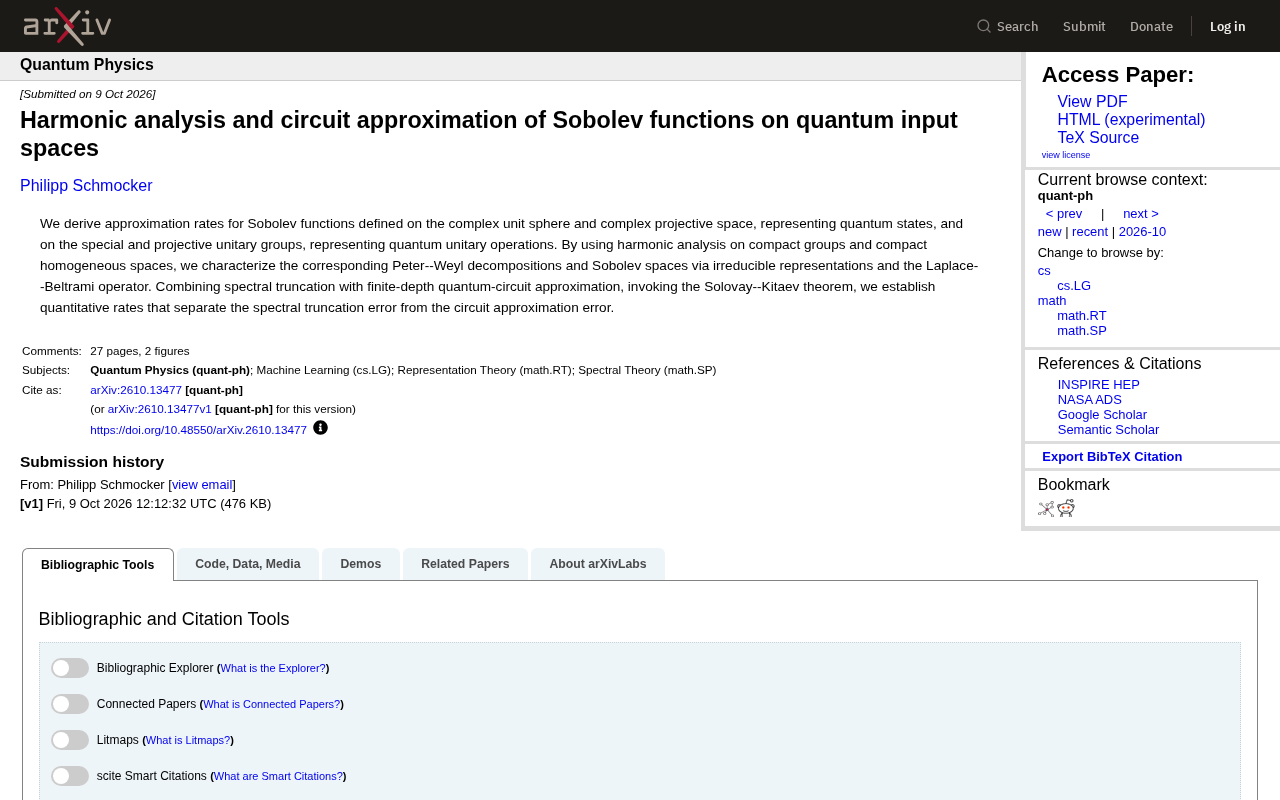
This research extends classical function approximation theory to quantum input spaces, deriving approximation rates for Sobolev functions defined on the complex unit sphere, complex projective space, and the special and projective unitary groups. The core tools are the Peter–Weyl theorem and the Laplace–Beltrami operator for spectral characterization of smoothness. The key contribution is a clean decomposition of total approximation error into spectral truncation error (governed by Sobolev smoothness and truncation order) and circuit approximation error (controlled to polylogarithmic depth via the Solovay–Kitaev theorem), providing a rigorous theoretical basis for the expressive power of quantum machine learning models on quantum inputs.
Background: Function Approximation Meets Quantum State Spaces
Classical function approximation theory studies how to approximate arbitrary smooth functions using finite basis functions or network architectures. But when the input is no longer a vector in Euclidean space, but rather a quantum state or quantum unitary operation, the geometric structure of the problem changes fundamentally. Quantum states do not live in flat vector spaces — they are distributed over curved compact manifolds such as the complex unit sphere and complex projective space. Quantum unitary operations correspond to special unitary groups and projective unitary groups.
This research specifically derives approximation rates for Sobolev functions defined on these quantum input spaces. It unifies two seemingly distant mathematical toolkits — harmonic analysis on compact groups and finite-depth quantum circuit approximation — within a single framework, yielding quantifiable error decomposition results.
Characterizing Sobolev Spaces on Quantum Spaces via Harmonic Analysis
The core mathematical tool is harmonic analysis on compact groups and compact homogeneous spaces. In Euclidean space, Fourier analysis expands functions into trigonometric series; on compact groups, the corresponding tool is the Peter–Weyl theorem, which decomposes the space of square-integrable functions on a group into an orthogonal direct sum of irreducible representations.
Using this decomposition, the authors characterize Sobolev spaces on the complex unit sphere, complex projective space, and the special unitary and projective unitary groups. The key ingredient is the Laplace–Beltrami operator — the natural second-order differential operator on a manifold — whose eigenvalues correspond one-to-one with irreducible representations. The smoothness of a Sobolev space can thus be expressed precisely via the decay rate of the operator spectrum. This spectral characterization gives the "degree of smoothness" of a function a computable spectral description, laying the foundation for the subsequent approximation analysis.
Why These Specific Spaces?
- Complex unit sphere and complex projective space: These directly correspond to quantum states. The projective space factors out the global phase, more faithfully reflecting physically observable quantum states.
- Special unitary group and projective unitary group: These correspond to quantum gates and quantum unitary evolutions — the fundamental objects of operations in quantum computing.
All of these spaces are compact homogeneous spaces, naturally suited to the Peter–Weyl decomposition framework.
The Peter–Weyl theorem is the central result of harmonic analysis on compact groups, and can be seen as a generalization of classical Fourier analysis to non-abelian groups. For a compact group $G$ (such as the special unitary group $\mathrm{SU}(n)$), the theorem states that the space $L^2(G)$ of square-integrable functions on $G$ decomposes into an orthogonal direct sum of subspaces spanned by matrix coefficients of all irreducible unitary representations, with each irreducible representation appearing with multiplicity equal to its dimension. Intuitively, irreducible representations play the role of "generalized frequencies" — the projection coefficients of a function onto each representation correspond to Fourier components at different frequencies in classical analysis. The Laplace–Beltrami operator is the generalized Laplacian on a Riemannian manifold; on compact homogeneous spaces, its eigenfunctions are precisely the matrix coefficients of irreducible representations, and its eigenvalues increase monotonically with the "complexity" of the representation (characterized by the highest weight). The Sobolev space $H^s$ can thus be equivalently defined as: a function whose Peter–Weyl expansion coefficients remain square-integrable after being weighted by the $s$-th power of the eigenvalues. Larger $s$ means greater smoothness and faster decay of high-frequency coefficients. This spectral characterization is the direct basis for the quantifiable truncation error estimates that follow.
The complex projective space $\mathbb{CP}^{n-1}$ is the quotient space of all one-dimensional subspaces of the $n$-dimensional complex vector space — equivalently, the manifold obtained by identifying vectors on the complex unit sphere $S^{2n-1}$ that differ by a global phase. In quantum mechanics, two state vectors differing by a global phase factor $e^{i\theta}$ describe exactly the same physical state, so observable pure quantum states correspond bijectively to points in $\mathbb{CP}^{n-1}$ rather than to vectors in $\mathbb{C}^n$. Similarly, the projective unitary group $\mathrm{PU}(n) = \mathrm{U}(n)/\mathrm{U}(1)$ removes the global phase, corresponding to truly distinguishable unitary evolutions in quantum computing. Building approximation theory on these quotient spaces is physically more meaningful than working on the original sphere or unitary group, and also introduces additional algebraic structure — these spaces are compact symmetric spaces whose harmonic analysis admits a more explicit classification of irreducible representations, yielding simpler closed-form estimates for spectral truncation errors.
Separating Two Sources of Error: Spectral Truncation and Circuit Approximation
The most valuable contribution of this work is the explicit decomposition of the approximation error into two parts:
Spectral truncation error. Since Sobolev functions can be expanded in terms of irreducible representations, retaining only the first few spectral components and discarding high-frequency parts yields a finite-dimensional approximation. The magnitude of the truncation error is jointly determined by the function's Sobolev smoothness and the truncation order — smoother functions have faster high-frequency decay and thus smaller truncation errors.
Circuit approximation error. The target operation obtained after truncation still needs to be implemented by an actual quantum circuit. This is where the celebrated Solovay–Kitaev theorem comes in: any single-qubit unitary operation can be efficiently approximated by a set of universal gates to polynomial depth. The theorem guarantees that a finite-depth circuit can control the post-truncation operational error to within any given precision.
Since the two error sources are different in origin and mechanism, separating them makes the overall approximation rate quantifiable and tunable — the spectral truncation order and circuit depth can be optimized independently according to available resource budgets.
Quantitative Rates via the Solovay–Kitaev Theorem
The Solovay–Kitaev theorem is one of the cornerstones of quantum computing theory. It states that a universal quantum gate set can approximate any unitary operation in a dense sense, with the approximation depth growing only polylogarithmically in the precision. By embedding this result into the function approximation framework, this research establishes a clean separation:
- Spectral analysis handles "approximating infinite-dimensional functions with finite-dimensional objects";
- Solovay–Kitaev handles "approximating finite-dimensional objects with physically realizable circuits."
Chaining these two steps together, the authors establish quantitative approximation rates that explicitly distinguish the contributions of each error type to the total error. This provides a rigorous theoretical foundation for understanding the expressive power of models that operate on quantum inputs — including quantum neural networks and quantum kernel methods.
The precise statement of the Solovay–Kitaev theorem is: given a finite universal gate set that densely generates $\mathrm{SU}(2)$ (or more generally $\mathrm{SU}(d)$), for any target unitary $U$ and precision $\varepsilon > 0$, there exists a gate sequence of length $O(\log^c(1/\varepsilon))$ — where the constant $c \approx 3.97$, later improved to near 1 in subsequent work — that achieves error at most $\varepsilon$. The key significance of the theorem is that the approximation depth grows only polylogarithmically with precision, rather than polynomially or exponentially, making high-precision circuit synthesis "mild" in resource cost. Note that the standard form of the theorem applies to single-qubit or fixed-dimension unitary groups; extending it to multi-qubit settings requires tensor product structures and recursive decompositions. In the framework of this research, the Solovay–Kitaev theorem ensures that the finite-dimensional unitary operations obtained after spectral truncation can be physically realized by circuits of controllable depth, bridging the final gap between "mathematical approximation" and "physical implementability."
Significance and Outlook
This work connects harmonic analysis and compact group representation theory from pure mathematics with circuit approximation theory from quantum information, and carries a distinctly interdisciplinary character. Its direct value is threefold.
First, it provides a theoretical foundation for quantum machine learning models that process quantum state inputs, answering the question of "how complex a function such models can approximate, and at what cost." Second, the error-separation framework is general and may extend to broader compact manifolds and richer gate sets. Third, it introduces Sobolev regularity — a classical measure of smoothness — into the quantum setting, building a bridge toward future studies of the generalization ability and sample complexity of quantum models.
It should be noted that this is a theoretical work, and its conclusions are asymptotic approximation rates with some distance from concrete engineering implementation. But as a theoretical contribution connecting mathematical approximation theory with quantum computing, its framework merits close attention.
Related articles

Amphibious Transforming Drone: Beyond 100x Power Savings, What Are the Real Needs?
Is the amphibious transforming drone just a gimmick? Starting from the 100x power difference of the M4 Morphobot, explore real application scenarios and thesis topic ideas, analyzing boundary conditions where pure drones and pure ground robots both fail.

Warhound Raises $200 Million: Genetically Engineered "War Dogs" Paired with Anduril Gear
Warhound raises $200M, backed by Ben Lamm and Palmer Luckey, to genetically engineer dogs for military and law enforcement use and equip them with Anduril gear. This article analyzes its technology direction, funding logic, and ethical controversy.

Claude API Comes to Google Cloud: IAM Integration and SDK Access Guide
Anthropic hosts the full Claude API on Google Cloud with IAM-controlled permissions and unified billing. This guide covers the Vertex AI and Anthropic-hosted entry points, IAM role configuration, and SDK access.