Harmony: An AI Agent That Auto-Resolves IT/HR Tickets Directly in Slack and Teams

Harmony rebuilds the enterprise IT service desk as an AI-native platform with 100+ agents in Slack and Teams.
Harmony is an AI-native ITSM platform that reimagines the traditional ticketing system: employees ask questions directly in Slack or Microsoft Teams, and 100+ production-ready agents handle password resets, access provisioning, onboarding, and more end-to-end — escalating to humans only when necessary. Its key differentiator is consolidating ticket management, asset inventory, SaaS management, and workflows into one workspace, giving agents the context needed to take real action. The company claims 60%+ auto-resolution within days, but scaling depends on deep integration with enterprise identity systems and robust security compliance.
When the IT Service Desk Gets Rebuilt as an AI-Native Platform
Enterprise IT and HR support has long depended on ticketing systems (ITSM) — employees submit requests, join a queue, and wait for manual processing. The result is a slow, fragmented experience. Harmony, which recently ranked fifth on Product Hunt, takes a fundamentally different approach to this age-old problem: rather than bolting a chatbot onto an existing ticketing tool, it rebuilds the entire service desk around AI agents from the ground up.
According to its official description, Harmony is an "AI-native ITSM platform" built for IT teams. Instead of navigating a cumbersome ticketing system, employees simply ask questions directly in Slack or Microsoft Teams, and the platform's built-in agents handle requests end-to-end. This positioning aligns with a real shift in how enterprises communicate — with so much collaboration already happening in instant messaging tools, putting the service entry point there fits naturally into how employees actually work.
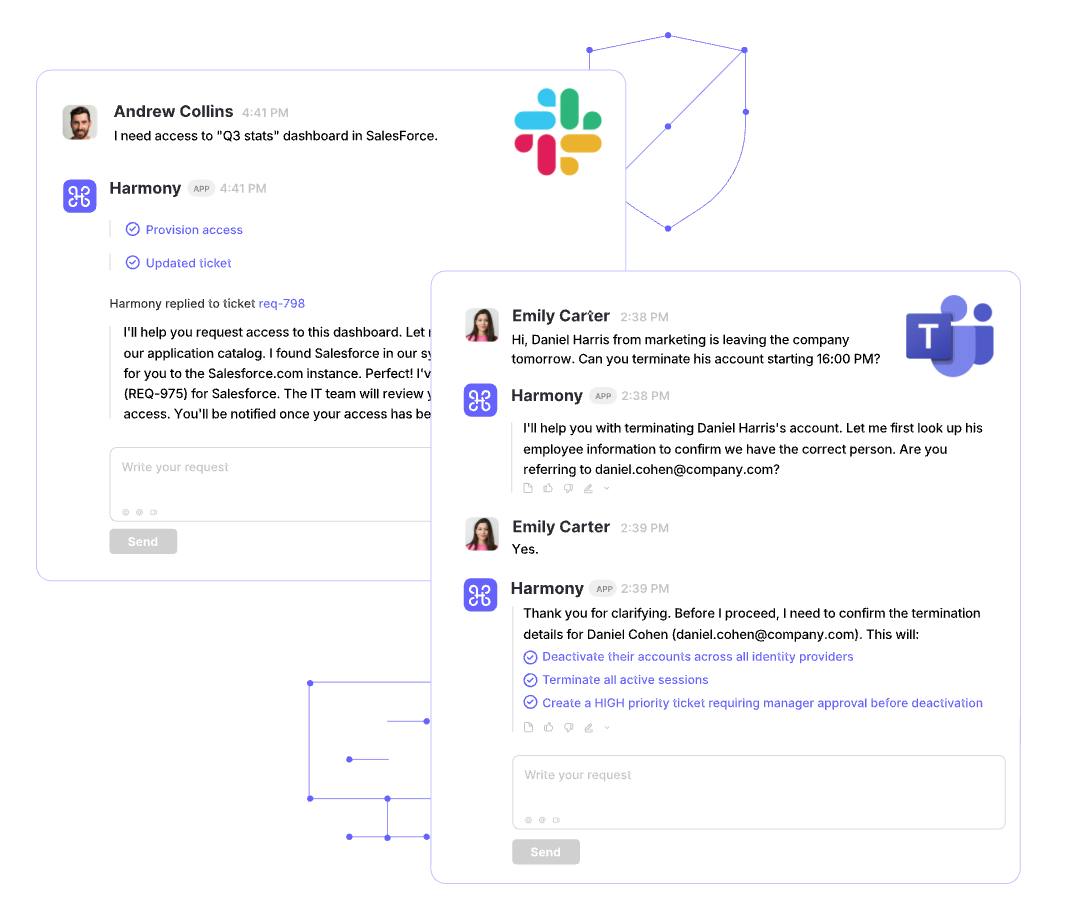
100+ Ready-Made Agents That Handle Common Requests End-to-End
Harmony's core value proposition is 100+ "production-ready" agents covering high-frequency scenarios like password resets, application access provisioning, employee onboarding, and device issues. "End-to-end" here means these agents don't just answer questions — they actually execute actions. Instead of pointing employees to a help document and calling it done, an agent can directly reset a password or provision access to a SaaS application.
Requests are only escalated to a human when genuine intervention is needed. This "AI-first, human fallback" model is the dominant design pattern in enterprise AI Agent products today. Its value lies in offloading large volumes of repetitive, well-defined, low-value tasks from IT staff, freeing human attention for genuinely complex problems.
Auto-Resolution Rate Is the Key Metric
The company claims that teams can achieve 60%+ auto-resolution rates within days of onboarding. If accurate, this would meaningfully reduce IT team workload. That said, how auto-resolution rate is measured varies widely across products — whether calculated by ticket volume, request type, or a weighted formula significantly affects what the number actually means. A healthy degree of skepticism toward such marketing figures is reasonable.
The "AI-first, human fallback" model relies technically on an architectural pattern known as Human-in-the-Loop. Before executing high-risk or low-confidence actions, agents automatically determine whether to pause and wait for human confirmation rather than proceeding blindly. The key distinction from earlier RPA (Robotic Process Automation) tools is this: RPA depends on fixed rules and scripts and breaks down the moment an edge case appears; LLM-based AI Agents can semantically interpret ambiguous inputs and dynamically assess whether they have sufficient information and permissions to complete a task. This capability turns "when to escalate to a human" into a learnable, optimizable decision point rather than a hardcoded trigger condition.
Centralized Context: Giving Agents Something to Work With
Conversational ability alone isn't enough for AI to actually resolve problems — what matters is whether it can access sufficient context. Another core design principle of Harmony is consolidating ticket management, asset inventory, SaaS management, and workflows into a single unified workspace.
This means when an employee says "I need access to a certain system," the agent can look up that employee's device status, current software licenses, and departmental permissions to make the right call and take the right action. This data centralization is what separates an agent that can act from one that can only respond — agents without context easily produce advice that sounds reasonable but can't actually be carried out.
From an architectural standpoint, Harmony effectively consolidates ITSM, SaaS management, and asset management — categories that have traditionally existed as separate enterprise IT tools — into a single AI-centric platform. This is both its competitive differentiator and a reminder that adopting it requires some degree of migration and integration investment.
Market Positioning and Signals
On Product Hunt, Harmony is categorized under Productivity, SaaS, and Artificial Intelligence. Its launch received 103 upvotes and 8 comments, landing it in fifth place — a solid mid-to-upper performance that reflects continued interest in enterprise internal AI Agent applications.
The team's background is worth noting. Co-founder Nitzan Shapira has prior startup experience in developer tools and observability — a background that typically suggests deeper familiarity with the complexity and integration demands of enterprise software, as opposed to building a consumer-facing chat product.
The Real Challenges This Category Faces
AI-native ITSM is a logically compelling but operationally difficult direction. The real barriers aren't in conversational UX — they lie in deep integration with enterprise identity systems (such as Okta and Entra ID) and various SaaS applications; security and audit compliance around permissioned actions; and rollback mechanisms when something goes wrong. For security-sensitive actions like password resets and access provisioning, enterprises tend to approach automation cautiously. Whether Harmony can deliver on its auto-resolution numbers while maintaining security is the central question for its ability to scale.
Okta and Microsoft Entra ID (formerly Azure Active Directory) are the most widely adopted Identity and Access Management (IAM) platforms in enterprise IT environments, responsible for centrally managing employee accounts, single sign-on (SSO), and access policies. Any AI agent that aims to replace human execution of actions like "reset a password" or "provision app access" must authenticate through these platforms' APIs — not bypass them by modifying underlying systems directly. This means Harmony needs to obtain privileged API access granted by enterprise IAM administrators, and must leave complete audit trails in operation logs to satisfy compliance requirements such as SOC 2 and ISO 27001. This is also why sales cycles for products in this category tend to be long — the IT security team's review process is not a step that can be skipped.
Summary
Harmony represents one direction for the evolution of the enterprise internal service desk: from "human-handled tickets" to "AI-native with human fallback." Its approach — placing the service entry point inside Slack/Teams, using ready-made agents to handle requests end-to-end, and centralizing data to give those agents meaningful context — aligns well with current best practices in enterprise AI adoption. For teams overwhelmed by repetitive IT/HR requests, this kind of tooling is worth watching. As for whether the 60%+ auto-resolution rate holds up in real deployments, that's something only production environments can answer.
Related articles

Gemini 4 Argon Launches Globally: Key Highlights from the AI Daily Brief
Google opens Gemini 4 Argon globally across Pro and Ultra subscriptions and the API, and demonstrates robot control. This article rounds up open-source models, Agent infrastructure, cost transparency, and safety governance updates.

OpenCode Surpasses Cursor with 213.5k Stars: The Three-Way AI Coding War Behind a $60 Billion Sale
OpenCode overtakes Cursor with 213.5k stars as Cursor reportedly seeks a $60B sale. We break down the business models, user scenarios, and moats of open-source OpenCode, commercial IDE Cursor, and Anthropic's Claude Code, plus three possible endings for the AI coding tool landscape.

Vercel CEO's AI Coding Workflow: 7 Key Principles
Vercel CEO shares his complete workflow for collaborating with AI agents: validate ideas with an MVP, use the direction command to prevent drift, scan security debt with DeepSec, use a breaker agent to attack the app, test from a first-visit user perspective, and close the customer feedback loop through MCP—plus seven actionable AI coding practices.