OpenCode Surpasses Cursor with 213.5k Stars: The Three-Way AI Coding War Behind a $60 Billion Sale

OpenCode, Cursor, and Claude Code compete for the AI coding entry point with different models, and their moats can't be measured with the same ruler.
The article compares three camps in AI coding tools: open-source OpenCode (MIT license, 213.5k stars, +1k/week), commercial IDE Cursor ($20 subscription, seeking a $60B sale), and Anthropic's Claude Code (token billing, terminal takeover). Their user profiles, competitive focus, and moat metrics differ—open source by contributors/adapters, commercial by DAU/revenue, official by API growth. Three endings are proposed, with the official camp becoming the de facto standard deemed least likely; the $60B valuation itself proves the Agent form factor is recognized by capital and developers.
Open Source vs. Commercial: A Head-On Clash
The AI coding tool arena is undergoing a structural reshuffle. A recent video from Bilibili creator "Xishuta" (西数塔) raises a sharp comparison: the open-source project OpenCode has accumulated 213.5k stars on GitHub, while Cursor—the flagship commercial IDE—is reportedly seeking a sale at a $60 billion valuation, and Anthropic's official CLI tool Claude Code is taking over the terminal directly with a token-based billing model. Three camps, three business models, all reshuffling at the same table.

The tension in these numbers: how does an MIT-licensed open-source project go head-to-head with a $60 billion commercial product in developers' minds? The answer lies in the paths each of the three has chosen.
Three Camps, Three Ways to Survive
OpenCode: The Ecosystem-First Open-Source Route
OpenCode uses the MIT license, meaning anyone can fork it, plug in their own models, and deploy it internally for free. Its growth curve confirms the effectiveness of this ecosystem strategy—1k new stars in a single week, bringing the total to 213.5k, a scale large enough to sustain a complete plugin and adapter ecosystem.
According to the creator's analysis, OpenCode covers both CLI and desktop form factors, and the sum of third-party model adapters constitutes its core asset. Its weakness is insufficient polish in user experience; troubleshooting still lags behind commercial IDEs.

The MIT license is an extremely permissive open-source license that allows anyone to freely use, modify, merge, publish, sublicense, and even sell copies of the software, with the only requirement being to retain the copyright and license notices. For AI coding tools, this means enterprises can deploy it privately and connect internal models without having to open-source their modifications, greatly lowering the legal barrier to commercial adoption. Compared with copyleft licenses like GPL, the MIT license is more conducive to ecosystem diffusion and commercial integration—this is the institutional foundation that enabled OpenCode to rapidly accumulate third-party adapters.
Cursor: Building Walls with Product Experience
Cursor takes the subscription route, starting at $20. Its moat is built on product experience: Tab autocomplete, multi-file editing, inline Chat—stacked together, these features form the competitive barrier of a commercial IDE. The $60 billion valuation story is essentially capital betting that "the IDE entry point can grow into the Office of the AI era."
But this logic has a soft spot—the entire experience is constrained by the capability boundaries of the underlying model. Once the model layer is surpassed or cut off, the product-layer advantage cannot stand on its own.
A VS Code fork is an independent product derived from Microsoft's open-source Visual Studio Code codebase. VS Code is open-sourced under the MIT license, allowing third parties to modify and redistribute it, and Cursor leverages this to deeply integrate AI features on top of it. This approach saves the cost of building an editor kernel from scratch, but requires handling synchronization with upstream updates and may face limitations such as extension marketplace compatibility. Cursor's business model is essentially a paid AI experience layer stacked on top of an open-source editor.
Claude Code: The Official Player Seizing the Terminal
Anthropic's Claude Code has no independent business model—it's an extension of the model subscription service, and what developers buy is tokens. The creator positions it as a combination of "terminal plus Agent protocol," directly taking over the CLI scenario. Its strength is Claude's top-tier capability in code understanding and long context; its weakness is that it cannot survive independently outside Anthropic's subscription system.
Token billing is the mainstream pricing method for large model APIs today, charging separately for input and output tokens, where a token can be roughly understood as a text fragment (about 0.75 English words or half a Chinese character). Claude Code, as Anthropic's official CLI tool, has developers consuming tokens through subscriptions or API calls rather than paying a fixed monthly fee. This model ties tool usage costs directly to model invocation volume—the advantage is flexibility and transparency, the disadvantage is that heavy usage can cost significantly more than a subscription, and users are locked into Anthropic's model ecosystem.
Where Are the Boundaries of User Scenarios?
The divergence in user profiles among the three is worth noting.
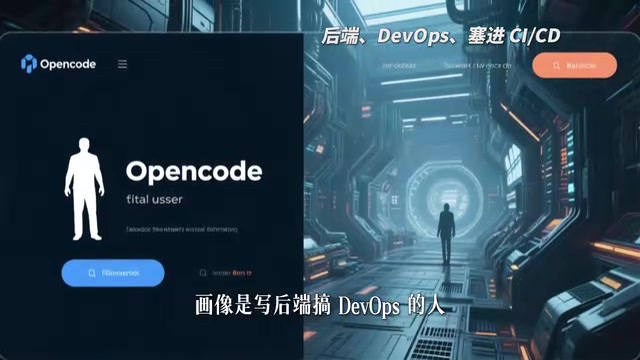
OpenCode pulls the battlefield to terminal plus desktop; its core users are developers writing backend code and doing debugging, while the desktop version is used as a Cursor alternative.
Cursor sets its battlefield inside the IDE, packaging AI experience on top of a VS Code fork—the "open, select, press Chat" workflow targets frontend and full-stack developers.
Claude Code focuses on terminal plus Agent protocol, with a profile leaning toward backend platform engineers.
The scenarios overlap—modifying 50 files, running CI, rolling back, writing tests—all three are competing for these. But the emphasis differs: Cursor is heavy and steady, OpenCode runs far, Claude Code plugs in directly.
Moats Are Measured in Different Units
This is the most easily overlooked dimension of the entire competition. The creator points out that the three moats simply cannot be measured with the same ruler:
- An open-source moat is measured by the number of contributors and the total volume of third-party adapters
- A commercial product's moat is measured by DAU and subscription revenue
- An official tool's moat is measured by the growth rate of API calls

Three units of measurement coexisting means that simply comparing star counts and valuations is meaningless. The fastest-growing curve is the force rewriting the rules of the table.
DAU (daily active users) is a core metric for measuring product stickiness and network effects, while subscription revenue reflects commercial monetization capability. For a commercial IDE like Cursor, capital valuation is often based on the DAU growth curve and subscription conversion rate rather than sheer feature count. High DAU means developers depend on it daily and migration costs are high, which constitutes the quantifiable foundation of a commercial moat. Unlike open-source contributor metrics, DAU and subscription revenue directly reflect the market voting with its feet.
Three Possible Endings
The creator offers three directions:
Ending One: The open-source camp eats 80% of scenarios, and Cursor retreats to a niche market.
Ending Two: The commercial camp turns things around through experience, and Cursor uses its $60 billion valuation to build the IDE into the development operating system of the AI era.
Ending Three: The official camp succeeds in moving downstream, Claude Code becomes the de facto standard, and all IDEs and CLIs connect to it.
By the creator's judgment, the third is the least likely. But the $60 billion sale itself already proves one thing: the victory of AI coding Agents is not the victory of any single product, but proof that the entire Agent form factor is recognized by both capital and developers alike.
Developers Vote with Their Feet
The real judge of this three-way war is the developer. OpenCode lowers the barrier to entry with the MIT license, Cursor retains paying users with experience, and Claude Code binds the ecosystem with model capability—all three paths have their followers, and all three have their skeptics.
The rules of the table are being rewritten, and the script has only just turned the page.
One-line Summary
OpenCode, Cursor, and Claude Code compete for the AI coding entry point with different models, and their moats cannot be measured with the same ruler.
Paragraph Summary
The article compares three camps in the AI coding tool arena: the open-source project OpenCode builds its ecosystem with the MIT license and 213.5k stars, adding 1k stars in a single week; the commercial IDE Cursor uses a $20 subscription and product experience as its moat and is seeking a sale at a $60 billion valuation; Anthropic's Claude Code takes over the terminal directly with token-based billing. The three differ in user profiles and competitive focus, and their moats are measured in different units—open source by contributors and adapters, commercial by DAU and subscription revenue, official by API call growth. The article presents three endings, considers the official camp becoming the de facto standard the least likely, and notes that the $60 billion valuation itself proves the Agent form factor is recognized by both capital and developers.
Related articles

Amphibious Transforming Drone: Beyond 100x Power Savings, What Are the Real Needs?
Is the amphibious transforming drone just a gimmick? Starting from the 100x power difference of the M4 Morphobot, explore real application scenarios and thesis topic ideas, analyzing boundary conditions where pure drones and pure ground robots both fail.

Warhound Raises $200 Million: Genetically Engineered "War Dogs" Paired with Anduril Gear
Warhound raises $200M, backed by Ben Lamm and Palmer Luckey, to genetically engineer dogs for military and law enforcement use and equip them with Anduril gear. This article analyzes its technology direction, funding logic, and ethical controversy.

Claude API Comes to Google Cloud: IAM Integration and SDK Access Guide
Anthropic hosts the full Claude API on Google Cloud with IAM-controlled permissions and unified billing. This guide covers the Vertex AI and Anthropic-hosted entry points, IAM role configuration, and SDK access.